Centrifuge disposal is one of the harder jobs in any laboratory clean-out. The unit is heavy, the rotor is a stressed part, refrigerated models hold gas and the chamber has usually been in contact with samples. This guide covers centrifuge disposal and centrifuge recycling in Australia: what we collect, how to prepare a unit, what the rules require and what happens to the machine afterwards.
- Free pickupFor eligible jobs
- Own teamNo subcontractors
- Blancco erasureFor data bearing devices
- Recycling certificateFor every job
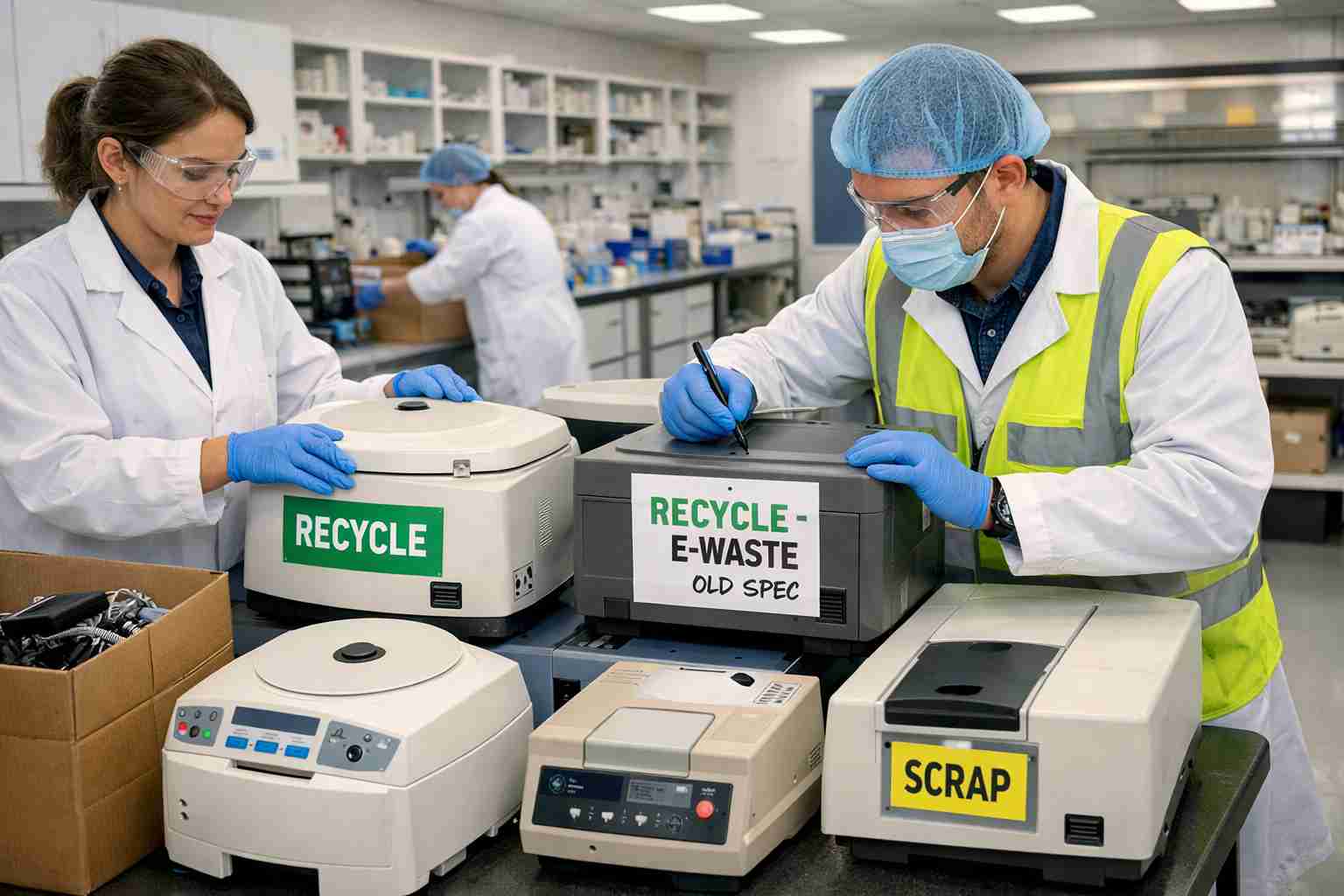
Laboratory centrifuges are heavy, contain high-value motors and metals and often reach end of life while still looking serviceable. E-Waste Collect collects benchtop, floor-standing and refrigerated centrifuges from pathology labs, hospitals, universities, research institutes and industrial testing facilities across Australia.
This page explains what happens to a centrifuge at end of life, how to prepare one for collection and what a specialist recycler handles differently to a general e-waste service.
Centrifuges We Collect
Benchtop centrifuges
Microcentrifuges, clinical spinners, haematocrit and cytology units.
Floor-standing centrifuges
High-capacity units used in pathology and blood banking.
Refrigerated centrifuges
Units with a sealed refrigeration circuit and compressor.
Ultracentrifuges and high-speed centrifuges
Including vacuum-assisted units.
Rotors, buckets, adaptors and spare parts
Collected with the unit or on their own.
Working, faulty, surplus, obsolete or end-of-life units are all accepted. If a unit still runs and has service history, tell us: working equipment is assessed for parts recovery before it is processed as scrap.
Why Centrifuges Need a Specialist Recycler
A centrifuge is not a simple electronic device. Four things change how it must be handled:
Weight and balance
Floor-standing units are commonly 100 to 300 kg with a high centre of gravity. They need proper lifting equipment and a trolley or pallet jack, not two people and a hope.
Rotors
Aluminium and titanium rotors are stressed components with a defined service life. They are removed before transport so they cannot shift in the chamber and they are separated for metal recovery.
Refrigeration
Refrigerated models contain fluorocarbon refrigerant. Under the Ozone Protection and Synthetic Greenhouse Gas Management Act 1989 it is an offence to release refrigerant to the atmosphere and recovery must be done by someone holding the right refrigerant handling or restricted recovery licence.
Biological contact
Chambers, buckets and seals that have held blood, urine or culture samples must be decontaminated by the facility before the unit leaves site.
How to Prepare a Centrifuge for Collection
Run your facility’s decontamination procedure on the chamber, rotor, buckets and lid seal and label the unit as decontaminated.
Remove all samples, tubes, broken glass and adaptors. Sharps and clinical waste go to your existing clinical waste stream, not with the equipment.
Leave the rotor loose in the chamber or beside the unit, whichever your service manual recommends.
Note the make, model, approximate weight and whether the unit is refrigerated.
Check access: floor level, lift dimensions, doorway width, stairs and where a trolley can reach.
Photograph the unit and the access path. Photos are the fastest way for us to quote accurately.
What Happens After Collection
Units are checked first for recoverable parts, because a working drive, lid interlock or rotor is worth recovering before the rest is recycled. The rest is dismantled into material streams: steel and cast housings, aluminium and titanium rotors, copper motor windings, circuit boards, cabling and plastics. Refrigerant from refrigerated models is recovered under licence before the cabinet is processed. A recycling certificate is provided for your records.
What We Do Not Accept
We collect equipment, not waste streams. Please keep the following separate and use your existing licensed providers:
- Hospital beds, bed frames and mattresses
- X-ray film and radiology film archives
- Clinical and biohazard waste
- Sharps such as needles, blades, lancets and scalpels
- Chemicals, solvents, reagents and fixatives
- Samples and biological material, including sample tubes, plates and used consumables
- Pharmaceuticals and medicines
- Pressurised gas cylinders and liquid nitrogen
- Contaminated consumables
- Loose radioactive sources on their own. Equipment with a sealed source still fitted is assessed case by case.
Everything else is welcome, including working, non-working, surplus, outdated, damaged and end-of-life equipment and single personal or home devices such as CPAP machines, nebulisers and mobility equipment.
Centrifuge Disposal Rules in Australia
Two rules shape centrifuge disposal for a laboratory. The first applies to refrigerated models: under the Ozone Protection and Synthetic Greenhouse Gas Management Act 1989 it is an offence to release fluorocarbon refrigerant to the atmosphere and recovery must be carried out by a person holding the correct refrigerant recovery licence. The second is your own compliance trail: most facilities need a record of what left the site and how it was processed.
Beyond that, laboratory centrifuge disposal is governed by your state environment protection authority rules for electronic waste and by your facility infection control procedure. Nothing about it is exotic, but a general e-waste service is rarely set up for it.
What Centrifuge Disposal Costs
There is no single price, because the work varies. Four things move the number:
Size and weight
A benchtop unit is a two-person carry. A floor-standing unit needs a trolley, a tail-lift vehicle and sometimes a second crew member.
Access
Ground floor with dock access is straightforward. A basement lab with a small lift and three fire doors is not.
Quantity
A single unit costs more per item than eight units collected in one visit during a lab clear-out.
Recoverable value
Working units, titanium rotors and late-model refrigerated centrifuges can offset part or all of the cost.
Eligible items may qualify for free pickup depending on type, quantity, location and access. Send photos and an item list and you get a straight answer before anything is booked.
Centrifuge Disposal Checklist
Decontaminate the chamber, rotor, buckets and lid seal, then label the unit.
Remove samples, tubes, broken glass and adaptors.
Note the make, model, weight and whether the unit is refrigerated.
Record the serial number and asset tag for your register.
Measure the exit path: doorway, lift, stairs, dock.
Photograph the unit and the access route.
Book the collection and keep the recycling certificate with your disposal records.
Who Books Centrifuge Disposal
Most centrifuge disposal requests come from four places. Pathology laboratories retire clinical spinners when a platform is replaced. Hospitals clear blood bank and haematology units during a department refit. Universities and research institutes dispose of centrifuges when a grant ends or a building is renovated. Industrial and environmental testing laboratories replace units that have outrun their service support.
The pattern matters because it changes the job. A single benchtop unit from a GP practice is a simple pickup. A university handing over eleven centrifuges, four fridges and a bench line is a staged clear-out that needs an asset list and a loading dock booking.
Which Centrifuges Have Recoverable Parts
Not every unit should be scrapped. A centrifuge usually has recoverable parts when it is a recent model, has service history, runs and holds speed, has an intact lid interlock and comes with at least one usable rotor. Units that fail for a simple reason, such as a worn brush set or a failed door switch, are often repairable.
Units that are genuinely end of life include those with a seized or out of certification rotor, a cracked chamber, water damage, or a control board that is no longer supported. These go straight to materials recovery. If a machine still has value, that value is applied against the cost of the job rather than disappearing into a scrap bin.
Data, Labels and Records
Larger centrifuges often store run logs, user profiles and sometimes network settings. Before collection, clear user accounts where the interface allows it and remove any asset or barcode labels your facility wants to keep out of circulation. If the unit is connected to a laboratory network, flag it so the controller is handled separately.
Keep three records for each unit: the asset entry, the collection record showing what left the site and the recycling certificate. Together they close the loop for an internal audit without extra paperwork on your side.
Common Centrifuge Disposal Mistakes
- Booking a general e-waste service that arrives with a van and no lifting equipment.
- Leaving the rotor bolted in, so it cannot be inspected or separated for metal recovery.
- Sending a refrigerated unit to scrap with the gas still in the circuit, which is an offence.
- Skipping decontamination, which stops the crew from loading the unit at all.
- Forgetting to measure the exit path, which turns a one hour job into a return visit.
- Throwing away a working machine that still had useful parts.
How Long Centrifuge Disposal Takes
For a prepared benchtop unit, the collection itself is usually fifteen to thirty minutes on site. A floor-standing unit with good access takes about an hour. A multi-room clear-out is normally planned across a half day or several visits so the laboratory can keep working. Bookings are typically scheduled within a few business days of the details being confirmed and sooner where a site has a hard deadline such as a handover or a lease end.
Centrifuge Disposal Across Australia
Centrifuge disposal runs nationally, with the heaviest coverage around the capital cities. See the service pages for Sydney, Melbourne, Brisbane, Perth and Adelaide, or the full list of service areas. Regional sites are covered case by case and larger centrifuge disposal jobs arranged in advance are worth the trip.
Centrifuge Types and What Changes at Disposal
| Type | Typical weight | What changes the job |
|---|---|---|
| Microcentrifuge | 5 to 15 kg | Simple carry. Check for sample residue in the rotor wells. |
| Clinical benchtop | 15 to 45 kg | Two person lift. Swing-out buckets should be removed first. |
| Refrigerated benchtop | 60 to 110 kg | Refrigerant recovery under licence before processing. |
| Floor-standing | 100 to 300 kg | Trolley, tail-lift vehicle and a measured exit path. |
| Ultracentrifuge | 250 to 450 kg | Vacuum pump, oil and a high value rotor that is assessed separately. |
The table is a guide only. Confirm the plate on the back of your unit, because the same model name can cover very different cabinets across generations.
Rotors: The Part Most Sites Forget
A rotor is a rated, fatigue-limited component, not an accessory. Most manufacturers set a service life in cycles or years and a rotor that has passed it should not go back into use even if it looks perfect. That matters at disposal for two reasons. First, an out of certification rotor must be separated so it is recovered as metal rather than returned to service. Second, a current rotor in good condition should be listed separately so our team can plan safe handling and parts recovery.
Before booking, gather the rotor type, the number of cycles if your log shows it and any buckets, adaptors or lids that belong with it. Store them with the unit so nothing is left behind in a bench drawer.
Centrifuge Disposal During a Laboratory Relocation
Relocations create a sorting problem rather than a lifting problem. Equipment splits into three groups: what moves to the new site, what is surplus but serviceable and what is end of life. The last two groups are where centrifuge disposal fits and deciding early is what keeps the move on schedule.
A workable sequence is to tag every unit during the audit, agree the surplus list with the laboratory manager, book the collection for the week before the move rather than the week of it and keep the recycling certificates with the project file. Where a lab must keep running during the transition, collections can be staged room by room.
What Happens to the Materials
A dismantled centrifuge separates into more streams than most people expect. The cabinet and chamber are steel or stainless steel. Rotors are aluminium or titanium. The drive motor holds copper windings and, in some models, rare earth magnets. Control boards and display modules go to electronics processing, where boards are recovered for their metal content. Wiring is stripped for copper. Insulation, gaskets and plastic panels are sorted by type where the material is recyclable.
This is the practical argument for using a specialist: a machine that goes to a mixed scrap bin loses most of that separation and anything with refrigerant or electronics in it should not be in a mixed bin in the first place.
Preparing a Quote Request That Gets a Fast Answer
The fastest quotes come from requests that answer the obvious questions up front. Include the number of units, make and model of each, whether any are refrigerated, the floor and building access, whether a lift is available and its size, your preferred timeframe and photos of both the equipment and the exit path. If some units still work, say so, because that can change the price in your favour.
If you are not sure what you have, send photos of the data plates and we will identify the models.
Brands We Collect
We collect centrifuges from most manufacturers, including Beckman Coulter centrifuge recycling and Eppendorf centrifuge. Brand names below describe equipment made by these manufacturers only and do not imply any partnership.
More Laboratory Equipment We Recycle
Our laboratory centrifuge recycling Australia service covers every common type, from a single spinner to a full lab clear-out.
Benchtop and microcentrifuges
Benchtop centrifuge recycling and microcentrifuge for pathology, research and teaching labs.
Refrigerated centrifuges
Refrigerated centrifuge recycling through appropriate recycling channels for refrigerated equipment.
Ultracentrifuges
Ultracentrifuge recycling, including vacuum pumps, with high value rotors listed separately.
Blood bank and cell washers
Blood bank centrifuge recycling and cell washer centrifuge from transfusion and haematology labs.
Cytology centrifuges
Cytocentrifuge and Cytospin recycling, once slide chambers and funnels have been removed and decontaminated.
Microhaematocrit centrifuges
Microhaematocrit centrifuge recycling from clinics, wards and hospital labs.
Collection centre centrifuges
We handle specimen centrifuge collection centre recycling when a pathology network retires spinners across several sites.
Rotors, motors and bowls
Centrifuge rotor recycling for aluminium and titanium rotors, plus centrifuge motor and stainless bowl.
Frequently Asked Questions
Do you collect a single centrifuge?
Yes, for laboratories, clinics, hospitals and universities. Whether pickup is free depends on the item, quantity, location and access, so send photos and we will confirm before booking.
Can you remove a centrifuge from an upper floor?
Usually yes. Tell us the floor, lift size and doorway width when you request a quote so the right equipment and crew are allocated.
Do I need to remove the rotor myself?
It helps and it is safer in transit. If the rotor is seized or you are unsure, leave it and note it on your request.
What about refrigerated centrifuges?
They are collected as normal. The refrigerant is recovered under the correct licence rather than vented, which is a legal requirement in Australia.
Do you buy working centrifuges?
No. We do not buy equipment. Working units are still collected and assessed for parts recovery before recycling.
Can centrifuge rotors be recycled on their own?
Yes. Aluminium and titanium rotors, buckets and adaptors can be collected with a unit or on their own. Decontaminate them first and list the rotor type, as rotors past their service life are separated for metal recycling.
Do you collect centrifuges from pathology collection centres?
Yes. We collect specimen centrifuges from single collection centres and from networks retiring units across several sites. Remove tubes and samples and decontaminate each unit before pickup. Pickup is free for eligible jobs.
Do you collect Beckman Coulter and Eppendorf centrifuges?
Yes. We collect centrifuges made by Beckman Coulter, Eppendorf, Thermo Fisher and most other manufacturers, including ultracentrifuges, refrigerated models and microcentrifuges. Send the model and photos and we will confirm the collection.
Book a Centrifuge Collection
Send a short list of your items with photos and your suburb and we will come back with pickup options and eligibility. See also laboratory equipment recycling and disposal, equipment deinstallation and removal and disposal compliance for clinics and labs.
Call 0402 457 565.
Centrifuges are one category among many. For the whole picture, including free pickup eligibility and what we cannot take, see equipment recycling across Australia.
Where we collect
We collect medical and lab equipment across Australia and New Zealand, including Sydney, Melbourne, Brisbane, Perth and Adelaide, plus Hamilton in New Zealand. For local pickup details see our Brisbane medical equipment collection page, or browse every service area we cover.
More laboratory equipment guides
Related guides from E-Waste Collect.
The main guide to lab equipment recycling and disposal.
Lab fridges, freezers and ULT freezers with refrigerant.
Sterilisers and autoclaves from labs, clinics and hospitals.
Analysers and pathology lab clear outs.
What to move and what to retire.
The rules clinics and labs need to follow.