
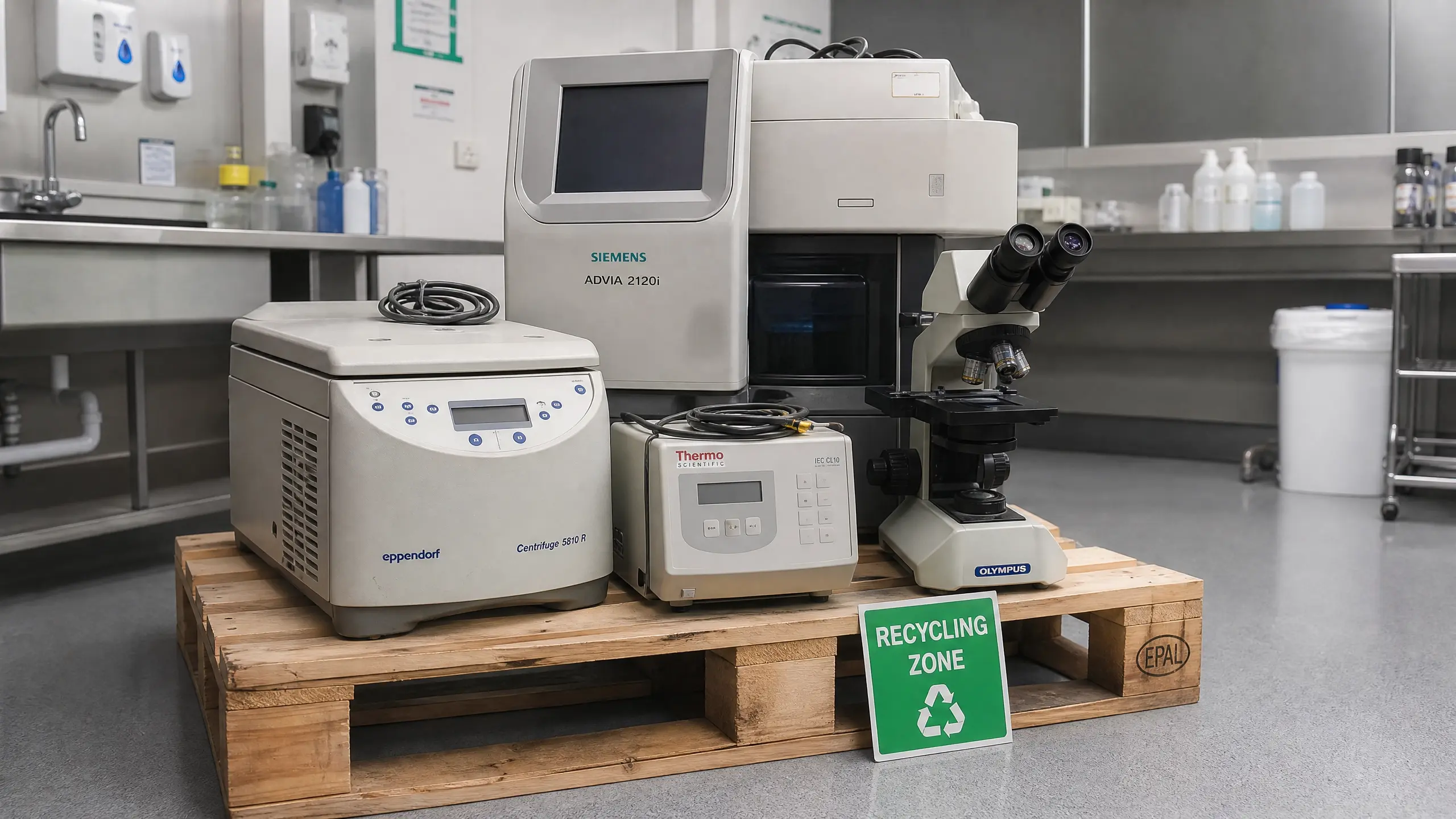
Lab freezer disposal is one of the few laboratory jobs with a hard legal rule attached to it. Ultra-low temperature freezers, pharmacy fridges, blood bank fridges and plasma freezers are heavy, they hold refrigerant gas and compressor oil, and they cannot be crushed or scrapped with that gas still inside. This guide covers lab freezer disposal in Australia: what we collect, the refrigerant rule, how to prepare a unit, costs, and what happens to the cabinet afterwards.
Ultra-low temperature freezers, pharmacy fridges, blood bank fridges and plasma freezers are among the hardest items in a laboratory to retire. They are heavy, they hold refrigerant gas and compressor oil, and they cannot legally be crushed or scrapped with the gas still inside. E-Waste Collect collects laboratory refrigeration from hospitals, pathology networks, universities, research institutes, IVF clinics and industrial laboratories across Australia.
Units We Collect
- Ultra-low temperature freezers: -80 °C upright and chest models.
- Laboratory and plasma freezers: -20 °C to -40 °C.
- Pharmacy, vaccine and blood bank refrigerators, including monitored and alarmed units.
- Under-bench and benchtop laboratory fridges.
- Cryogenic storage equipment, once emptied of liquid nitrogen and samples.
- Cold rooms and walk-in units, where deinstallation is arranged in advance.
The Refrigerant Rule You Cannot Skip
Every one of these units contains fluorocarbon refrigerant. Under the Ozone Protection and Synthetic Greenhouse Gas Management Act 1989, discharging that refrigerant into the atmosphere is an offence, regardless of quantity. Recovery has to be carried out by a person who holds the appropriate refrigerant handling or restricted refrigerant recovery licence, and the recovered gas must be passed to an authorised business.
In practice this means a laboratory freezer cannot simply be sent to a scrap metal bin or a general e-waste bin. The refrigeration circuit is dealt with first, then the cabinet, compressor, insulation and electronics are separated for recycling. Ask any recycler you use how they handle this step, and keep their answer on file with your disposal records.
Lab Freezer Disposal Rules in Australia
Two things make lab freezer disposal different from ordinary equipment recycling. The first is the gas. Under the Ozone Protection and Synthetic Greenhouse Gas Management Act 1989, releasing fluorocarbon refrigerant to the atmosphere is an offence, and recovery must be done by someone holding the correct refrigerant recovery licence. The second is your own audit trail: a hospital or university disposing of an asset generally needs to show what left the site and how it was handled.
Everything else follows normal electronic waste practice under your state environment protection authority, plus your facility’s own infection control procedure for anything that held biological material.
Lab Freezer Disposal for Universities and Research Institutes
University lab freezer disposal has its own rhythm. Units pile up when a grant finishes, a researcher moves institution, or a building is scheduled for refurbishment, and they often sit powered on for months because nobody wants to make the call on the samples inside. By the time the decision is made, there are five or six cabinets to move at once and a fixed handover date.
The practical answer is to treat lab freezer disposal as part of the project plan rather than an afterthought. Tag units during the audit, agree a sample relocation deadline, defrost in batches, and book collections across two or three visits so corridors stay clear and the lab keeps operating.
Lab Freezer Disposal Versus General E-Waste Collection
A general e-waste service is built for computers, printers and small electronics. Lab freezer disposal needs three things that service usually does not have: licensed refrigerant recovery, equipment to move 300 kg safely out of a working building, and an understanding of what a decontamination label means. Sending a ULT freezer to a mixed scrap bin is also how gas ends up vented and how a recoverable compressor and controller are lost.
The cost difference is smaller than people expect once the recoverable value of the cabinet, compressor and controller is taken into account.
Preparing a Freezer or Fridge for Collection
- Empty it completely. Samples, racks, boxes, reagents and vaccines must be relocated or disposed of through your existing streams before the unit is booked.
- Defrost and dry. A -80 °C unit can take 24–48 hours to defrost. Ice adds weight, water leaks into lifts and corridors, and a wet cabinet is unsafe to move.
- Clean and decontaminate per your facility procedure and label the unit as decontaminated.
- Disconnect and secure. Power down, coil the lead, tape the door shut, and remove loose shelving.
- Check the exit path. Measure the doorway, note the lift capacity, stairs, ramps, and where a truck can park. Upright ULT freezers are commonly 250–400 kg.
- Record the asset. Make, model, serial number and asset tag, so your register and our collection record match.
Data and Monitoring Devices
Alarmed and monitored units often include a data logger, a controller with a memory card, or a network module. These can hold site names, temperature history and network credentials. Flag them before collection so they can be removed or handled separately rather than leaving with the cabinet.
What Happens After Collection
Serviceable units and spare parts, controllers, compressors, doors, racks and shelving, are assessed for reuse first. Units that are beyond economic repair are processed: refrigerant recovered under licence, compressor oil drained, then steel, copper, aluminium, insulation, plastics and electronics separated into their own streams. You receive a recycling certificate for your records.
What We Do Not Accept
We collect equipment, not waste streams. Please keep the following separate and use your existing licensed providers:
- Hospital beds, bed frames and mattresses
- X-ray film and radiology film archives
- Clinical and biohazard waste
- Sharps such as needles, blades, lancets and scalpels
- Chemicals, solvents, reagents and fixatives
- Samples and biological material, including sample tubes, plates and used consumables
- Pharmaceuticals and medicines
- Pressurised gas cylinders and liquid nitrogen
- Contaminated consumables
- Loose radioactive sources on their own. Equipment with a sealed source still fitted is assessed case by case.
Everything else is welcome, including working, non-working, surplus, outdated, damaged and end-of-life equipment, and single personal or home devices such as CPAP machines, nebulisers and mobility equipment.
What Lab Freezer Disposal Costs
There is no flat price for lab freezer disposal, because the work changes with the unit and the building. Five factors drive the quote:
- Size and weight. An under-bench fridge is a two person carry. An upright ULT freezer at 300 kg or more needs a trolley, straps and a tail-lift vehicle.
- Refrigerant. Every unit needs licensed recovery before the cabinet can be processed.
- Access. Dock and ground floor is simple. Basement plant rooms, small lifts and fire doors add time and crew.
- Quantity. Six units collected in one visit cost far less per unit than one unit on its own.
- Condition. A recent working unit or a good compressor and controller can offset part of the cost.
Eligible items may qualify for free pickup depending on type, quantity, location and access. Send photos and a unit list to get a straight answer before booking.
Who Books Laboratory Refrigeration Collections
Requests usually come from pathology networks consolidating sites, hospital departments replacing blood bank or pharmacy fridges, universities closing or refurbishing laboratories, IVF and fertility clinics upgrading storage, and facilities managers clearing a building before handover. Vaccine fridges retired after a program ends are another common one.
What these have in common is timing pressure. A replacement unit is usually already ordered, and the old cabinet has to be out before the new one lands. Book the collection when you order the replacement, not the week it arrives.
Preparation Mistakes That Delay Collection
- Booking before the unit is defrosted. Ice adds weight and melts across corridors and lift floors.
- Leaving samples, racks or boxes inside. The crew cannot legally take biological material.
- Not checking whether the cabinet fits back out through the doorway it came in through.
- Forgetting the data logger or controller card, which can hold site and network details.
- Leaving the unit powered on until the crew arrives, so the interior is still wet.
- Skipping the asset record, which makes your internal disposal trail incomplete.
Freezer Types and What Changes at Disposal
| Unit | Typical weight | What changes the job |
|---|---|---|
| Under-bench lab fridge | 40 to 80 kg | Two person lift, simple refrigerant circuit. |
| Pharmacy or vaccine fridge | 80 to 160 kg | Often has a data logger and alarm module to remove. |
| Blood bank fridge | 150 to 300 kg | Monitored unit, heavier cabinet, usually on castors. |
| Plasma freezer | 150 to 250 kg | Needs full defrost, doors taped for transport. |
| ULT -80 freezer | 250 to 400 kg | Two stage refrigeration, long defrost, tight exit paths. |
| Cold room | Varies | Deinstallation and panel removal arranged in advance. |
Lab Freezer Disposal During Closures and Relocations
Most laboratory refrigeration leaves site as part of something bigger: a lab closing, a department moving floors, a fit-out replacing a bench line, or assets written off before 30 June. The equipment decision is simple enough, but the sequencing is what keeps the project on time.
A workable order is to audit and tag units first, confirm which are surplus with the laboratory manager, relocate samples with plenty of margin, defrost in batches so the corridor is not full of dripping cabinets, then book collections room by room. Keep the recycling certificates with the project file so the disposal trail is complete when the building is handed back.
What Happens to the Materials
A laboratory freezer separates into more streams than most people expect. Refrigerant is recovered under licence and passed to an authorised business. Compressor oil is drained. The compressor itself is steel and copper. Cabinets are steel with painted or stainless surfaces, interiors are usually aluminium or plastic, and the insulation between them is separated by type. Controllers, alarm boards and data loggers go to electronics processing, and wiring is stripped for copper.
Serviceable parts are pulled before any of that happens. Doors, gaskets, racks, shelving, controllers and compressors are reused where they are in good condition, which is why a unit that failed for one reason is worth more intact than shredded.
Getting a Fast Quote
Include the number of units, the make and model of each, the floor and access details, lift size, whether each unit is defrosted or still running, and photos of both the cabinet and the exit path. If any unit still works, say so. Those details are the difference between a quote in an hour and three rounds of emails.
Lab Freezer Disposal Across Australia
Lab freezer disposal runs nationally, with the densest coverage around the capital cities. See the pages for Sydney, Melbourne, Brisbane, Perth and Adelaide, or the full list of service areas. Regional sites are handled case by case, and a larger job arranged in advance is worth the distance.
How Long the Whole Process Takes
Plan on three stages. Emptying and relocating samples is yours to schedule and is usually the longest part. Defrosting takes one to two days for a ULT freezer and a few hours for a small fridge. The collection itself is generally thirty to sixty minutes per unit with good access, longer where stairs or tight corners are involved. Booking lead time is normally a few business days once the details and photos are in.
Questions Worth Asking Any Recycler
- Who recovers the refrigerant, and under what licence?
- What paperwork do I receive, and how soon?
- Do you remove the unit from the room, or only from the kerb?
- What happens to a unit that still works?
- Can you stage collections so the laboratory keeps running?
Any specialist should answer these without hesitating. If the answer to the first one is vague, that is the point to stop.
A Realistic Lab Freezer Disposal Timeline
Below is the sequence most sites end up following. It assumes one ULT freezer and a clear replacement date.
- Week 1. Decide the unit is going. Record make, model, serial and asset tag. Photograph the cabinet and the exit path.
- Week 2. Relocate samples. This is the step that slips, so give it more room than you think it needs.
- Week 3, day 1. Power down and open the doors to defrost. Put towels or a tray under the cabinet.
- Week 3, day 2 or 3. Clean, decontaminate and label the unit. Tape the doors shut and remove loose shelving.
- Week 3, day 3. Confirm the booking with photos and access notes.
- Week 4. Collection. Refrigerant is recovered under licence, and the recycling certificate follows.
Smaller fridges compress this to a few days. Multi unit lab freezer disposal in a closing laboratory is usually staged over two or three visits instead.
What to Do With Samples You No Longer Need
This sits outside equipment collection, but it is the step that holds up most jobs. Biological material, reagents and chemicals stay in the streams your facility already uses, through your clinical waste and chemical waste providers. Liquid nitrogen and pressurised cylinders go back to the gas supplier. Once the cabinet is empty, clean and dry, the equipment side becomes straightforward.
If part of the collection is tangled up with a sample decision that has not been made yet, book the units that are clear and leave the rest for a second visit rather than delaying everything.
Frequently Asked Questions
Do you take a freezer that no longer runs?
Yes. Faulty and dead units are collected the same way. Tell us if the unit failed with samples inside so we know what condition to expect.
Can you get a ULT freezer out of a basement or upper floor?
Usually yes, with notice. Send photos of the unit and the full exit path, including lift dimensions and door widths, and we will confirm the crew and equipment needed.
Is pickup free?
Eligible items may qualify for free pickup depending on type, quantity, location and access. Laboratory refrigeration often involves two people and a tail-lift vehicle, so we quote each job on the details you send.
Do we need to defrost first?
Yes. It is the single biggest cause of delayed collections. Allow one to two days for a -80 °C unit.
Can you take several units at once during a lab clear-out?
Yes, and it is usually cheaper per unit. See laboratory equipment recycling and disposal for multi-item clear-outs and relocations.
Is lab freezer disposal different for a vaccine fridge?
The principle is the same. Lab freezer disposal and vaccine fridge disposal both involve licensed refrigerant recovery, and the main practical difference is the monitoring hardware, which is removed or handled separately before the cabinet is processed.
Can lab freezer disposal be arranged for a single unit?
Yes. Single unit lab freezer disposal is common for clinics and small laboratories, though a multi unit booking costs less per cabinet.
Do you handle lab freezer disposal for closing laboratories?
Yes, and it is the most common request. Lab freezer disposal during a closure is normally staged over several visits alongside the rest of the equipment.
What paperwork comes with lab freezer disposal?
A collection record of what left the site and a recycling certificate for your disposal file.
Book a Laboratory Refrigeration Collection
Send your unit list, photos and suburb and we will confirm options. Related: centrifuge disposal and recycling, equipment deinstallation and removal, and disposal documentation to keep.
Request a free pickup quote or call 0402 457 565.