About E-Waste Collect
E-Waste Collect is a specialist collection and recycling service for medical, dental, ophthalmic, pathology and laboratory equipment. Our own team works with hospitals, clinics, laboratories and households across Australia and New Zealand.
- Our own collection team
- Free pickup for eligible jobs
- Certificate for every job
Who we are
E-Waste Collect was created to solve a simple problem. Healthcare and laboratory equipment does not belong in landfill, yet many organisations have no clear way to remove it. Old analysers sit in storerooms, imaging units wait in corridors and data bearing devices stay on shelves because nobody knows who should take them.
Every collection follows the same process as our medical equipment recycling service, from pickup to recycling certificate.
We give these organisations one clear pathway. You tell us what you have and where it is. We give you a quote, collect the equipment with our own team and provide a recycling certificate at the end. Every job follows the same process, whether it is a single CPAP machine or a full hospital floor.
Our work is focused only on medical and laboratory equipment. That focus means we understand the equipment, the access challenges of clinical buildings and the documentation that healthcare organisations need.
E-Waste Collect at a glance
- Specialist in medical and laboratory equipment
- Collection by our own trained team
- Free pickup for eligible jobs
- Recycling certificate for every job
- Data destruction for data bearing devices
- Coverage across Australia and New Zealand
What E-Waste Collect does
Our services cover every step from enquiry to certificate.
Equipment collection
Pickups from hospitals, clinics, laboratories, universities, aged care facilities and homes.
Medical equipment pickupDeinstallation
Safe disconnection and removal of fixed, heavy and complex equipment.
Equipment deinstallationPacking and palletising
Protective packing, palletising and crating for large or delicate items.
Packing and cratingData destruction
Data on every data bearing device is destroyed and confirmed in writing.
Reuse and parts recovery
Equipment is assessed for reuse and useful parts are recovered before recycling.
Recycling certificate
Every job ends with a certificate for audits, asset registers and reporting.
Where E-Waste Collect operates
We operate from two bases so that customers in both countries are served by a local team.
| Country | Base | Coverage |
|---|---|---|
| Australia | Unit 3/9 Mill Rd, Campbelltown NSW 2560 | All states and territories, with dedicated pages for each area |
| New Zealand | 36 Faraday Street, Hospital Hill, Napier 4110 | All 16 regions, with equipment processed at our Napier facility. See our New Zealand page |
How E-Waste Collect works
Every job follows the same simple process.
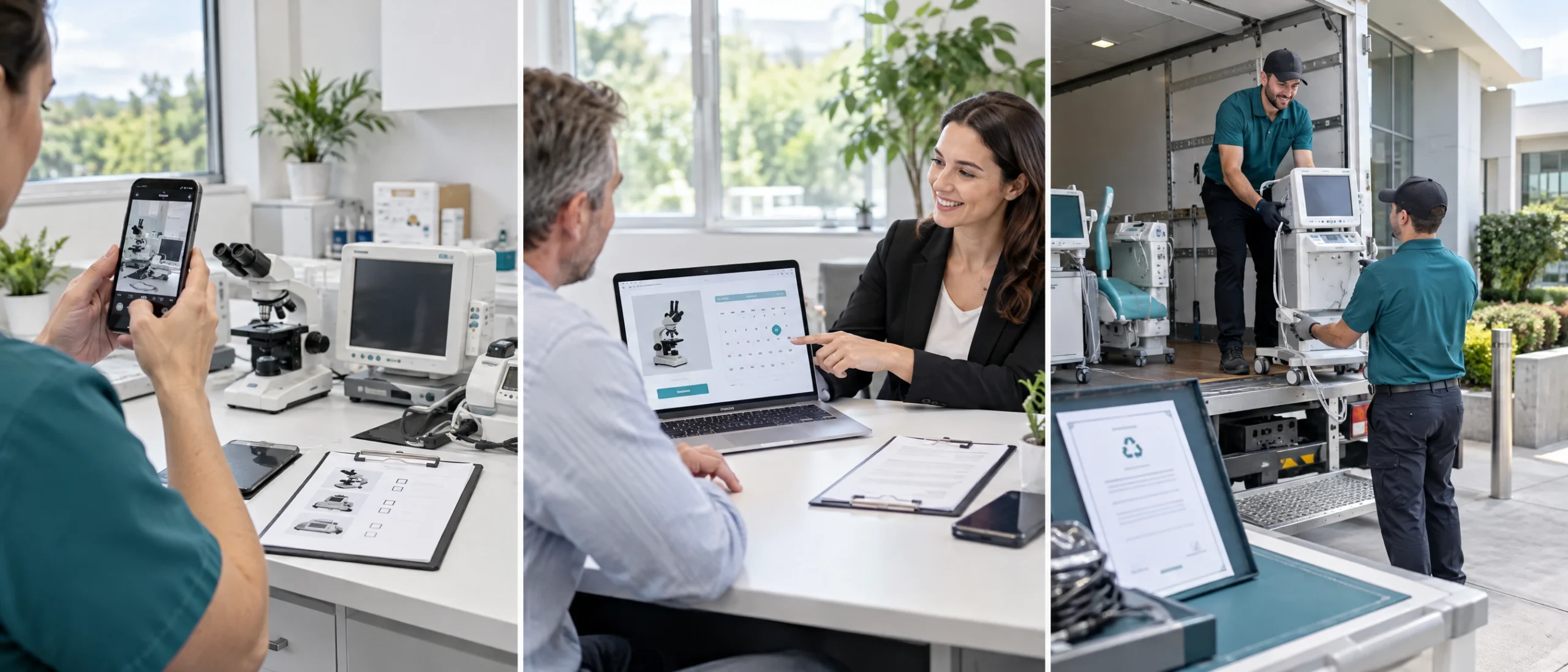
- Step 1: Send your list or photos
Tell us what equipment you have, how many items there are and where your site is. Photos on WhatsApp help us quote faster.
- Step 2: Receive your quote
We confirm whether your pickup is free, agree on a date and plan access, loading and any deinstallation work.
- Step 3: Collection and certificate
Our team collects the equipment. It is assessed for reuse, parts recovery or recycling and you receive a recycling certificate.
Our commitments
Clear pricing. Many pickups are free. When a charge applies, it is shown in your quote before anything is booked. We never add surprise fees.
Data security. Many devices store patient information. We destroy data on every data bearing device and confirm this in writing. This supports your obligations under the Australian Privacy Act 1988 and the New Zealand Privacy Act 2020.
Responsible recycling. Metals, circuit boards and plastics are recovered and kept out of landfill. You can read more about electronic waste on the Australian Government waste website.
Our own people. We do not hand your equipment to unknown subcontractors.
What we do not accept
- Hospital beds, bed frames and mattresses
- X ray film archives
- Clinical waste, biohazard waste and sharps
- Chemicals, reagents and pharmaceuticals
- Samples and biological material
- Gas cylinders and liquid nitrogen
- Loose radioactive sources
Why specialised collection matters
General waste and electronic waste services are not set up for healthcare equipment. Clinical devices can be very heavy, fixed to walls or benches, connected to building services or full of sensitive data. Many also need careful handling because of their size, weight or delicate components.
Healthcare organisations also carry obligations that a general waste service may not understand. Asset registers must be updated, patient data must be protected and auditors often ask for proof of responsible disposal. A specialist service that understands these needs saves time and reduces risk.
Because we focus only on medical and laboratory equipment, our team knows how to plan access in busy clinical buildings, how to protect floors and doorways, how to move large imaging and laboratory items safely and what paperwork your organisation will need afterwards.
Common problems we solve
- Storerooms full of old equipment
- Equipment left behind after a refit or move
- Data bearing devices with no disposal pathway
- Heavy items that need deinstallation
- Audit requests for proof of disposal
- Equipment spread across several sites
Our team
Our collection team is trained to handle clinical and laboratory equipment with care. Before each job we review your list, photos and access notes so the right people and the right equipment arrive on the day.
On site, the team confirms the list with your contact person, protects the work area and loads each item safely. Once the job is complete, you receive clear documentation that your team can file with your asset records.
Who E-Waste Collect works with
Our customers range from large hospitals to individual households.
Hospitals and health services
Department clearances, replacement programmes and refits.
Clinics and specialist practices
General practice, dental, radiology, ophthalmology and allied health.
Laboratories and research
Pathology, university, research and industry laboratories.