We collect and recycle medical, dental, ophthalmic, pathology and laboratory equipment across Australia and New Zealand.

Professional Medical Equipment Removal

Medical Equipment Deinstallation for Imaging, Hospital and Specialist Systems

We provide professional deinstallation of medical equipment, including imaging systems, hospital equipment and specialist devices. This service suits projects that need planned disconnection, site access coordination and controlled medical systems removal.

Selected Deinstallation Support for Complex Equipment

Some healthcare equipment requires more than a standard pickup. Medical equipment deinstallation support may be helpful where equipment is fixed in place, part of a clinical room setup, connected to infrastructure, or difficult to remove safely without planning.
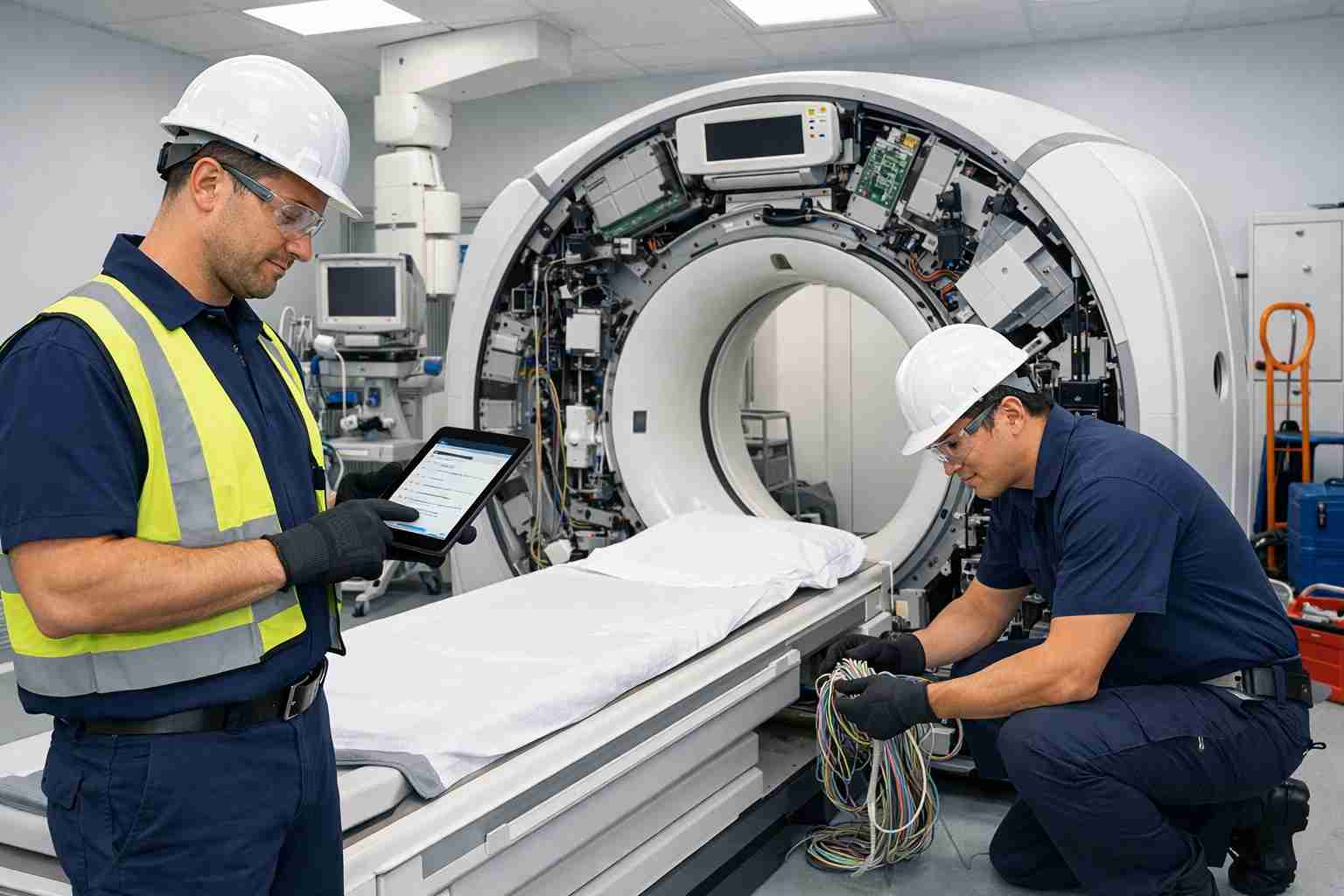
Medical equipment deinstallation of a fixed imaging system

Imaging systems with X ray tubes or radiation sources are also covered by state radiation rules. National guidance is published by ARPANSA.

Imaging Systems

Suitable for selected imaging rooms and specialist equipment projects that require controlled removal planning.

Hospital Equipment

Useful for fixed, bulky, or site-integrated hospital equipment where safe removal needs a more structured process.

Specialist Devices

Appropriate for certain specialist medical or laboratory devices that need added handling, access review, or staged removal.

What Deinstallation Support May Include

Depending on the project scope, equipment category and site conditions, medical equipment deinstallation support may include one or more of the following.

Project Review & Planning

  • Review of equipment type and site conditions
  • Assessment of removal access and movement path
  • Planning for room clearance or staged removal
  • Coordination with collection or transport needs

Selected Disconnection Support

  • Review of installed or fixed equipment setups
  • Consideration of attached or supporting components
  • Controlled preparation before movement or removal
  • Support aligned to site-specific conditions

Safe Equipment Removal

  • Planned removal for larger or sensitive devices
  • Handling support for bulky or specialist items
  • Access-aware movement through site constraints
  • Integration with pickup or broader project work

Site Coordination

  • Loading bay and building access review
  • Lift, corridor, stair, and security considerations
  • Timing coordination for healthcare facilities
  • Support for larger clear-outs or relocation projects
Final suitability depends on equipment type, installation condition, access, movement path, supporting infrastructure, and overall project requirements.

When Equipment Deinstallation Is Useful

This service is often relevant for equipment that is harder to remove than standard loose or portable items.

Imaging Rooms Hospital Clear-Outs Installed Equipment Bulky Medical Devices Specialist Removal Projects Relocation Support Access-Limited Sites Project-Based Equipment Removal

How the Deinstallation Process Works

Each project is reviewed individually so the removal plan matches the equipment, site conditions, and timing requirements.

1

Assessment

We review the equipment, access conditions, and whether medical equipment deinstallation is appropriate for the project.

2

Scope Planning

The removal approach is planned based on site setup, equipment condition, movement path, and service needs.

3

On-Site Removal

The equipment is prepared and removed according to the agreed project scope and site coordination requirements.

4

Collection or Project Completion

After medical equipment deinstallation, the equipment can move into pickup, transport, recycling, or broader project completion stages.

Frequently Asked Questions

These questions help explain when medical equipment deinstallation may be appropriate for medical equipment projects.

No. Some equipment can be collected as standard loose items, while others require a more structured removal process depending on installation and access conditions.
Imaging systems, fixed hospital devices, bulky specialist equipment, and certain site-integrated setups may require additional review and removal planning.
Yes. Selected medical equipment deinstallation work can be reviewed as part of a larger collection, removal, relocation, or recycling project.
It helps to send equipment photos, item details, room setup information, access notes, preferred timing, and whether the equipment is installed, connected, or part of a larger project.

Need Help With Medical Equipment Deinstallation?

Contact E-Waste Collect to discuss professional removal and selected deinstallation support for imaging systems, hospital equipment, and specialist medical devices.

Medical Systems Removal After a Move

Most medical equipment deinstallation work starts as a move. A department changes floors, a clinic moves suburb, or two laboratories consolidate into one site. A move is never a clean split between what travels and what stays, and the units that do not travel still have to leave the building. E-Waste Collect handles the second half of that job. We take the leftovers, the surplus assets and the end of life systems, then recycle them instead of sending them to the new site or to landfill. For planning the whole move, see our medical equipment relocation guide.

Cardiac theatres and intensive care units also retire large perfusion systems. See our guide to heart lung machine disposal for ECMO consoles, heater cooler units and perfusion equipment.

Where Relocation and Recycling Meet

  • Medical equipment relocation. You decide what moves. We clear everything that does not, so the old site can be handed back empty and on schedule.
  • Medical systems removal. Fixed and installed systems are isolated by licensed trades, then removed, dismantled and processed for material recovery.
  • Equipment decommissioning. Asset numbers, serials and a recycling certificate, so finance and compliance can close each asset out properly.
  • Laboratory relocation services. During a lab relocation we clear the benches, cold storage and analysers that are not being transported, and we stage collections around your move dates.
  • Lab equipment transport. Where equipment is headed for recycling rather than reinstallation, the transport is part of our job, so you do not need a second contractor for the discards.
  • Uninstall medical machinery. Imaging, sterilisation and heavy laboratory machinery, including units that are bolted down, plumbed in or hardwired.
  • Destruction of medical equipment. For devices that cannot be reused or resold we provide secure destruction, with data wiping or drive removal where internal storage is present.

What a Relocation Clear-Out Usually Contains

In our experience the equipment left behind after a move falls into four groups. Knowing which group an item belongs to is what makes a quote accurate:

  1. Too old to reinstall. Analysers, monitors and imaging units at the end of their service contract. These go straight to recycling and material recovery.
  2. Too heavy or too fixed to move twice. Steam sterilisers, floor standing centrifuges, cold rooms and shielded imaging rooms. Removing them once, for recycling, costs far less than moving them and then retiring them a year later.
  3. Duplicates after a merger. When two sites become one, the second of everything becomes surplus. Working units in this group are assessed for reuse and parts recovery before anything is scrapped.
  4. Data bearing equipment. Workstations, LIMS and PACS hardware, controllers and devices with embedded storage. These need a documented destruction path, not a skip bin.

What We Do and What We Do Not Do

We are a recycler, not a removalist. We do not transport working equipment to a new address for reinstallation, and we do not provide equipment decontamination services. Decontamination stays with your facility and follows your infection control procedure, and any medical equipment moving company you engage handles the assets you are keeping. Our role begins at the point where an asset is retired, and it ends with a recycling certificate in your file.

For the full picture of what we collect and what we cannot take, see medical and laboratory equipment recycling across Australia.

Deinstallation and Relocation Questions

Do you handle the deinstallation of medical equipment as well as the collection?
Yes, for most categories. Electrical, plumbing and gas isolation is carried out by licensed trades. We coordinate our crew and vehicles around that work, then remove, transport and recycle the equipment.

Can you clear a site during a medical equipment relocation?
Yes. This is the most common way we are engaged. Send a list of what is staying behind, plus photos and access details, and we will plan the collection around your move dates.

Do you offer laboratory relocation services?
We do the recycling side of a lab relocation. We clear surplus and end of life laboratory equipment so your removalist only has to carry what you are actually keeping.

What is the difference between equipment decommissioning and disposal?
Decommissioning is the paperwork and the safe shutdown. Disposal is what physically happens to the asset afterwards. We cover both, and the recycling certificate ties them together.

What We Do Not Accept

We collect equipment, not waste streams. Please keep the following separate and use your existing licensed providers:

  • Hospital beds, bed frames and mattresses
  • X-ray film and radiology film archives
  • Clinical and biohazard waste
  • Sharps such as needles, blades, lancets and scalpels
  • Chemicals, solvents, reagents and fixatives
  • Samples and biological material, including sample tubes, plates and used consumables
  • Pharmaceuticals and medicines
  • Pressurised gas cylinders and liquid nitrogen
  • Contaminated consumables
  • Loose radioactive sources on their own. Equipment with a sealed source still fitted is assessed case by case.

Everything else is welcome, including working, non-working, surplus, outdated, damaged and end-of-life equipment, and single personal or home devices such as CPAP machines, nebulisers, blood pressure monitors and mobility equipment.

Medical Equipment Deinstallation Australia: Full Service Guide

Medical equipment deinstallation Australia is a specialised process required when healthcare facilities retire, relocate, or upgrade clinical equipment. Unlike general office equipment removal, medical devices often involve utility disconnections, embedded patient data, infection control requirements, and compliance documentation that must be managed before equipment leaves a facility.

E-Waste Collect coordinates medical equipment deinstallation support and certified recycling for healthcare organisations across all Australian states and territories. Every collection is documented with a certificate of recycling and, where applicable, a data destruction certificate issued within three business days.

E-Waste Collect is a recycler and collector, not a buyer. We coordinate medical equipment deinstallation support and certified recycling for end-of-life devices. We do not buy used medical equipment.

Equipment Types Supported for Deinstallation Across Australia

Equipment CategoryExamplesKey Considerations
Diagnostic imagingCT scanners, digital X-ray, ultrasound, mammography, fluoroscopy, PET, OPG, CBCTSpecialist logistics; data destruction for consoles and workstations
MRI systemsMRI scanners, gradient amplifiers, RF systems, MRI consolesMagnet must be decommissioned by qualified engineers prior to collection
Surgical and proceduralElectrosurgical units, endoscopy towers, laparoscopic stacks, colonoscopy processorsDecontamination required; data destruction for processor units
Laboratory and pathologyAnalysers, centrifuges, PCR machines, microscopes, haematology systemsDecontamination for specimen-contact surfaces
Patient monitoringBedside monitors, ventilators, infusion pumps, defibrillators, ECG and EEG systemsData destruction for devices with patient data storage
Clinical IT systemsPACS servers, medical workstations, radiology viewing stations, EMR terminalsData destruction mandatory; certified destruction certificate issued
Nuclear medicineGamma cameras, SPECT systemsRadioactive source removal must occur prior to E-Waste Collect involvement

What Deinstallation Support Covers

Project Review and Scoping

We review the equipment list, confirm access requirements, and identify any specialist logistics needs before scheduling. For complex equipment, we work with your biomedical engineering or facilities management team to plan a compliant removal approach.

Data Destruction

Any device with internal data storage, including imaging consoles, PACS servers, medical workstations, patient monitors and clinical computers, requires data destruction prior to leaving the facility. E-Waste Collect manages this step and issues a written data destruction certificate confirming irrevocable destruction of all patient and facility data.

Safe Removal and Chain of Custody

Equipment is safely removed from its installed location. For large or heavy capital equipment, specialist removal teams and lifting equipment are coordinated as required. A collection manifest is issued at the point of removal, itemising every device collected with serial numbers where available.

The Deinstallation and Collection Process

  1. Initial Enquiry and Scoping

    Contact E-Waste Collect with details of the equipment to be deinstalled. We review the scope, confirm eligibility, and identify any specialist requirements for the equipment type and facility.

  2. Pre-Deinstallation Planning

    We coordinate with your biomedical, facilities, and clinical teams to plan the removal sequence, including data destruction timing, disconnection arrangements, and access logistics.

  3. Data Destruction

    Patient and facility data on all data-bearing devices is destroyed prior to or at the time of collection. A data destruction certificate is issued within three business days.

  4. Equipment Removal

    Equipment is safely removed from its installed location. Specialist lifting and logistics are coordinated for large capital items such as CT scanners, imaging systems, and surgical suites.

  5. Collection Manifest Issued

    A signed manifest is issued at the point of collection, itemising all equipment removed. This supports asset deregistration and internal audit requirements.

  6. Certified Recycling and Documentation

    All equipment is transported to compliant Australian recycling facilities. A certificate of recycling is issued within three business days, suitable for accreditation audits and environmental reporting.

Compliance Documentation for Medical Equipment Deinstallation

Collection Manifest

Itemised list of every device removed, signed at collection. Supports asset register deregistration and internal audit trails.

Data Destruction Certificate

Issued for all data-bearing devices. Confirms irrevocable destruction of patient and facility data under the Privacy Act 1988 and the Australian Privacy Principles.

Certificate of Recycling

Confirms all collected equipment has been processed through compliant Australian recycling streams. Suitable for ACHS accreditation and TGA decommissioning records.

Chain of Custody Record

Documents movement of equipment from your facility to our recycling site. Supports compliance reporting across all Australian jurisdictions.

Frequently Asked Questions

Common questions about medical equipment deinstallation across Australia.

What does medical equipment deinstallation involve?
Medical equipment deinstallation Australia involves the structured removal of clinical or medical electronic devices from a healthcare facility. This includes coordination of data destruction, disconnection from utilities and networks, safe physical removal, appropriate packing, transport, and the issue of compliance documentation including a collection manifest, data destruction certificate, and certificate of recycling.
Is medical equipment deinstallation support free?
E-Waste Collect's collection and recycling service is provided at no charge for most healthcare equipment categories. Contact our team with details of your equipment and location to confirm terms for your specific deinstallation project across Australia.
Can you support MRI deinstallation across Australia?
E-Waste Collect coordinates the recycling and collection phase of MRI system decommissioning after the magnet has been professionally decommissioned by qualified specialist engineers. Magnet quenching must be completed by the appropriate specialists prior to our involvement in removal and recycling.
How is patient data managed during medical equipment deinstallation?
Patient data on all data-bearing devices is destroyed prior to or at the time of collection. A written data destruction certificate is issued confirming irrevocable destruction of all patient and facility data. This is included as standard in every collection across Australia.
What compliance documentation is provided after medical equipment deinstallation?
E-Waste Collect provides a collection manifest, a data destruction certificate for data-bearing devices, a certificate of recycling, and a chain of custody record. All documents are issued within three business days and are suitable for ACHS accreditation and Privacy Act compliance.
Do you cover regional and rural healthcare facilities across Australia?
Yes. E-Waste Collect coordinates medical equipment deinstallation support and collection across all Australian states and territories, including regional and rural locations in NSW, Victoria, Queensland, WA, SA, Tasmania, NT, and the ACT.
What equipment cannot be accepted for medical equipment deinstallation?
E-Waste Collect cannot accept hospital beds and bed frames, X-ray film and film archives, loose radioactive sources, pressurised gas cylinders and liquid nitrogen, clinical and biohazard waste, sharps, chemicals, reagents, samples, pharmaceuticals or contaminated consumables. Equipment with a sealed radioactive source still fitted is assessed case by case. For MRI systems, the magnet must be decommissioned by qualified engineers before our involvement. Contact our team if you are unsure whether a specific device is suitable.

Common Questions About Medical Equipment Deinstallation in Australia

Answers to the most frequent questions from hospital facilities managers and procurement teams.

Do all equipment removals need deinstallation support?

No. Simple freestanding equipment can usually be disconnected without specialist support. However, complex or room-integrated systems, including CT scanners, MRI machines, X-ray units and large imaging systems, require structured deinstallation to ensure safe removal, site protection and regulatory compliance.

What kinds of equipment may require deinstallation?

Equipment that commonly requires deinstallation includes CT scanners, MRI machines, C-arm fluoroscopy units, fixed X-ray systems, digital mammography units, radiation therapy equipment, large laboratory autoclaves, and any device fixed to walls, floors, or ceiling-mounted infrastructure, or connected to specialist utilities such as high-voltage power, chilled water, or medical gases.

Can deinstallation be combined with pickup or recycling services?

Yes. E-Waste Collect offers integrated medical equipment deinstallation and collection services. Once equipment is safely removed, it can be collected, transported, and processed through our certified medical equipment recycling program in a single coordinated project with unified compliance documentation.

What information should I send before asking for deinstallation support?

Useful information includes the equipment type and model, quantity, facility location and access details (floors, lifts, door widths), specialist utility connections (medical gases, high-voltage power), preferred timeline, and photos of the installation for larger or more complex systems.

Related Services

For specialised large imaging system decommissioning, see our CT scanner disposal Australia service, covering radiation compliance, data destruction and full site removal.

For scientific and pathology equipment collection, see our laboratory equipment disposal Australia guide covering centrifuges, PCR machines, analysers, and LIMS servers.

Moving to a new site?

If you are relocating rather than just removing equipment, our relocation guide explains how to plan the move.

Medical equipment relocation

Moving premises? Plan what moves, what is removed and what is recycled.

What we accept

The full list of equipment we collect.

Where to recycle medical equipment

Compare your recycling options, including CPAP and home care devices.

Scroll to Top