MRI Machine Disposal Australia: Safe Decommissioning and Certified Recycling
MRI machine disposal Australia is one of the most complex medical equipment decommissioning processes in the healthcare sector. Magnetic resonance imaging systems contain superconducting magnets with powerful residual magnetic fields, cryogenic coolant systems using liquid helium and liquid nitrogen, large-format electronic components, radiofrequency shielding infrastructure and in older units, materials that require specialist handling. E-Waste Collect coordinates compliant MRI machine disposal Australia for hospitals, private radiology practices and imaging centres, working alongside specialist MRI decommissioning engineers to manage every stage of the process compliantly and safely.
- Free pickupFor eligible jobs
- Own teamNo subcontractors
- Blancco erasureFor data bearing devices
- Recycling certificateFor every job
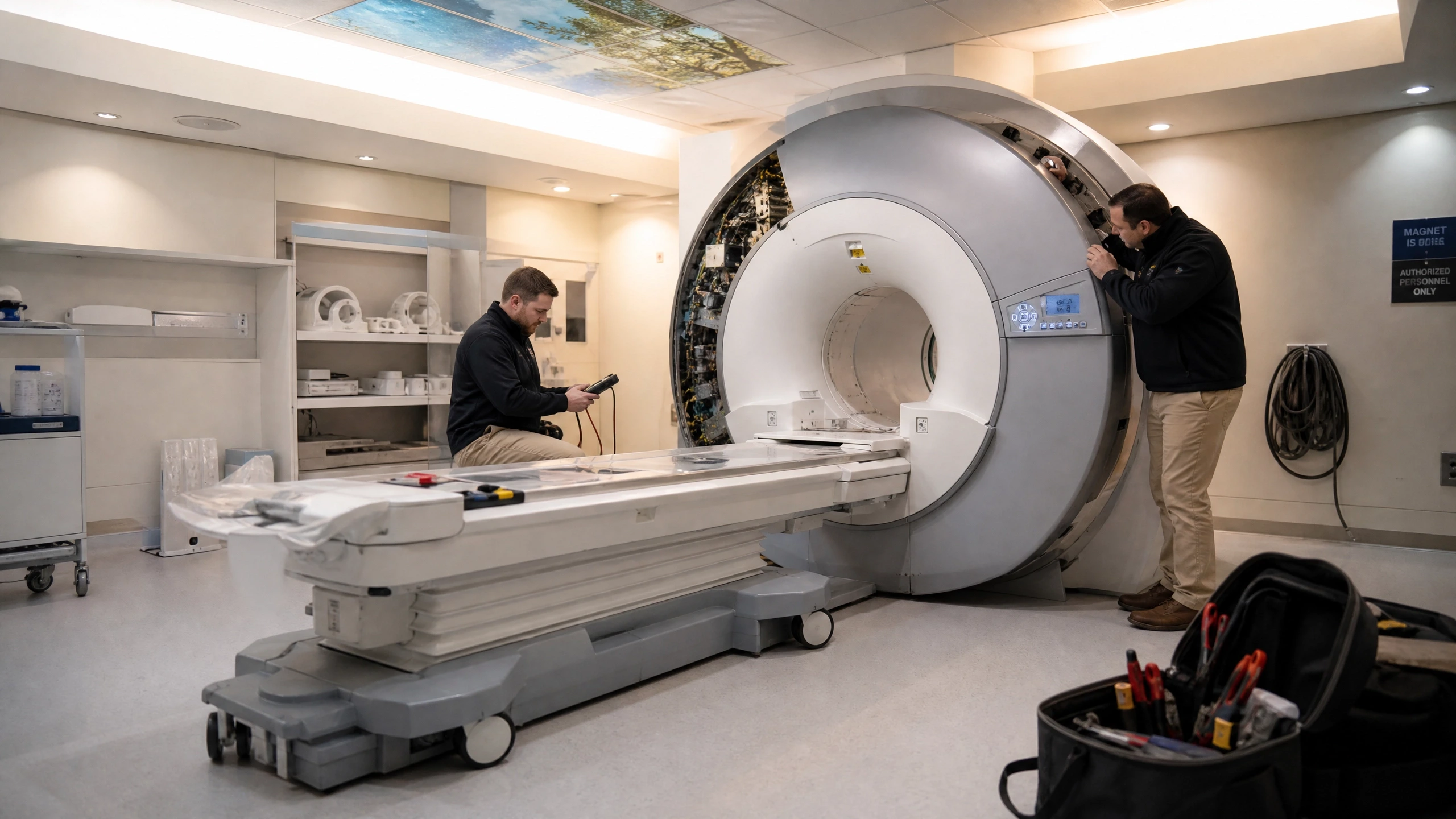
An MRI scanner cannot be simply switched off and removed. The magnetic field must be safely ramped down and the cryogenic system quenched under controlled conditions before any physical dismantling can begin. This process, known as a "quench" or controlled magnet ramp-down, requires specialist MRI engineers and must be planned well in advance of any equipment removal. E-Waste Collect coordinates with your existing MRI service provider or specialist decommissioning engineers and takes responsibility for the downstream collection and recycling of all MRI components once the system has been safely prepared for removal.
Important: MRI magnet ramp-down and quench procedures must be performed by qualified MRI engineers, not general contractors. E-Waste Collect coordinates the compliant recycling and removal of MRI components after the magnet has been safely decommissioned by qualified specialists. We do not perform magnet ramp-down procedures ourselves but can refer you to specialist MRI decommissioning engineers.
MRI System Components Covered by E-Waste Collect
A complete MRI system comprises multiple major component groups, each requiring specific handling. E-Waste Collect's MRI machine disposal Australia service covers all of these component categories once the system has been safely decommissioned.
MRI Magnet Assembly
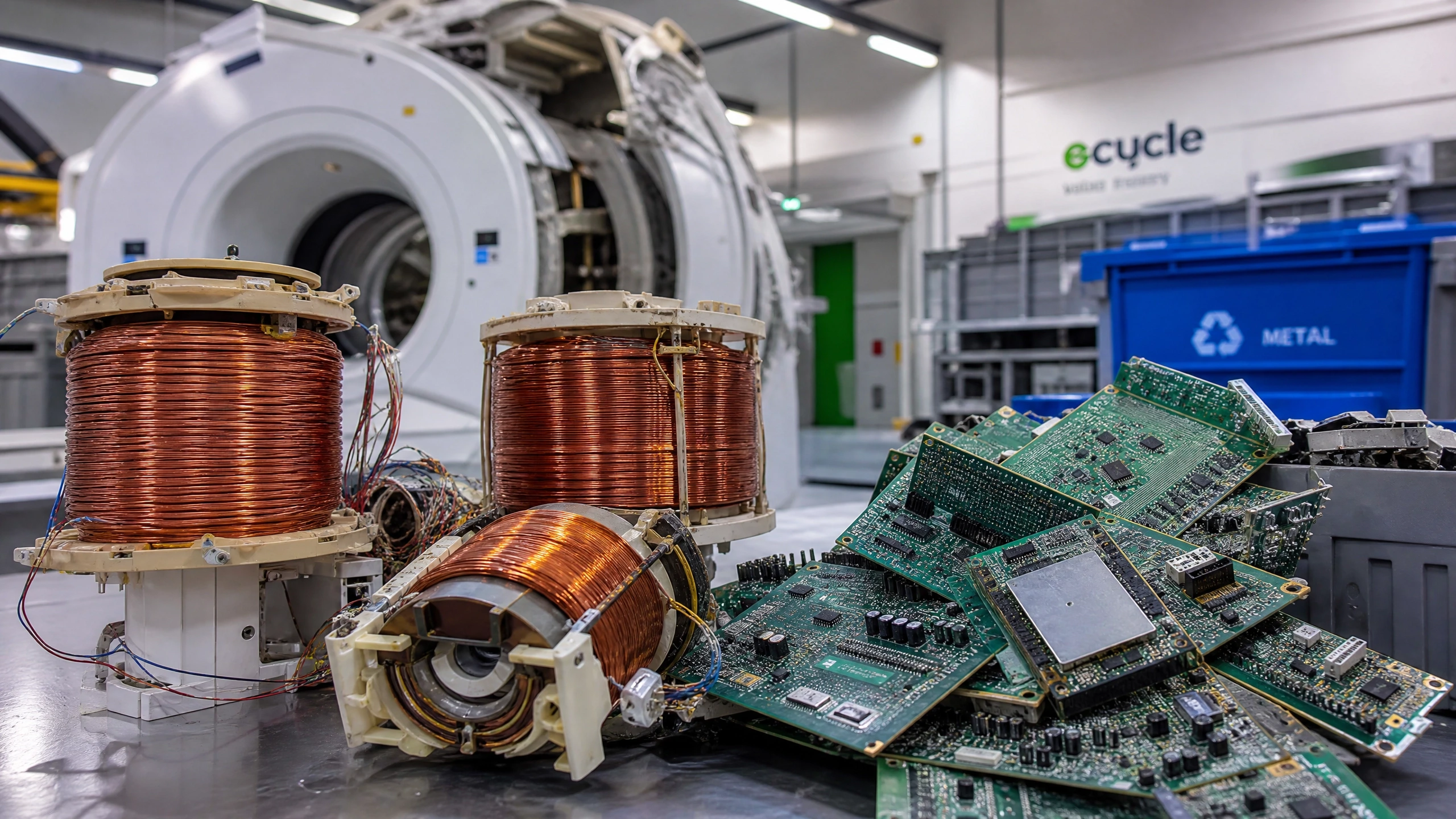
The magnet assembly is the core of the MRI system and by far its largest and heaviest component, typically weighing between 4,000 and 15,000 kilograms depending on field strength and configuration. After the magnetic field has been ramped down and the cryogenic system safely quenched, the magnet assembly contains superconducting coil windings, stainless steel and aluminium structural components, helium vessel assemblies and extensive cabling. The physical magnet bore, gradient coil assembly and magnet housing are all included in E-Waste Collect's MRI machine removal Australia scope.
Gradient Coil System
The gradient coil system sits inside the main magnet bore and generates the rapidly switching magnetic field gradients used to spatially encode MRI signals. Gradient coils contain precision copper windings, fibre reinforced polymer formers and high-current cabling and connectors. Once the main field has been ramped down, gradient coil systems are collected as part of the main magnet assembly or separately depending on the decommissioning approach used.
Radiofrequency Coils
MRI radiofrequency coils, including body coils, head coils, spine coils, extremity coils and specialty coils, are electronic devices containing precision electronic components, connectors and composite materials. End-of-life RF coils accumulate in imaging departments as systems are upgraded or coil technology changes. E-Waste Collect accepts all RF coil types for MRI machine decommissioning Australia, including coils that are no longer compatible with the facility's current system.
MRI Console and Computer Systems
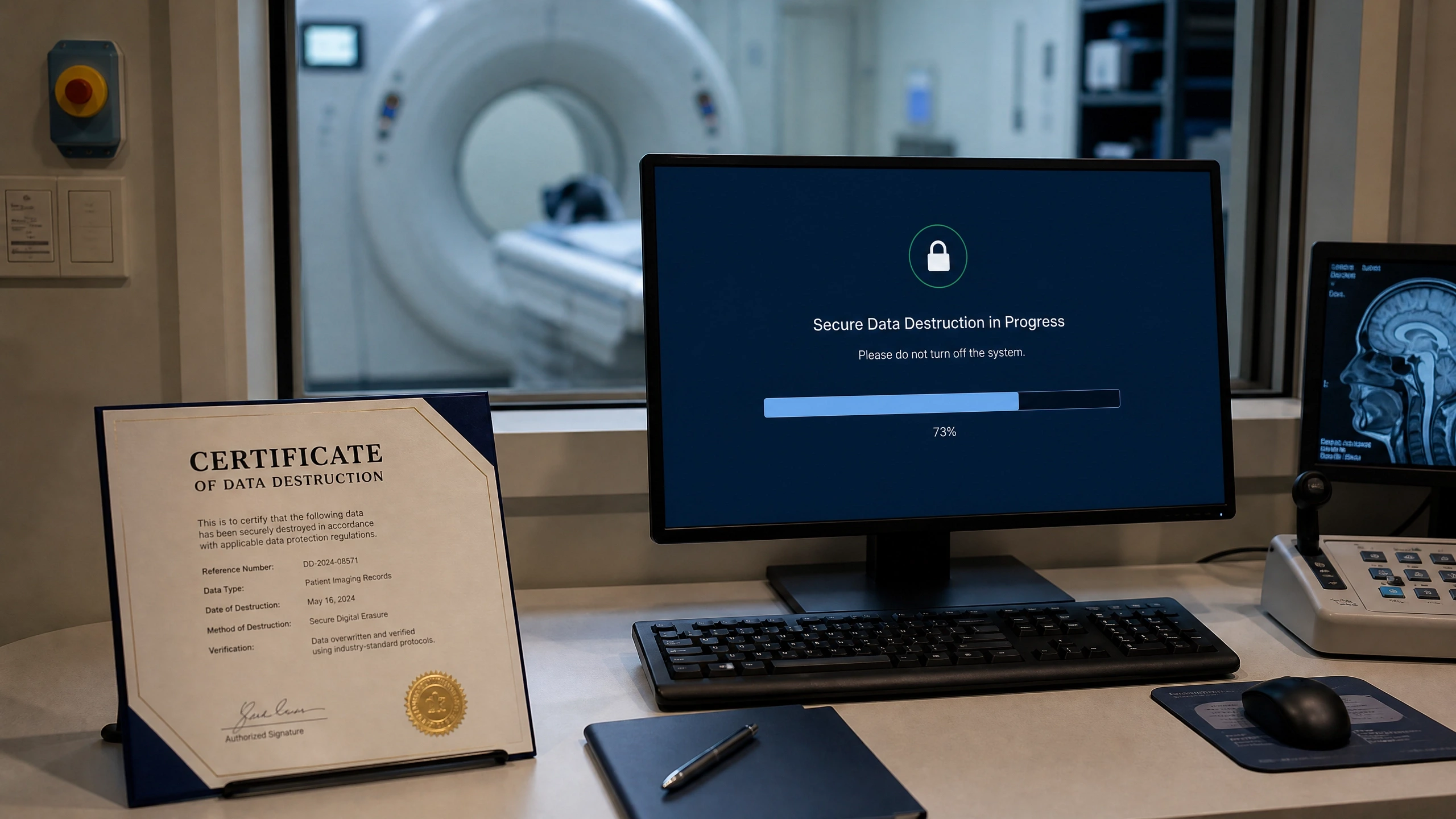
The MRI operator console, image reconstruction computers and associated processing hardware contain electronic components, storage media holding patient scan data, printed circuit boards with recoverable precious metals and display systems. Patient data stored on MRI console systems must be securely destroyed in accordance with the Privacy Act 1988 (Cth) before equipment leaves the facility. E-Waste Collect provides secure data destruction for all MRI console and computer systems as part of every MRI machine removal Australia project.
Radiofrequency Shielding and Faraday Cage Infrastructure
MRI suites require radiofrequency shielding, a Faraday cage, to prevent external RF interference from degrading image quality. When an MRI scanner is decommissioned, the RF shielding panels, waveguide filters, shielded doors and associated infrastructure in the MRI room may also need to be removed, particularly in facility closures, room repurposing, or when a new MRI is being installed in a different location. E-Waste Collect can include RF shielding infrastructure in the MRI machine decommissioning Australia collection scope.
Cryogenic Infrastructure
Superconducting MRI magnets are cooled by liquid helium and, in some configurations, liquid nitrogen systems. After a controlled quench, the cryogenic infrastructure including helium vessel components, quench pipe assemblies and coolant system hardware requires specialist handling. E-Waste Collect coordinates with qualified cryogenic handling specialists for the safe management of cryogenic system components as part of MRI machine removal Australia projects.
MRI-Compatible Patient Monitoring and Ancillary Equipment
MRI suites typically include MRI-compatible patient monitoring equipment, anaesthesia delivery systems for sedation cases, patient positioning devices, contrast injection systems and communication equipment. End-of-life MRI-compatible equipment accumulates in imaging departments as systems are upgraded. E-Waste Collect accepts all MRI suite ancillary equipment for compliant disposal as part of MRI machine decommissioning Australia collections.
Planning an MRI Decommission?
E-Waste Collect coordinates the compliant recycling and collection phase of MRI machine removal Australia projects. Contact our team early in your planning process to ensure the downstream recycling phase is coordinated with your engineering and project timeline.
Start Your MRI Disposal EnquiryWhy MRI Machine Decommissioning Australia Requires Specialist Coordination
MRI machine removal Australia is categorically different from general medical equipment disposal. Several factors make specialist coordination essential for safe, compliant and efficient decommissioning.
Magnetic Field Safety
Even powered-down MRI magnets with superconducting coils retain a residual magnetic field unless the coil has been deliberately warmed above its superconducting transition temperature. A powerful residual field presents serious projectile risks: ferromagnetic objects brought near the magnet can be violently attracted and become dangerous projectiles. This is why all magnetic field work must be performed by specialist MRI engineers with appropriate training and safety protocols, well before any removal or recycling activity begins.
Cryogen Safety
Liquid helium at minus 269 degrees Celsius and liquid nitrogen at minus 196 degrees Celsius present serious cryogenic burn, asphyxiation and pressure risks if mishandled during a quench procedure. The controlled quench of an MRI magnet results in rapid vaporisation of the cryogen and release through the quench pipe. This process must be performed only by qualified personnel with appropriate safety equipment and site preparation.
Patient Data Security
MRI console systems and image archive hardware store extensive patient imaging data accumulated over the operational life of the system. Facilities must ensure all patient data is securely destroyed before console or archive hardware leaves their control. E-Waste Collect provides secure data destruction with written certification, issued within three business days of collection, confirming all patient data has been irreversibly removed.
Weight and Access Logistics
MRI magnets weigh between 4,000 and 15,000 kilograms and are typically located in purpose-built shielded rooms that may not have direct access for standard removal equipment. Removal requires structural engineer assessment, specialist lifting equipment, possible removal of walls or doorways and careful floor loading calculations. E-Waste Collect coordinates with specialist MRI removal contractors for the physical extraction phase of MRI machine decommissioning Australia projects.
Hazardous Materials in Older Systems
MRI systems manufactured before widespread adoption of RoHS-equivalent design standards may contain lead solder in electronic assemblies, cadmium in batteries and other hazardous materials subject to specific handling requirements under Australian environmental legislation. E-Waste Collect's recycling processes are designed to identify and appropriately manage hazardous components across all MRI equipment types.
The E-Waste Collect MRI Machine Removal Australia Process
E-Waste Collect's MRI machine decommissioning Australia process is structured to integrate with the specialist engineering phases of MRI decommissioning. We recommend engaging our team at the earliest stage of your decommissioning planning to ensure the recycling phase is coordinated with your engineering and project timeline.
Early Engagement and Scope Review
Contact E-Waste Collect as early as possible in your MRI decommissioning planning process. Our team will review the MRI system type, field strength, configuration, site access and all associated equipment to be collected and provide a scope and proposal for the recycling and collection phase.
Engineering Coordination
E-Waste Collect coordinates with your existing MRI service provider or specialist MRI decommissioning engineers for the magnet ramp-down and quench phase. If you do not have an existing engineering relationship, we can refer you to qualified MRI decommissioning specialists.
Data Destruction Planning
For MRI console systems and image archive hardware, we confirm the data destruction method to be applied, either on-site prior to collection or at our processing facility and arrange the relevant documentation and certification.
Removal Logistics Planning
E-Waste Collect assesses the physical removal requirements for your MRI system, including access constraints, floor loading, specialist lifting equipment and any structural modifications required for extraction. We coordinate with specialist MRI removal contractors as required.
Collection and Chain of Custody
Following successful magnet decommissioning and site preparation by engineering teams, E-Waste Collect attends to collect and transport all MRI components under documented chain of custody. A manifest is issued at collection confirming every item removed.
Compliant Recycling and Documentation
MRI components are processed at compliant recycling facilities, with a certificate of recycling and data destruction certificate issued within three business days of collection.
Early engagement is the most important factor in a smooth MRI machine removal Australia project. MRI decommissioning typically requires four to twelve weeks of planning across engineering, logistics and facility management teams. Contacting E-Waste Collect at the start of this process ensures the recycling phase is integrated into your project plan from day one.
Documentation Issued for MRI Machine Decommissioning
Documentation for MRI machine removal Australia projects is comprehensive, reflecting the complexity of the equipment and the regulatory obligations involved.
Collection Manifest
Itemised list of every component collected from your facility, including magnet assembly, console systems, RF coils and all ancillary equipment, with serial numbers where available. Issued at collection and signed by both parties.
Certificate of Recycling
Confirms all collected MRI components have been processed through compliant Australian recycling streams. Suitable for asset register updates, environmental reporting and accreditation evidence.
Data Destruction Certificate
Issued for MRI console systems and all equipment with internal data storage. Confirms patient imaging data and device records have been irreversibly destroyed in accordance with applicable privacy obligations.
Chain of Custody Record
Documents the movement of all MRI components from your facility to our recycling site. Provides a traceable record for internal compliance reporting, health network governance and accreditation purposes.
MRI Machine Decommissioning Australia Coverage
E-Waste Collect provides MRI machine removal Australia services to facilities in every state and territory. Our national reach means you can arrange consistent, compliant disposal regardless of where your facility is located.
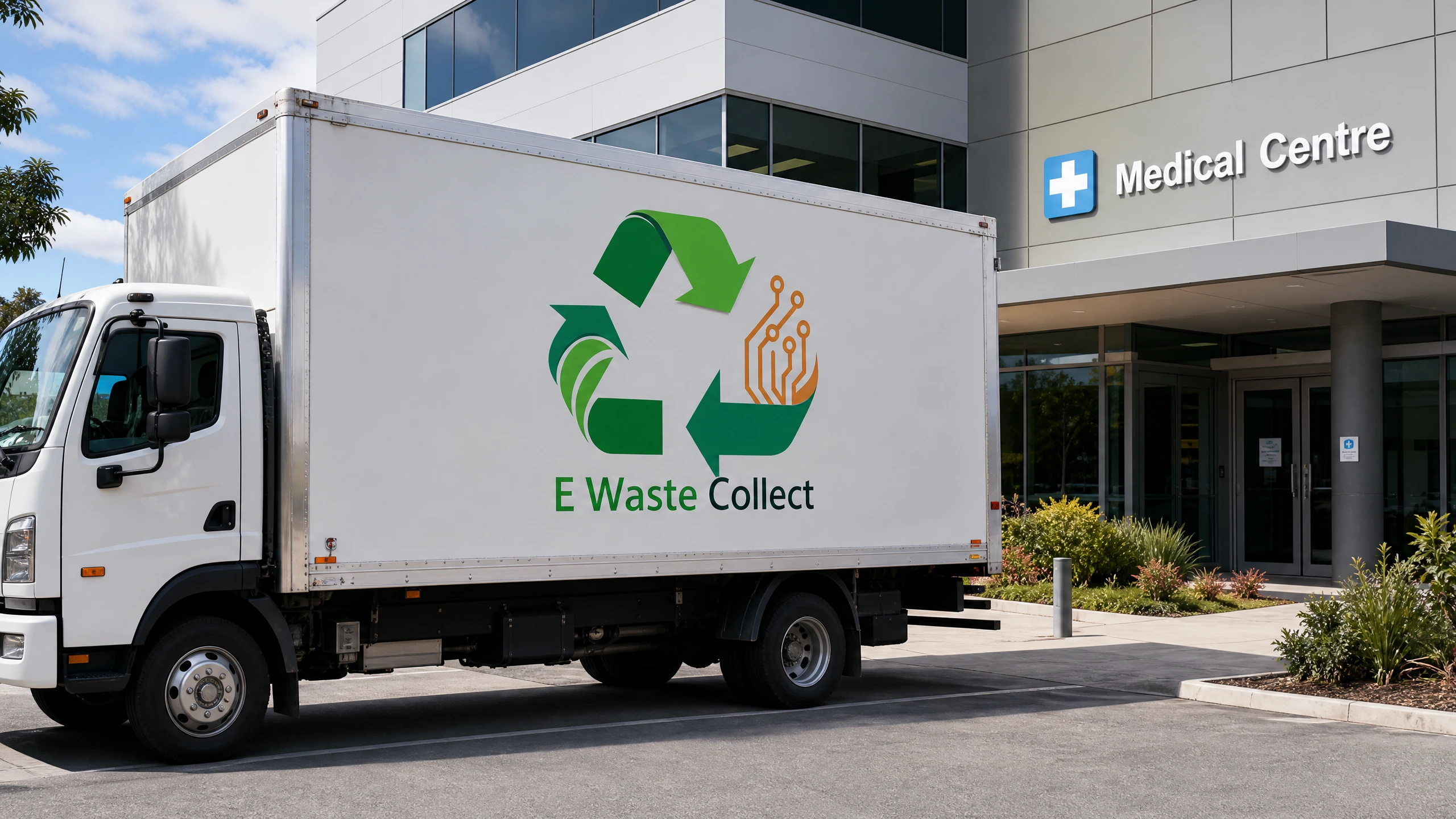
We coordinate MRI machine disposal Australia projects across metropolitan and regional locations, including major public hospital networks, private radiology practices, imaging centres and research institutions. For facilities in regional locations, we coordinate with local logistics and engineering partners to manage the physical extraction and transport phase efficiently.
MRI Field Strengths and System Types Covered
E-Waste Collect's MRI machine decommissioning Australia service covers all clinical MRI system types regardless of field strength, magnet type, or manufacturer.
| System Type | Common Field Strengths | Typical Weight Range |
|---|---|---|
| Superconducting (closed bore) | 1.5T, 3T | 4,000 to 15,000 kg |
| Open MRI (permanent magnet) | 0.2T to 1.0T | 8,000 to 30,000 kg |
| Wide bore superconducting | 1.5T, 3T | 5,000 to 16,000 kg |
| Extremity MRI | 0.2T to 1.0T | 400 to 2,000 kg |
| Research MRI (7T and above) | 7T, 9.4T and above | Varies significantly |
All major MRI manufacturers are covered including Siemens Healthineers, GE Healthcare, Philips Healthcare, Hitachi, Canon Medical and all other manufacturers. E-Waste Collect does not manufacture MRI systems and is not affiliated with any MRI vendor. We are an independent recycling and collection service.
When to Plan MRI Machine Disposal Australia
MRI machine removal Australia planning should begin at least three to six months before the intended decommissioning date in most cases and longer for complex installations. The following situations commonly trigger MRI disposal projects.
Technology upgrades are the most frequent driver, as Australian radiology facilities transition from 1.5T to 3T systems or adopt newer platform generations. Retiring an established MRI fleet generates significant logistical and compliance work and should be planned well in advance to allow coordinated scheduling of engineering, logistics and recycling phases.
Facility closures or relocations require complete MRI machine disposal Australia for all systems not being transferred to a receiving site. The timeline for facility closure is typically fixed, making early engagement with recycling and decommissioning partners critical to meeting the closure deadline.
Infrastructure failures in older MRI systems, particularly helium fill failures, gradient amplifier failures or magnet quench events, can result in unplanned decommissioning. E-Waste Collect can respond to unplanned MRI disposal requirements and coordinate expedited collection where possible.
Brands We Collect
We collect MRI scanners and suite equipment made by these manufacturers, along with most other makes. We are an independent recycling service and are not affiliated with any manufacturer.
More MRI Equipment We Recycle
Our MRI machine recycling Australia wide service covers the scanner and the plant and accessories around it. Every item is listed on the recycling certificate for the job.
Scanners of every field strength
1.5T MRI scanner recycling, 3T MRI scanner, open MRI machine and extremity MRI scanner, after the magnet has been ramped down by qualified MRI engineers.
Magnet and coils
MRI superconducting magnet recycling once the system has been safely quenched, plus MRI gradient coil recycling and MRI RF coil for head, body, spine and extremity coils.
Chillers and cooling plant
MRI chiller unit recycling, including cooling tower and chiller for MRI suites, once the plant is disconnected and the refrigerant has been recovered by your licensed HVAC contractor.
RF cage, copper pipe and waveguides
MRI RF cage copper recycling for shielding panels that have been removed, plus copper pipe and waveguide from MRI rooms.
Trolleys and contrast injectors
MRI patient trolley recycling and MRI contrast injector. Please remove contrast, syringes and tubing first, as we do not take contaminated consumables.
Frequently Asked Questions About MRI Machine Decommissioning Australia
Does E-Waste Collect perform MRI magnet ramp-downs and quench procedures?
No. Magnet ramp-down and quench procedures must be performed by qualified MRI engineers with specific training in cryogenic and magnetic field safety. E-Waste Collect coordinates the compliant recycling and collection of MRI components after the magnet has been safely decommissioned by qualified specialists. We can refer you to specialist MRI decommissioning engineers if you do not have an existing relationship with one.
How early should we contact E-Waste Collect for an MRI disposal project?
We recommend contacting E-Waste Collect as early as possible, ideally three to six months before the intended decommissioning date for standard installations and longer for complex systems or regional sites. Early engagement allows us to integrate the recycling phase into your project timeline and coordinate with your engineering and facilities teams from the outset.
What happens to patient imaging data stored on the MRI console?
Patient imaging data stored on MRI console systems, image archive hardware and associated storage must be securely destroyed before any equipment leaves your facility. E-Waste Collect provides secure data destruction for all MRI console and archive systems as part of every MRI machine disposal Australia project. A written data destruction certificate is issued confirming all patient data has been irreversibly removed.
Does E-Waste Collect buy MRI machines?
No. We do not buy equipment. E-Waste Collect is a recycling and collection service. We collect end-of-life MRI machines for responsible recycling.
Can E-Waste Collect handle MRI disposal for regional and rural facilities?
Yes. E-Waste Collect provides MRI machine disposal Australia services for facilities across metropolitan, regional and rural locations in every state and territory. For regional facilities, we coordinate with local logistics and engineering partners to manage the physical extraction and transport phase. Contact our team to discuss the options for your facility's location.
What happens to the MRI Faraday cage shielding when the scanner is removed?
RF shielding infrastructure can be included in the MRI machine disposal Australia collection scope if required. Whether the shielding is removed typically depends on whether the room will be repurposed, whether a new MRI is being installed in the same location, or whether the facility is being closed. E-Waste Collect can assess the RF shielding as part of the overall collection scope and advise on the most appropriate approach for your situation.
Is MRI equipment covered by Australian e-waste regulations?
Yes. MRI console systems, computer hardware, monitors, RF coils, patient monitoring equipment and associated electronic components fall under the Product Stewardship Act 2011 and associated co-regulatory arrangements that restrict these items from entering general landfill waste streams. The magnet assembly itself is not classified as e-waste but requires specialist handling and recycling as a large industrial item. E-Waste Collect's MRI machine disposal Australia service ensures full compliance with applicable regulations across all components.
What metals are recovered when recycling MRI machines?
MRI machines are mostly steel, copper and aluminium, plus circuit boards and other electronics. The magnet, gradient coils, RF cage copper and cabling are separated so each material goes to the right recycling stream.
Do you collect MRI chillers, contrast injectors and patient trolleys?
Yes. We collect MRI chiller units, contrast injectors, patient trolleys and RF coils, either with the scanner or as a separate job. Chillers must be disconnected and have the refrigerant recovered by your HVAC contractor first.
Can you recycle an open MRI or extremity MRI scanner?
Yes. We collect open MRI machines, extremity MRI scanners and closed bore 1.5T and 3T systems. Send the make, model, field strength and site access details and we will confirm what is needed.
Ready to Arrange MRI Machine Disposal?
E-Waste Collect provides compliant MRI machine removal Australia for hospitals, radiology practices, imaging centres and research institutions. Contact our team early in your decommissioning planning to ensure a smooth, compliant project.
Start Your MRI Disposal EnquiryWhat We Do Not Accept
We collect equipment, not waste streams. Please keep the following separate and use your existing licensed providers:
- Hospital beds, bed frames and mattresses
- X-ray film and radiology film archives
- Clinical and biohazard waste
- Sharps such as needles, blades, lancets and scalpels
- Chemicals, solvents, reagents and fixatives
- Samples and biological material, including sample tubes, plates and used consumables
- Pharmaceuticals and medicines
- Pressurised gas cylinders and liquid nitrogen
- Contaminated consumables
- Loose radioactive sources on their own. Equipment with a sealed source still fitted is assessed case by case.
Everything else is welcome, including working, non-working, surplus, outdated, damaged and end-of-life equipment and single personal or home devices such as CPAP machines, nebulisers, blood pressure monitors and mobility equipment.
MRI is one of many systems we retire. For everything else we collect and how pickup works, see our medical equipment recycling service.