
Medical Imaging Disposal & Deinstallation
Medical Imaging Disposal is no longer a simple end of life task handled at the last minute. Old CT units, MRI systems, C arm machines, and ultrasound platforms are being replaced more quickly than ever at hospitals, diagnostic centers, private clinics, research facilities, and specialty imaging departments. That replacement cycle creates a serious operational question: how do you remove large, expensive, technically sensitive imaging equipment from a live clinical environment without damaging the site, exposing staff to risk, breaching environmental expectations or slowing down the next installation?
The answer requires more than just collection. Proper Medical Imaging Disposal combines planning, deinstallation, lifting strategy, room protection, asset handling, component segregation, recycling pathways, data management, site safety and documentation. In other words, this is a full project, not a quick pickup. When done correctly, it protects people, preserves site integrity, supports sustainability goals and helps organisations transition from outdated imaging infrastructure to modern diagnostic capacity with less chaos and less cost.
Why this pillar page matters
This page is designed to help healthcare providers, practice managers, biomedical teams, radiology departments, facility coordinators and procurement decision makers understand the full scope of Medical Imaging Disposal. Whether you are replacing a single ultrasound cart in a suburban clinic or removing a legacy MRI suite from a major hospital, the logic is the same: the bigger and more specialised the asset, the more essential structured deinstallation becomes.
Many facilities underestimate the complexity of imaging equipment retirement because they focus only on the visible machine. In reality, the project often involves chilled water disconnection, RF room considerations, access route constraints, rigging, shielding review, cable isolation, accessories removal, temporary storage planning, packaging, loading method, recycling separation, and proof of compliant downstream handling. A serious imaging disposal program accounts for the entire ecosystem surrounding the equipment.
Good Medical Imaging Disposal also creates an opportunity. It is not just about getting rid of obsolete equipment. It is a chance to reduce landfill, recover valuable materials, streamline refurbishment decisions, improve compliance records, protect internal teams from unsafe manual handling, and strengthen your organisation’s environmental credibility. Facilities that treat disposal strategically often discover they can improve both operational efficiency and sustainability performance at the same time.
Another reason this topic deserves attention is scale. CT gantries can weigh several tonnes. MRI systems can require complex disassembly and strict planning around magnet related risk. C arm systems may involve mobile and fixed components, monitors, accessories and procedural room integration. Ultrasound units can look simple compared with heavy modalities, but they still involve electronics, probes, plastics, cables, peripherals and often internal storage concerns. Each category has its own logic, and each one demands a different disposal pathway.
For a healthcare organisation aiming to become a trusted environmental leader, there is also a reputation layer. Patients, staff, donors, regulators and procurement partners increasingly expect evidence that medical equipment is handled responsibly at end of life. A sloppy removal job sends the wrong signal. A documented, professional, site safe process says something powerful: this organisation manages risk properly and takes sustainability seriously.
What responsible Medical Imaging Disposal usually includes
- Site assessment before removal
- Equipment isolation and safe shutdown coordination
- Deinstallation planning and disassembly sequencing
- Protection of floors, walls, lifts and access routes
- Segregation of reusable, recyclable and non recoverable components
- Documentation for disposal and downstream handling
- Coordination with refurbishers, recyclers and transport teams
- Reduced disruption to clinical operations and nearby departments
Throughout this pillar page, we will cover the major imaging categories one by one, then move into shielding, site safety and deinstallation services. The goal is practical clarity. No fluffy brochure fog. No magical thinking. Just the nuts and bolts of how imaging equipment should be removed, handled and recycled in a way that makes sense for modern healthcare environments.
CT disposal & recycling
CT disposal is one of the most logistically demanding parts of Medical Imaging Disposal because computed tomography systems are physically large, structurally heavy and deeply integrated into their rooms. A typical CT setup includes the gantry, patient table, consoles, workstations, cabling, power components, accessories and often room specific fit out elements that must be assessed before anything is moved. You are not simply unplugging a device and wheeling it out. You are dismantling a diagnostic system that was designed to stay put.
Before any CT disposal project begins, the site team should establish what exactly is being retired. Is it the full system, or only selected components? Is there a possible reuse pathway, such as resale, refurbishment, parts harvesting or educational repurposing? Is the room being demolished, rebuilt or prepared for a new scanner installation? These questions affect timing, labour, packaging method and separation of materials. A rushed decision at the front end usually becomes a costly mess at the back end.
In practical terms, CT disposal starts with coordinated shutdown and isolation. Clinical use must cease. Service teams may need to disconnect the unit according to manufacturer protocols. Electrical safety and residual hazards should be reviewed. Then the removal crew typically documents the access route, checks door widths, turning arcs, lift capacities, loading dock conditions and any restrictions related to working hours. Hospitals are living organisms with endless corridors and surprise bottlenecks. A gantry does not care about your optimism if the path was measured badly.
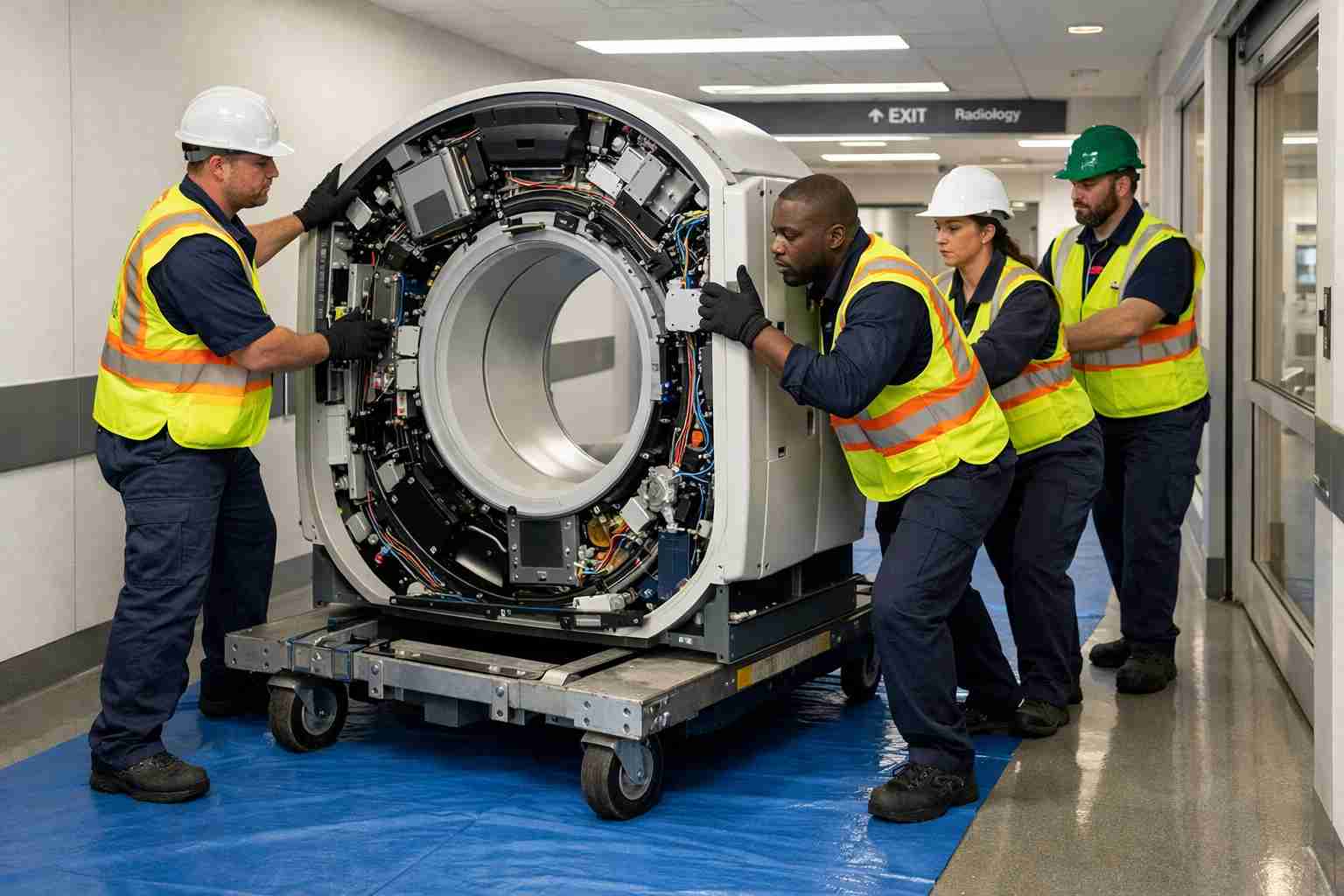
One of the biggest issues in CT disposal is weight distribution. The gantry may require specialist lifting gear, skates, palletisation or controlled breakdown into sub assemblies. Floor protection becomes essential, especially in leased medical buildings or premium hospital interiors where damage claims can get spicy very quickly. Patient tables, injector support equipment, monitors and workstations are easier to move, but the primary unit needs a carefully choreographed removal plan.
From a recycling perspective, CT disposal can recover significant material streams. Steel framing, aluminium, copper wiring, circuit boards, plastics and selected electronic components may enter recycling channels if they are properly segregated. Some parts may also be evaluated for reuse by technical refurbishers, provided they are safe, functional and legally appropriate to circulate. This decision has to be made carefully because medical equipment is not an ordinary consumer electronics category. Traceability matters.
There is also the data and software side. While CT systems are not always thought of as data storage devices in the same way as computers, many do contain consoles, workstations or integrated systems that may store configuration files, study information or network credentials. Responsible Medical Imaging Disposal should include a review of associated digital assets, especially if operator consoles, review stations or connected storage hardware are leaving the site.
Another often missed point in CT disposal is room transition planning. The disposal team should not only remove the old machine, but also help the site move from old state to ready state. That means identifying leftover anchors, floor penetrations, cable runs, brackets, debris, packaging waste and disconnected ancillary items that could delay the incoming installation. Good deinstallation makes the next phase easier. Bad deinstallation hands the new installer a haunted room full of annoying surprises.
Healthcare organisations should also look at scheduling logic. CT areas may be adjacent to sensitive departments, emergency pathways or active patient traffic. Removal during peak hours can create operational headaches, noise issues and safety risks. That is why strong Medical Imaging Disposal planning often includes after hours coordination, temporary barriers, route marshals and staged loading to minimise disruption.
For organisations across Australia, aligning CT disposal with broader environmental goals is increasingly important. Rather than defaulting to general waste or unmanaged scrap pathways, facilities should prioritise specialised medical equipment recyclers who understand the technical and logistical demands of diagnostic imaging equipment. That improves material recovery, lowers avoidable waste and helps build a disposal record that procurement, compliance and sustainability teams can actually stand behind.
| CT disposal consideration | Why it matters |
|---|---|
| Gantry weight and access route | Determines whether specialist lifting, skates, rigging or partial disassembly is required |
| Console and workstation handling | May involve data review, electronics recycling and secure separation of peripherals |
| Floor and wall protection | Reduces property damage during removal through corridors, lifts and loading areas |
| Material segregation | Improves recycling outcomes for metals, boards, plastics and reusable components |
| Room readiness after removal | Supports smoother installation of replacement imaging systems |
In short, CT disposal should be handled by a team that understands engineering reality, healthcare workflow and environmental responsibility at the same time. Medical Imaging Disposal in the CT category is one of those fields where competence is obvious. A good team leaves behind a clean, safe, documented transition. A poor one leaves dents, confusion, loose cables and a very tired facilities manager.

MRI disposal & recycling
MRI disposal is arguably the most specialised branch of Medical Imaging Disposal because magnetic resonance systems combine extraordinary weight, complex room conditions and unique risk factors. This is not merely another large machine. An MRI suite often includes the magnet system, patient table, control electronics, RF room elements, cooling infrastructure, accessories and carefully designed environmental controls. Every one of those layers affects removal strategy.
The first planning question in MRI disposal is whether the project involves full decommissioning, relocation, resale, component recovery or outright recycling. That single decision changes everything. A magnet intended for reuse requires a very different process from one being dismantled for material recovery. The site also needs to confirm the status of the magnet, including whether the system remains energised, what service support is available and what manufacturer procedures apply.
MRI disposal usually demands highly structured coordination between site management, engineering personnel, technical specialists, removal crews and transport providers. Space must be assessed not just for width and height, but for turning zones, floor loading, external crane access if required, and the suitability of exit points. In some cases the most direct route out of the building is not the original route in. Buildings change. Walls appear. Fire doors get upgraded. Corridors develop opinions.
One of the defining concerns in MRI disposal is safety around the magnet system itself. Even where the user is not dealing directly with all technical magnet management steps, the disposal plan must respect the reality that MRI infrastructure carries risks beyond ordinary equipment removal. This is why professional deinstallation matters so much. The work area, equipment state, access restrictions and specialised handling requirements must all be locked down before general removal activities begin.
In addition to the magnet, MRI disposal may involve associated room elements such as RF shielding components, cabling, filters, panels, chilled systems or support hardware. Some projects require only partial removal. Others require the room to be fully stripped for rebuild or repurposing. That scope should be documented clearly because “remove the MRI” can mean wildly different things depending on who is talking. In healthcare projects, vague language is the little goblin that eats budgets.
Recycling outcomes in MRI disposal can still be strong when the project is well managed. Structural metals, electronics, cabling and selected sub components can often be diverted from landfill through specialist recovery channels. The challenge is that MRI systems are not uniform scrap. They are high value technical assemblies that need controlled separation. A recycler without medical imaging experience may not know how to categorise, store or process components correctly.
There is also documentation value in MRI disposal. Because these projects are so visible and costly, stakeholders often want records showing what was removed, when it left site, how it was handled and where materials were directed. For hospitals and major diagnostic groups, that paper trail supports internal governance and helps avoid the black hole feeling of expensive assets vanishing into the mist with no proper closure.
Another key issue is building preservation. MRI suites are often located in constrained areas with expensive internal finishes, controlled access zones and nearby departments that remain operational during the project. Walls, corners, lifts, doors and thresholds all need protection. Dust control, noise management and timing restrictions may also apply. In many cases, the best MRI disposal projects are the least dramatic looking ones. No chaos. No avoidable damage. No corridor opera.
Core priorities in MRI disposal
- Confirm system status and project scope before physical work begins
- Coordinate with qualified technical specialists for safe deinstallation
- Protect access routes and structural surfaces during removal
- Separate recyclable metals and electronics wherever possible
- Keep thorough disposal and transport records for accountability
Medical Imaging Disposal at the MRI level demands respect for complexity. Facilities that try to shortcut the planning stage often run into delays, building damage, rescheduling costs or contractor disputes. Facilities that plan properly can retire legacy MRI infrastructure with minimal disruption and stronger recovery outcomes. That difference matters. MRI rooms are expensive assets in their own right, and poor disposal can delay a replacement project by weeks.
The sustainability side matters too. When organisations map MRI disposal into their wider environmental strategy, they begin to see end of life handling not as a headache but as a measurable improvement opportunity. Recyclable materials are identified earlier. Packaging and transport are planned more intelligently. Reuse potential is reviewed before destruction. Internal teams learn what a good retirement pathway looks like. That is how Medical Imaging Disposal grows from reactive task to repeatable system.
C arm disposal & recycling
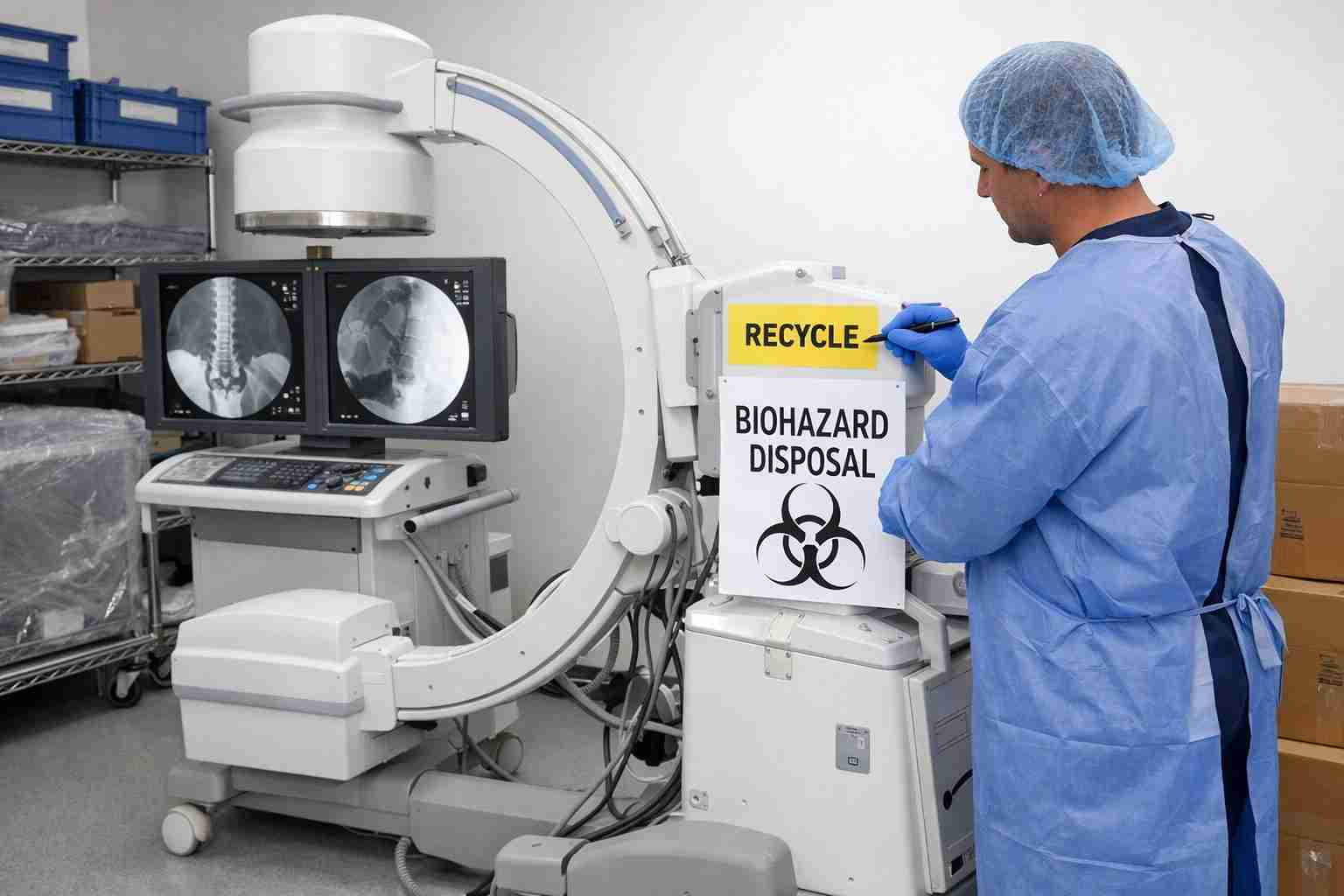
C arm disposal sits in an interesting middle zone within Medical Imaging Disposal. Compared with CT and MRI, many C arm systems are smaller and more manoeuvrable, yet they can still be technically complex, operationally sensitive and surprisingly awkward to remove. Fixed or mobile configurations, integrated displays, accessory carts, control units and theatre based usage all shape the disposal pathway.
A common mistake is to assume that because a C arm can move during clinical use, its disposal will be straightforward. Sometimes that is true for compact mobile systems, but often the surrounding reality is messier. There may be accessories stored in multiple rooms, detached monitors, archived manuals, spare parts, foot switches, mounting hardware and cables that were never documented well. Disposal teams need to audit the full asset group before pickup, otherwise the site ends up with half a machine gone and a nest of forgotten components sitting in a cupboard like abandoned robot tentacles.
C arm disposal also raises practical scheduling issues because these systems are frequently used in high value procedural spaces. Operating theatres, pain clinics, orthopaedic areas and intervention rooms often run on tight timetables. Removal cannot interfere with sterile flows, patient lists or incoming replacement equipment. The disposal provider must work around live healthcare operations, which means communication and timing are just as important as transport.
For mobile C arm disposal, pre removal checks should confirm whether batteries, accessory storage devices, displays or detachable components require separate handling. The machine’s condition should also be documented, especially if refurbishment or resale is being considered. A unit that is not suitable for clinical reuse may still have recoverable components or recyclable material streams. The goal is not to guess. The goal is to classify correctly.
In fixed room environments, C arm disposal may involve brackets, boom systems, integrated monitors or control assemblies that need disconnection and dismantling. This turns a seemingly simple collection into a true deinstallation project. Medical Imaging Disposal teams that understand imaging rooms will identify this early and quote the job based on actual scope rather than optimistic fairy dust.
Environmentally, C arm disposal can produce meaningful recovery when materials are separated correctly. Metal structures, electronic boards, cabling, plastics and some display components may enter appropriate downstream recycling. Again, the value comes from sorting and handling, not from brute force removal. Throwing specialised medical technology into a generic mixed waste pathway is not efficient, not responsible and frankly a bit caveman.
Another consideration in C arm disposal is records and traceability. Healthcare groups often want confirmation that the asset was removed from service, collected from site and directed into the appropriate downstream channel. Where there are associated computers or digital storage elements, those should be reviewed too. Even when no patient imaging data remains, organisations usually prefer a documented process rather than vague assurances and crossed fingers.
Medical Imaging Disposal for C arm equipment should also account for future room use. If the room is being reconfigured, the disposal team should clarify what stays and what goes. Are monitor arms being retained? Is cable infrastructure remaining in place? Are wall penetrations to be capped? Is packaging removal included? The more clearly this is defined, the fewer arguments appear later when everyone discovers they imagined a different job in their head.
A good C arm disposal project feels controlled from start to finish. The equipment group is identified, the access route is protected, the removal timing matches site workflow, and the downstream handling is documented. That is what healthcare facilities should expect from professional Medical Imaging Disposal. Not confusion, not scope drift, and not a “she’ll be right” approach in a procedural environment full of expensive surfaces and very unimpressed staff.

Ultrasound disposal & recycling
Ultrasound disposal may look simpler than other forms of Medical Imaging Disposal, but that simplicity can be deceptive. Ultrasound systems exist in many formats, from compact portable units and shared trolley based systems to high end diagnostic platforms with advanced probes, carts, displays, printers, software packages and peripheral accessories. Their lighter footprint compared with CT or MRI should not lead to careless disposal. These devices still contain electronics, plastics, metals and often data related hardware that need responsible handling.
One of the main strengths of ultrasound disposal is flexibility. Because many units are smaller and easier to relocate, facilities may have more reuse options before they choose recycling. A functioning ultrasound system might be suitable for refurbishment, redistribution within a larger healthcare network, parts harvesting or non clinical secondary use where legally appropriate. This should always be assessed before the unit is broken down for material recovery.
At the same time, age, probe condition, software limitations, cosmetic wear and service history can all reduce reuse value. That is where proper classification matters. The disposal provider should know whether the goal is collection for recycling, evaluation for reuse, or direct removal from service with environmentally responsible downstream processing. Sloppy category decisions waste time and reduce recovery potential.
In operational terms, ultrasound disposal is often easier to schedule than heavy imaging modalities because units can frequently be removed through standard access routes without major structural concerns. But there are still site details to consider. Shared units may be spread across departments. Accessories can be missing or mixed with other equipment. Probes may need separate inventory. Gel warmers, printers, carts and consumable holders may still be assigned to the asset even if nobody has thought about them in months.
Medical Imaging Disposal teams handling ultrasound should therefore perform a practical asset sweep, not just pick up the obvious main unit. A complete removal project asks: what belongs to this system, what is staying on site, what can be reused, what needs recycling, and what needs secure handling due to digital or organisational sensitivity?
Recycling pathways for ultrasound disposal can be very effective because these systems contain concentrated electronics in a manageable form factor. Circuit boards, wiring, metal chassis components and selected plastics may all be separated for downstream processing. Probes and specialised accessories may require different treatment depending on condition and composition. The key is controlled segregation rather than one pile trucking.
Facilities should also remember that ultrasound equipment often lives in fast moving clinical environments such as emergency, women’s health, vascular, cardiac, musculoskeletal and point of care settings. That means removal projects should be coordinated to avoid interfering with active diagnostic capacity. Even a small device can create a big headache if the wrong department loses access at the wrong time.
Another piece of the puzzle is aesthetics and professionalism. Clinics and hospitals want old ultrasound systems removed cleanly, quietly and with minimal fuss. No corridor clutter. No busted trolleys scraping walls. No forgotten accessories left behind in drawers. The disposal process should look as competent as the clinical service that used the equipment in the first place.
For organisations building a stronger environmental profile, ultrasound disposal is also a great place to establish internal standards. Because these projects are more frequent and easier to manage than major modality removals, they can become the proving ground for a smarter Medical Imaging Disposal policy. Once staff understand how to identify assets, separate accessories, document pickup and confirm downstream handling, the same discipline can later be scaled to larger and more complex imaging removals.
In that sense, ultrasound disposal is not the minor league. It is often the frontline where disposal habits are formed. Do it well and the organisation learns good behaviour. Do it badly and the bad habits spread everywhere like glitter at a craft party.
X ray disposal & deinstallation
X ray disposal is an essential part of Medical Imaging Disposal because X ray systems are still widely used across hospitals, dental clinics, imaging centres, orthopaedic practices, urgent care sites and general medical facilities. While some X ray units may appear less complex than CT or MRI systems, proper removal still requires technical planning, safe deinstallation and responsible downstream handling. Fixed X ray rooms, digital radiography systems, mobile X ray units and older analogue installations all come with different removal requirements.
X-ray equipment is frequently integrated into the design of rooms in medical facilities. The system may include wall stands, tables, ceiling mounted tube assemblies, generators, control panels, monitors, detectors, cabling and supporting brackets. That means X ray disposal is often not just about taking away one machine. It is a coordinated deinstallation project that may involve partial dismantling, disconnection of mounted hardware and safe removal of room based components without damaging floors, walls or structural finishes.
A professional X ray disposal process usually starts with a site review. The removal team should confirm what equipment is being retired, which parts are included, whether the unit is fixed or mobile, and whether the room is being upgraded for a replacement installation. This is important because a simple collection job and a complete X ray deinstallation are not the same thing. One involves pickup. The other involves room transition planning, controlled dismantling and safe separation of reusable and recyclable components.
X ray disposal can also create strong recycling outcomes when handled correctly. Structural metals, electronic assemblies, wiring, plastics, monitors and control hardware may all enter appropriate recycling channels depending on condition and composition. Where there is still asset value, some systems or components may also be assessed for refurbishment or controlled reuse. That decision should always be based on technical condition, legal suitability and traceable handling rather than guesswork.
Site safety matters heavily in X ray deinstallation. Ceiling mounted systems, wall mounted bucky units and heavy generator components may require staged dismantling and careful manual handling controls. Removal routes should be measured in advance, surfaces protected and work timed around clinical activity where needed. In active hospitals and busy clinics, even a relatively standard X ray disposal project can disrupt operations if it is handled with too much cowboy energy and not enough planning.
Another important consideration is associated digital infrastructure. Modern X ray setups may include consoles, image acquisition workstations, display systems and connected accessories. These items should be reviewed as part of the broader Medical Imaging Disposal workflow so that nothing important is left behind and any data related hardware is handled appropriately.
For facilities aiming to improve sustainability, X ray disposal offers a practical opportunity to reduce landfill and improve environmental reporting. Instead of treating outdated radiography systems as general waste, healthcare organisations can work with specialist medical equipment recyclers who understand imaging assets, deinstallation workflows and compliant downstream processing. That approach supports both environmental responsibility and operational professionalism.
In short, X ray disposal & deinstallation should be treated as a structured service, not a last minute removal task. When planned well, it helps healthcare providers retire outdated imaging infrastructure safely, protect the building, prepare rooms for replacement systems and recover more value through recycling and responsible equipment handling.
Radiation/shielding & site safety considerations
Radiation, shielding and site safety considerations are a core part of Medical Imaging Disposal because imaging equipment is rarely removed from an empty warehouse with infinite space and zero consequences. Most removals happen in active healthcare buildings where the disposal task sits alongside patient care, infection control, building management, contractor rules and regulatory expectations. The project therefore has to protect not only the equipment and the workers, but also the broader site environment.
Start with room level safety. Before any disposal or deinstallation activity begins, the site should confirm who controls the room, which services are active, whether adjacent areas remain operational and what access limitations apply. This sounds obvious, yet a surprising number of disposal headaches begin with some version of “we thought facilities had done that bit.” Thought is lovely. Confirmation is better.
For imaging environments, shielding considerations can become especially important. Depending on the modality and room design, there may be shielding elements, specialised panels, lead lined features or structural protections that need to remain, be modified or be removed under controlled conditions. The disposal provider should clarify whether the project scope includes only the equipment or also related room infrastructure. This distinction matters because the tools, labour, packaging and waste pathways may be completely different.
Site safety during Medical Imaging Disposal also includes route management. The team needs to know exactly how equipment will move from room to truck, what surfaces require protection, which doors need temporary removal or control, whether lifts can take the load and what backup plan exists if the primary path is blocked. This is especially important for high traffic hospitals where patient movement, emergency transport and contractor access can collide in unpredictable ways.
Manual handling risk should be controlled from the start. Even smaller imaging equipment can become hazardous when awkwardly shaped or poorly balanced. Larger systems obviously require mechanical aids, rigging or specialist lifting methods. A safe project is never built on human heroics and lower back gambling. It is built on planning, the right equipment and clear sequencing.
Infection control can also matter depending on the site and room type. Removal teams may need to follow site specific access protocols, cleaning expectations, PPE rules or work zone controls. In operating areas, interventional environments or sensitive clinical spaces, this becomes even more important. Medical Imaging Disposal should adapt to the healthcare setting, not bulldoze through it like a removalist from an alternate dimension.
Noise, dust and debris management should be planned too. Deinstallation work may involve dismantling brackets, panels, cable trays or room hardware. That can produce debris, dust and service disruption unless controls are in place. If the building remains operational during the job, these issues affect more than just the work crew. They affect adjacent departments, patients and site management.
Then there is contractor coordination. Imaging disposal jobs often involve multiple parties: internal facilities teams, biomedical staff, electrical contractors, OEM technicians, riggers, transport providers, waste handlers and incoming installation teams. When responsibilities are not defined, safety gaps appear. One group assumes the other has isolated power. Another assumes route protection is in place. A third turns up early with a truck and no loading permit. Tiny bureaucratic gremlins, enormous practical consequences.
The best way to manage this is through a site specific disposal plan that defines scope, responsibilities, sequence, access route, timing, protection measures and completion requirements. This is one of the most valuable features of professional Medical Imaging Disposal. It turns a risky, vague task into a controlled project with visible ownership.
Key site safety questions before imaging equipment removal
- Has the room been released for disposal work?
- Are all relevant services isolated and confirmed?
- Is shielding or room infrastructure part of the project scope?
- Has the removal route been measured, inspected and protected?
- Do lifting methods match equipment size and building constraints?
- Are adjacent departments aware of timing and possible disruption?
- Who signs off the room as complete after removal?
A site safe Medical Imaging Disposal program does not happen by accident. It happens when the provider understands that healthcare buildings are complex ecosystems, not just pickup addresses. That mindset protects workers, patients, site assets and project timelines all at once.
Organisations that standardise these safety considerations also gain a strategic advantage. Every future disposal becomes easier because the framework already exists. Staff know what information to collect. Contractors know what standards to meet. Risks are identified earlier. Unexpected costs shrink. The process becomes repeatable rather than improvised, and that is exactly where serious disposal management should land.
Deinstallation services
Deinstallation services are the bridge between a working imaging department and a cleared, ready for next use space. In the world of Medical Imaging Disposal, deinstallation is the stage where planning becomes physical reality. It includes the controlled shutdown, disconnection, dismantling, handling, packing, route management and loading of imaging equipment and its related components. Without this step, disposal is just wishful thinking wearing a hi vis vest.
A professional deinstallation service begins with scope definition. What exactly is being removed? Is the asset complete or partial? Are accessories included? Is the room being returned to base condition? Are monitor arms, brackets, rails, cabling or control furniture staying or going? Is packaging and debris removal included? Is there a requirement for after hours works? These details shape staffing, equipment, timing and cost.
Next comes site review. The provider should inspect the equipment, access path, room conditions, building restrictions and loading arrangements. For heavy modalities this may involve engineering or rigging input. For smaller systems it may simply mean verifying route dimensions, floor conditions and parking access. Either way, guessing is a terrible method. Measurement is much more civilised.
During the actual deinstallation, the goal is controlled sequencing. The equipment is safely isolated, disconnected where appropriate, dismantled in the correct order, protected for movement and transported through the site without damage or disruption. If reusable components are being separated, that classification is done deliberately. If materials are destined for recycling, they are directed into the correct downstream pathway rather than muddled together.
Strong deinstallation services also protect the building. That means corner guards, floor coverings, lift protection, route supervision and careful loading methods. In premium healthcare settings, this matters immensely. The cost of repairing walls, floors, doors and lifts can quickly erase any savings from using a cheaper, less capable removal crew. Medical Imaging Disposal is one of those domains where bargain improvisation often becomes premium regret.
Documentation is another major piece. Healthcare organisations usually need a clear record of what was removed, when the project occurred and what happened afterwards. This may include asset lists, collection confirmations, disposal records or recycling notes. Deinstallation is therefore not just physical labour. It is a traceable service with operational and governance value.
A well run deinstallation partner should also help facilities teams think ahead. Does the incoming replacement system need a clean, cleared room by a specific date? Does the builder need access immediately after removal? Does the old system need temporary holding before final transport? Can ancillary equipment be consolidated into the same project to reduce cost and disruption? These are the sorts of questions that turn a vendor into a useful project partner rather than a simple collection provider.
For Australian healthcare organisations, deinstallation services can support a broader circular approach to equipment management. Instead of thinking only in terms of disposal, they can assess reuse, recovery, responsible recycling and staged site transition as one coordinated program. That makes Medical Imaging Disposal more efficient, more sustainable and easier to defend internally.
What a complete deinstallation service may include
- Pre removal site assessment
- Shutdown coordination and asset verification
- Disassembly and safe handling of imaging equipment
- Packaging or palletisation where required
- Route protection and supervised movement through the building
- Loading, transport coordination and downstream disposal handling
- Room clear out of associated accessories and loose components
- Basic completion reporting and disposal documentation
Deinstallation services matter because they reduce uncertainty. They help clinical teams hand over old equipment safely. They help facilities managers avoid building damage. They help procurement teams prepare for incoming systems. They help sustainability teams capture better recycling outcomes. And they help executives avoid the very expensive phrase “why is this project delayed?”
When selecting a provider, organisations should look for more than a truck and a labour crew. They should look for experience with healthcare environments, familiarity with imaging categories, confidence around site safety, realistic planning, clear communication and documented downstream handling. In actuality, professional medical imaging disposal looks like that.
How to build a smarter Medical Imaging Disposal program
For organisations with more than one clinic, department or site, Medical Imaging Disposal should evolve into a structured internal program rather than a series of one off decisions. The first step is asset visibility. Know what imaging equipment exists, where it is located, what condition it is in and when replacement is likely. Disposal becomes easier when it is anticipated rather than triggered in a panic by a failed unit and a grumpy installer.
The second step is pathway logic. Decide how you will classify retired imaging equipment. Some assets may qualify for reuse review. Some may be harvested for parts. Some should go directly into specialist recycling streams. Some may need coordinated deinstallation because of room constraints or building access. When these categories are documented in advance, teams make better decisions under pressure.
The third step is approved provider selection. Not every waste contractor or mover is suitable for imaging equipment. The right provider understands healthcare sites, heavy or delicate medical systems, documentation needs and environmentally responsible downstream handling. Having a vetted partner reduces procurement delay and helps standardise quality across projects.
The fourth step is internal communication. Clinical staff, biomedical teams, procurement managers and facilities coordinators should all know the basic disposal process. Who reports retirement? Who signs off removal? Who confirms data related components? Who books the collection? Who receives the documentation? Without clear ownership, old equipment tends to linger in storerooms like a museum of expensive indecision.
Finally, connect disposal to sustainability reporting. Medical Imaging Disposal is part of the healthcare environmental story. If you recover materials, reduce landfill and use specialist recycling channels, that deserves to be measured. Over time, those numbers can support tenders, ESG reporting, stakeholder trust and internal funding decisions.
Why healthcare facilities trust specialist imaging disposal partners
Healthcare facilities trust specialist partners because imaging equipment is too valuable, too heavy and too sensitive for generic end of life handling. The stakes are practical as much as environmental. A poor removal can damage the building, delay a new installation, create internal risk, lose accessories, confuse staff and leave no proper record of what happened. A specialist team solves those problems before they become stories people tell angrily in project meetings.
Specialist imaging disposal partners understand modality differences. They know that CT, MRI, C arm and ultrasound each require different handling. They understand that a room can be as important as the machine. They recognise that access routes, infection control, timing and documentation matter in healthcare settings. They know how to balance reuse, recycling and safe deinstallation without oversimplifying the job.
This matters even more for growing diagnostic groups, hospital networks and multi site practices. Standardising Medical Imaging Disposal through an experienced partner means every retirement project becomes more predictable. Costs are clearer. Scope is clearer. Timelines are clearer. Environmental outcomes are clearer. In other words, the weirdness level drops, and that is a beautiful thing.
Official external resources
For broader guidance on health care waste, environmental responsibility and radiation safety, you can also review official resources from:
Frequently asked questions about Medical Imaging Disposal
Can old imaging equipment be recycled instead of dumped?
Yes. In many cases, Medical Imaging Disposal can recover metals, electronics, cabling and selected components through specialist recycling pathways. The exact outcome depends on equipment type, age, condition and whether any parts are suitable for reuse or refurbishment.
Do imaging systems need deinstallation before pickup?
Often yes. Large or room integrated systems usually require structured deinstallation before they can be moved safely.Even smaller units might require controlled disconnection, route planning, or accessory separation.A simple pickup model is often not enough for imaging equipment.
Is disposal only about removing the machine itself?
No. Good Medical Imaging Disposal also considers room readiness, accessories, monitors, cables, attached hardware, packaging waste, building protection and downstream recycling or disposal records. The equipment is only one part of the project.
Why should hospitals use a specialist provider?
Because imaging equipment is heavy, technical and often located in sensitive clinical environments. A specialist provider is more likely to understand deinstallation, access constraints, site safety, recycling segregation and healthcare workflow requirements.
Can disposal be scheduled around active clinical operations?
Yes. Professional Medical Imaging Disposal is usually planned around access windows, after hours needs, patient movement and department workflow so disruption is kept to a minimum.
Final word: build your site authority with the right pillar page
Medical Imaging Disposal is one of the strongest authority topics for a healthcare recycling and deinstallation brand because it sits at the intersection of compliance, sustainability, engineering logistics and real operational pain points. A clinic director, procurement manager or hospital facilities lead searching for CT disposal, MRI disposal, C arm disposal or ultrasound disposal is not casually browsing. They usually have a real project, real equipment and real pressure.
That is exactly why this pillar topic can become a powerful SEO and conversion asset for EwasteCollect. It positions your brand as more than a general e waste pickup company. It frames you as a specialist partner for medical, laboratory and hospital equipment removal across Australia. It also creates natural internal linking opportunities to service pages, city pages, booking pages and future cluster articles around specific modalities, compliance topics and deinstallation workflows.
The biggest win is this: when your content explains the process clearly and professionally, buyers feel safer contacting you. They can picture the job getting done. They can see you understand their world. And in service SEO, that matters a lot more than empty buzzwords and recycled fluff.