OCT Machine Recycling Australia | OCT Scanner Disposal for Eye Clinics
OCT machine recycling Australia is a specialist disposal service for ophthalmology practices, optometry clinics, private hospitals, public hospital eye departments, and retinal imaging centres that need to decommission, remove, or recycle OCT scanners safely, responsibly, and with full documentation. EwasteCollect manages collection, data sanitisation, and compliant recycling of OCT machines from all major manufacturers across every Australian state and territory.
When your eye clinic or hospital upgrades its OCT scanner, the old unit cannot simply be placed in general waste or left in a back room indefinitely. OCT machine recycling Australia requires a structured approach, because OCT systems are precision medical instruments that contain electronic components, optical assemblies, and in most clinical settings, stored patient retinal imaging data. Getting disposal wrong creates regulatory, privacy, and environmental risks for your practice.
EwasteCollect provides a dedicated OCT machine recycling Australia service designed specifically for the healthcare environment. We understand the clinical, data privacy, and compliance context that applies when a Zeiss Cirrus, Heidelberg Spectralis, Topcon Maestro, or any other OCT system is decommissioned in an Australian eye clinic. This page explains everything your practice needs to know, from data handling to the collection process, brand coverage, state-by-state service, and documentation.
This service is part of our broader ophthalmology equipment recycling Australia offering for eye healthcare providers.
Ready to Book OCT Machine Collection?
Send us your OCT machine brand, model, clinic location, and preferred timing. EwasteCollect responds within one business day with a collection plan tailored to your practice.
What Is an OCT Machine and Why Does Recycling Require a Specialist?
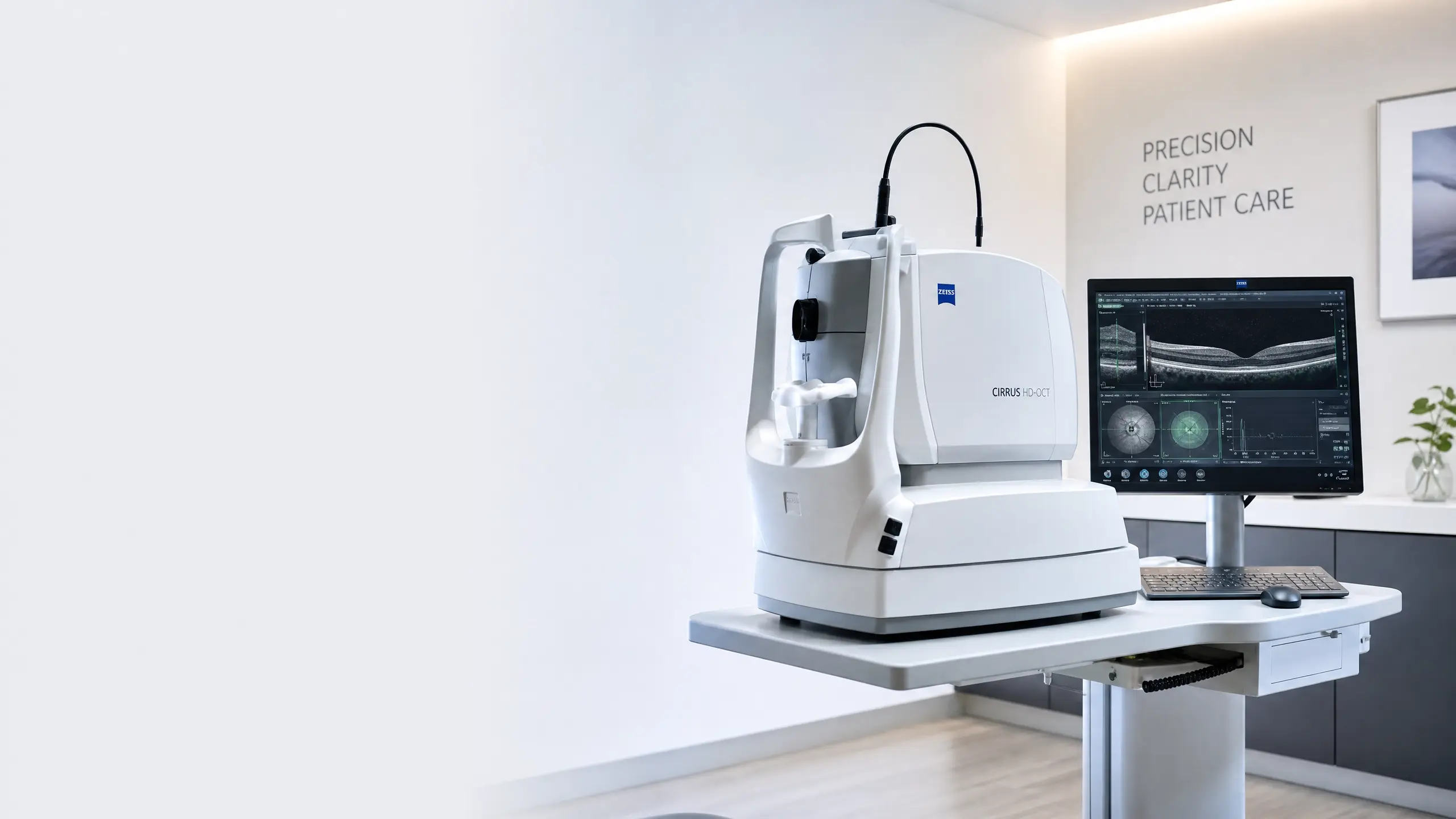
Optical Coherence Tomography (OCT) is a non-invasive imaging technology that uses low-coherence near-infrared light to produce high-resolution, cross-sectional images of retinal tissue. OCT machines are standard diagnostic equipment in virtually every ophthalmology and optometry practice in Australia, used daily for diagnosing and monitoring age-related macular degeneration, glaucoma, diabetic retinopathy, macular holes, vitreomacular traction, and corneal pathology.
Why OCT Technology Gets Replaced So Frequently
OCT technology has advanced through several generations in a relatively short period. Time-domain OCT was replaced by spectral-domain OCT (SD-OCT), which has since been supplemented or replaced by swept-source OCT (SS-OCT) with its superior depth penetration, and more recently by OCT Angiography (OCTA), which images retinal vasculature without dye injection. Each generational leap drives upgrade cycles across Australian ophthalmology and optometry practices, generating a regular supply of decommissioned OCT machines that need responsible disposal.
Beyond technology, OCT machines are also replaced when manufacturer service contracts expire for older models, when practices undergo relocation or closure, when hospital departments conduct capital equipment refresh cycles, or when lease and finance agreements reach end of term. OCT machine recycling Australia is the result of a high-value instrument market with accelerating upgrade cycles.
What Is Inside an OCT Machine?
An OCT system is not a simple electronic device. It contains a combination of precision optical components, near-infrared light sources, interferometers, high-speed line-scan cameras, circuit boards, motors, power supplies, display systems, internal computer hardware, and in clinical configurations, hard drives or SSDs storing patient imaging data. This combination of hazardous electronic materials, precision optics, and potential patient data is exactly why OCT machine recycling Australia should not be handled by a general rubbish removal company.
Key Components Requiring Specialist Recycling
- Printed circuit boards containing lead, cadmium, beryllium, and brominated flame retardants
- Near-infrared light sources and laser diodes
- Precision optical assemblies including beam splitters and fibre-optic components
- Internal computer systems with patient data on hard drives or SSDs
- Display panels, older units may include mercury-containing CCFL backlights
- Lithium-based backup batteries presenting a fire risk if improperly handled
- Structural metals, steel and aluminium chassis and frames
Why OCT Machine Disposal Requires Compliance, Australian Regulatory Context
Healthcare organisations in Australia have specific obligations when disposing of electronic medical equipment. For OCT machine recycling Australia, the key regulatory frameworks are:
Product Stewardship Act 2011 (Federal)
The Australian Government’s Product Stewardship Act 2011 establishes co-regulatory and voluntary schemes for electronic equipment. Computers, monitors, and associated IT equipment connected to OCT systems fall within scope of the National Television and Computer Recycling Scheme (NTCRS). EwasteCollect processes OCT equipment and connected IT hardware through pathways that satisfy these federal obligations.
State Environmental Legislation
Every Australian state has environmental protection legislation that governs electronic waste disposal, including the Protection of the Environment Operations Act 1997 (NSW), the Environment Protection Act 2017 (VIC), the Waste Reduction and Recycling Act 2011 (QLD), and the Waste Avoidance and Resource Recovery Act 2007 (WA). Disposing of an OCT machine through non-compliant pathways can attract penalties under these frameworks. EwasteCollect’s collection and recycling processes satisfy all state-based requirements.
Privacy Act 1988 and Australian Privacy Principles
The Privacy Act 1988 (Cth) and the Australian Privacy Principles, particularly APP 11, which mandates that organizations take reasonable measures to protect personal information from misuse and unauthorized access, apply to any OCT machine that has been used in clinical practice. An OCT scanner with unsanitised patient data leaving a practice without a documented destruction process represents a potential data breach reportable to the Office of the Australian Information Commissioner (OAIC).
Compliance Summary
Your practice needs compliant OCT disposal to satisfy federal product stewardship obligations, state environmental protection legislation, and federal data privacy requirements, all at once. EwasteCollect provides the documentation to cover all three.
Patient Data and OCT Machine Recycling, The Hidden Risk

The single most underestimated aspect of OCT machine recycling Australia is patient data. An OCT scanner that has been in active clinical use for five years may contain thousands of individual patient retinal scans, linked to patient names, dates of birth, referring practitioners, and in some cases Medicare or private health identifiers. Many practices are not aware of how much data accumulates inside an OCT system or its connected workstation until they begin the decommissioning process.
Patient data in an OCT environment can reside in several places simultaneously: on the OCT machine’s internal storage, on the connected workstation’s hard drive, on a dedicated PACS server, on an external backup drive, and on any printer that has cached imaging jobs. A responsible OCT machine recycling Australia service considers the full data environment, not just the OCT unit itself.
Our Data Sanitisation Protocol
Before any OCT machine or connected equipment leaves your premises, EwasteCollect applies a documented data sanitisation process that meets Australian Privacy Principles under the Privacy Act 1988, RANZCO clinical governance standards, RACGP medical record requirements, and any relevant My Health Records Act 2012 obligations. Following data sanitisation, your practice receives a data destruction certificate recording the method used, equipment processed, date, and technician, suitable for your compliance file and any future audit.
Important
If your OCT machine is connected to a PACS server, network storage, or cloud-synced practice management system, advise our team before collection so the full data environment can be assessed. Do not assume the data only lives in the OCT unit itself.
OCT Machine Brands We Collect Across Australia
EwasteCollect collects OCT machines for recycling from all manufacturers used in Australian clinical practice. The table below covers the most common systems, but if your unit is not listed, contact our team. Our OCT machine recycling Australia service covers all brands, models, and generations.
| Brand | Common Australian Models | Technology Type | Data Considerations |
|---|---|---|---|
| Zeiss | Cirrus HD-OCT 400, 500, 6000; PLEX Elite 9000 | SD-OCT / SS-OCT / OCTA | Internal storage + connected workstation |
| Heidelberg Engineering | Spectralis OCT, Spectralis HRA+OCT, OCT2, FLEX Module | SD-OCT / OCTA | HEYEX server or local workstation |
| Topcon | 3D OCT-1 Maestro, Maestro2, Triton SS-OCT, Atlantis | SD-OCT / SS-OCT / OCTA | Internal storage + imaging workstation |
| Optovue | Avanti, RTVue XR, AngioVue OCTA | SD-OCT / OCTA | Connected computer and external drives |
| Canon | OCT HS100, Xephilio OCT-S1 | SD-OCT / SS-OCT | Internal or workstation-based storage |
| Nidek | RS-3000 Advance, RS-3000 Advance 2 | SD-OCT | Connected workstation or internal drive |
| Older / Legacy | Stratus OCT, Humphrey-era units, early SD-OCT | TD-OCT / Early SD-OCT | Legacy storage media, assess carefully |
How OCT Machine Recycling Australia Works, The Full Process
The OCT machine recycling Australia process at EwasteCollect is designed to minimise disruption to your clinical environment while ensuring every regulatory and data privacy obligation is met. Here is what happens from initial contact to final documentation.
Step 1: Submit Your Collection Request
Contact our team by phone or through our online booking form. Provide the OCT machine brand and model, your practice address, any connected equipment (workstation, PACS, printer, external drives), your data handling requirements, and your preferred collection timeframe. We respond within one business day with a confirmed collection plan.
Step 2: Pre-Collection Assessment for Complex Collections
For multi-unit collections, combined imaging suite removals, or collections from hospital departments with specific access or infection control requirements, our team conducts a pre-collection assessment. This covers equipment placement, disconnection requirements, building access, lift or loading bay specifications, and any clinical scheduling constraints. For a single OCT unit in a small practice, this step is usually handled over email or phone, no site visit needed.
Step 3: Scheduled Pickup and On-Site Data Handling
Our collection team arrives at your agreed time. We safely disconnect and remove the OCT system, securing fragile optical components during transport preparation. Data sanitisation is performed on-site or during processing according to your practice’s preference and the data environment involved. A data sanitisation report is generated at this stage.
What Happens If the OCT Is Still Connected to a Network?
If your OCT machine or connected workstation is linked to a practice management system, PACS server, or cloud-synced platform, we coordinate the disconnection with your IT manager or software vendor before physical removal. This ensures no data pathways remain open after collection and no network integrity issues affect your remaining clinical systems.
Step 4: Compliant Recycling and Component Processing
Once collected, OCT components are directed to appropriate certified recycling streams. Circuit boards and electronic assemblies go to specialist e-waste recyclers who recover metals and safely manage hazardous materials. Structural metals are directed to metal recycling. Display panels are processed for mercury recovery where applicable. Optical elements receive specialist handling. The result is maximum material recovery with zero landfill contribution from your OCT machine.
Step 5: Documentation Issued to Your Practice
Following collection and processing, EwasteCollect provides your practice with a collection certificate, an asset manifest listing all equipment collected by brand, model, and serial number, and a data destruction certificate. These documents satisfy RANZCO clinical governance standards, RACGP requirements, hospital asset management policies, ESG and sustainability reporting needs, and any professional college or accreditation body requirements.

Who We Collect From, Eye Healthcare Providers Across Australia
Private Ophthalmology Practices
Solo and group ophthalmology practices are the most common source of OCT machine recycling Australia requests. Whether you are a single-practitioner retinal specialist upgrading to OCTA, or a multi-site practice standardising across a new equipment platform, EwasteCollect manages the collection and recycling of your old units on your schedule.
Optometry Groups and Chains
Large Australian optometry groups frequently upgrade OCT fleets on a coordinated basis across multiple locations. We work with practice managers and equipment coordinators to schedule multi-site collections efficiently, one consistent process, one set of documentation, across all branches.
Private Hospital Ophthalmology Departments
Private hospital groups including Ramsay Health Care, Healthscope, and St John of God Health Care operate ophthalmology wards and day surgery facilities across Australia. We understand the procurement and disposal requirements that apply in private hospital settings, including asset register management and internal approval workflows.
Public Hospital Eye Departments
Public hospital ophthalmology departments are subject to specific procurement and disposal frameworks. EwasteCollect provides the documentation and processes that satisfy public health system requirements, including compliance with state health department asset disposal policies.
Eye Surgery Day Procedure Centres
Specialist day procedure centres performing cataract surgery and vitreoretinal procedures often carry OCT machines for pre- and post-operative assessment. We schedule collections around operating lists to minimise clinical disruption.
Where We Service, Australian States and Territories
EwasteCollect services the full national footprint for OCT machine recycling Australia, metropolitan and regional. If your practice is outside a capital city, contact us early with your suburb and we will plan the logistics.
New South Wales and ACT
We collect OCT machines from practices across Sydney (CBD, North Shore, Eastern Suburbs, Western Sydney, Parramatta, Macquarie Park medical precinct), Newcastle, Wollongong, Central Coast, Hunter Valley, and regional NSW. Canberra-based practices in the ACT are fully serviced including Civic, Woden, and Belconnen.
Victoria
Victorian practices from Melbourne (CBD, St Kilda Road medical precinct, Box Hill, Dandenong, Frankston, Ringwood, Brunswick, Fitzroy) to regional centres including Geelong, Ballarat, Bendigo, and Shepparton are within our OCT machine collection area.
Queensland
We service Brisbane (South Brisbane, Greenslopes, Chermside, Carindale), Gold Coast, Sunshine Coast, Toowoomba, Cairns, and Townsville for OCT machine and ophthalmology equipment collection.
Western Australia
Perth practices across the metropolitan area, including the Nedlands and Subiaco medical precincts near Sir Charles Gairdner Hospital, the Murdoch precinct near Fiona Stanley Hospital, Joondalup, Fremantle, Rockingham, and Cannington, are fully serviced. We also cover regional WA for larger equipment projects.
South Australia, Tasmania, and Northern Territory
We collect from Adelaide and surrounding SA, Hobart and Launceston in Tasmania, and Darwin in the Northern Territory. For remote practices, contact our team early to plan logistics.
OCT Machine Pickup Preparation Checklist
- Record the OCT machine brand, model, and serial number from the label plate.
- Photograph the front, back, and label plate of the OCT unit and workstation.
- Identify all connected equipment: workstation, PACS server, monitor, printer, external drives.
- Check whether patient images, scan reports, or user data are stored on the device or workstation.
- Advise our team if the OCT is connected to a network, cloud system, or PACS.
- Confirm access: stairs, lifts, loading bay, parking, and room location within your practice.
- Remove unrelated items from the area, paper, packaging, clinical waste, loose cables.
- Request a data destruction certificate and recycling certificate if your practice needs documentation.
For hospital collections or multi-site projects, prepare a spreadsheet with location, device brand, model, quantity, data risk assessment, and access notes. This allows EwasteCollect to plan the full OCT machine recycling Australia collection efficiently across all sites.
External References for Australian Eye Clinic Equipment Disposal
For further guidance on e-waste and product stewardship obligations for Australian healthcare providers, see the Australian Government DCCEEW e-waste and product stewardship information. For clinical governance context specific to ophthalmology practice in Australia, the Royal Australian and New Zealand College of Ophthalmologists (RANZCO) provides resources relevant to practice management and equipment standards.

Book OCT Machine Recycling Across Australia
Whether you have a single OCT unit or a full imaging suite to decommission, EwasteCollect provides a specialist, documented, and compliant OCT machine recycling Australia service for eye clinics, hospitals, and optometry practices nationwide.
Frequently Asked Questions, OCT Machine Recycling Australia
1) How much does OCT machine recycling cost in Australia?
Pricing depends on the brand and model of the OCT machine, your location, whether data sanitisation is required, whether deinstallation support is needed, and the volume of equipment being collected. Contact EwasteCollect for a no-obligation quote. Some OCT systems may qualify for a reduced or waived collection fee depending on condition.
2) Can you collect a working OCT machine?
Yes. Many OCT machines collected for recycling are in full working order, they are simply being replaced with newer technology such as SS-OCT or OCTA. Condition does not affect our ability to collect and recycle the equipment compliantly.
3) Do you collect non-working or damaged OCT machines?
Yes. We collect OCT machines regardless of whether they are fully functional, partially operational, or non-working. Even non-functional units contain valuable recyclable materials including metals, circuit boards, and optical components.
4) What happens to patient data on an OCT machine before recycling?
Patient data sanitisation is a mandatory part of every OCT machine collection. Our team applies a documented data destruction method, on-site or during processing, that renders patient imaging data irrecoverable. You receive a data destruction certificate recording the method, equipment, date, and technician. This is suitable for OAIC compliance, RANZCO governance, and any future audit.
Tip: Advise our team if the OCT is connected to a PACS server or network storage, the full data environment needs to be considered, not just the OCT unit itself.
5) Do you collect OCT machines from regional and rural Australia?
Yes. We service practices across regional and rural Australia. For regional collections, logistics and scheduling may differ from metropolitan collections, contact our team early to discuss your location and we will plan a practical collection arrangement.
6) How quickly can you arrange an OCT machine pickup?
For metropolitan practices, we can typically schedule within 3–7 business days of your request. For regional practices or larger collections, allow 7–14 business days. If you have a specific deadline, practice relocation, lease expiry, or decommissioning date, contact us as early as possible and we will prioritise your OCT machine recycling Australia collection.
7) Can you collect other ophthalmology equipment at the same time as the OCT machine?
Yes, and this is often more efficient. If your practice is also replacing a slit lamp, fundus camera, visual field analyser, phacoemulsification system, or other ophthalmology equipment alongside the OCT machine, we can coordinate a single collection visit for all items. This reduces clinic disruption and often reduces the overall cost.
8) What documentation do I receive after OCT machine recycling?
EwasteCollect provides a collection certificate, asset manifest (listing each item by brand, model, and serial number), data destruction certificate, and recycling certificate. These documents are suitable for practice records, hospital asset management systems, ESG and sustainability reporting, and professional college or accreditation requirements.
9) Do you handle large OCT systems like the Heidelberg Spectralis HRA+OCT or Zeiss PLEX Elite?
Yes. We collect all sizes and configurations of OCT systems, from compact tabletop units to larger combined fundus imaging and OCT platforms. For larger or heavier systems, our team plans access, disconnection, and transport requirements in advance to ensure safe collection from your practice.
10) How do I start the OCT machine recycling process?
Use our booking form to send the OCT brand, model, practice suburb, access details, and whether data handling documentation is required. EwasteCollect will respond within one business day with a collection plan. For multi-site groups, prepare a spreadsheet listing each location, device, quantity, and data risk, this speeds up the planning process significantly.
Tip: Take photos of the OCT unit, workstation, and label plates before contacting us. This helps us assess the collection accurately without a site visit.