
MRI Machine Disposal Australia: Safe Decommissioning and Certified Recycling
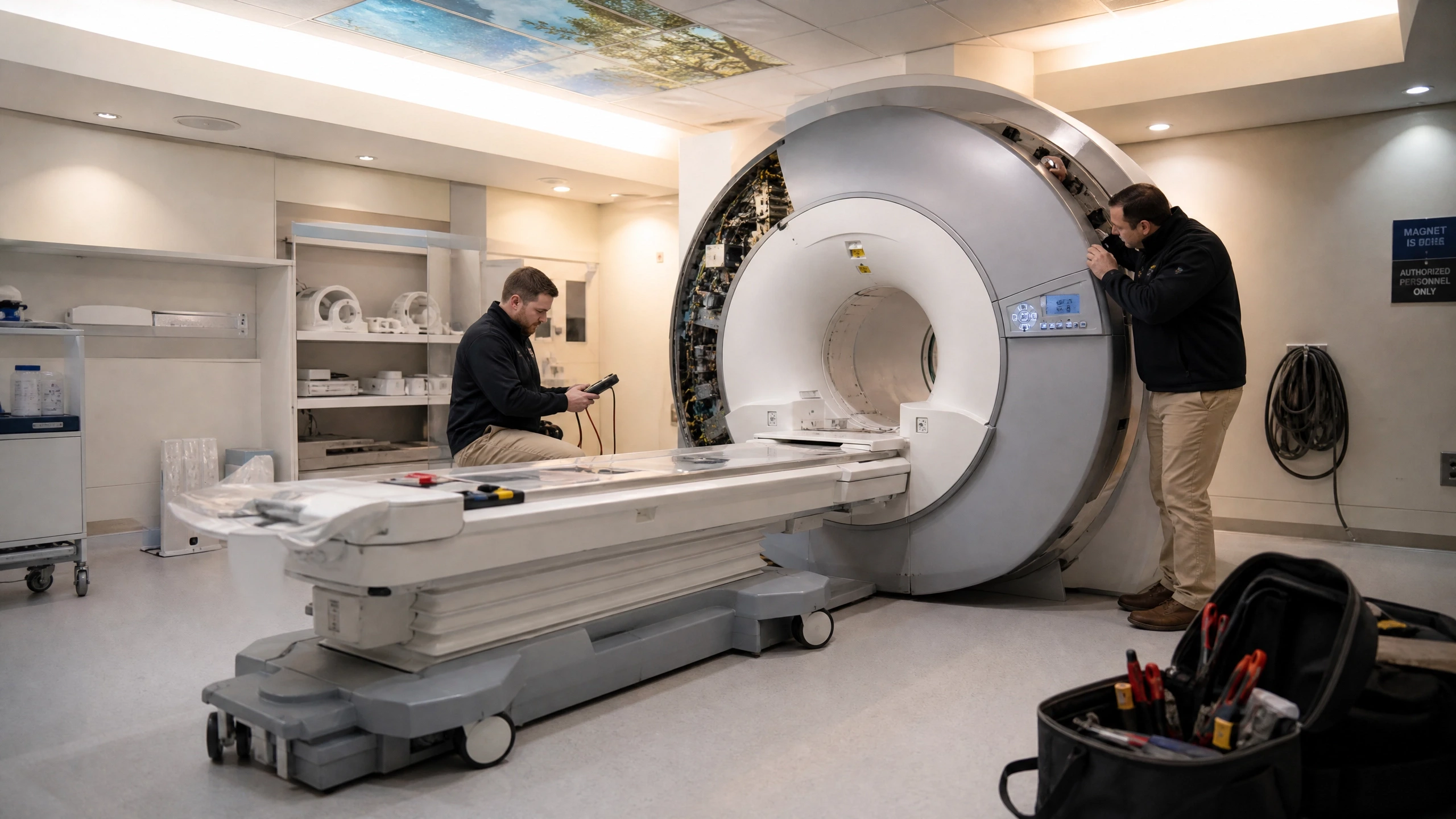
MRI machine disposal Australia is one of the most complex medical equipment decommissioning processes in the healthcare sector. Magnetic resonance imaging systems contain superconducting magnets with powerful residual magnetic fields, cryogenic coolant systems using liquid helium and liquid nitrogen, large-format electronic components, radiofrequency shielding infrastructure, and in older units, materials that require specialist handling. EwasteCollect coordinates certified MRI machine disposal Australia for hospitals, private radiology practices, and imaging centres, working alongside specialist MRI decommissioning engineers to manage every stage of the process compliantly and safely.
An MRI scanner cannot be simply switched off and removed. The magnetic field must be safely ramped down and the cryogenic system quenched under controlled conditions before any physical dismantling can begin. This process — known as a “quench” or controlled magnet ramp-down — requires specialist MRI engineers and must be planned well in advance of any equipment removal. EwasteCollect coordinates with your existing MRI service provider or specialist decommissioning engineers and takes responsibility for the downstream collection and recycling of all MRI components once the system has been safely prepared for removal.
Important: MRI magnet ramp-down and quench procedures must be performed by qualified MRI engineers, not general contractors. EwasteCollect coordinates the certified recycling and removal of MRI components after the magnet has been safely decommissioned by qualified specialists. We do not perform magnet ramp-down procedures ourselves but can refer you to specialist MRI decommissioning engineers.
MRI System Components Covered by EwasteCollect
A complete MRI system comprises multiple major component groups, each requiring specific handling. EwasteCollect’s MRI machine disposal Australia service covers all of these component categories once the system has been safely decommissioned.
MRI Magnet Assembly
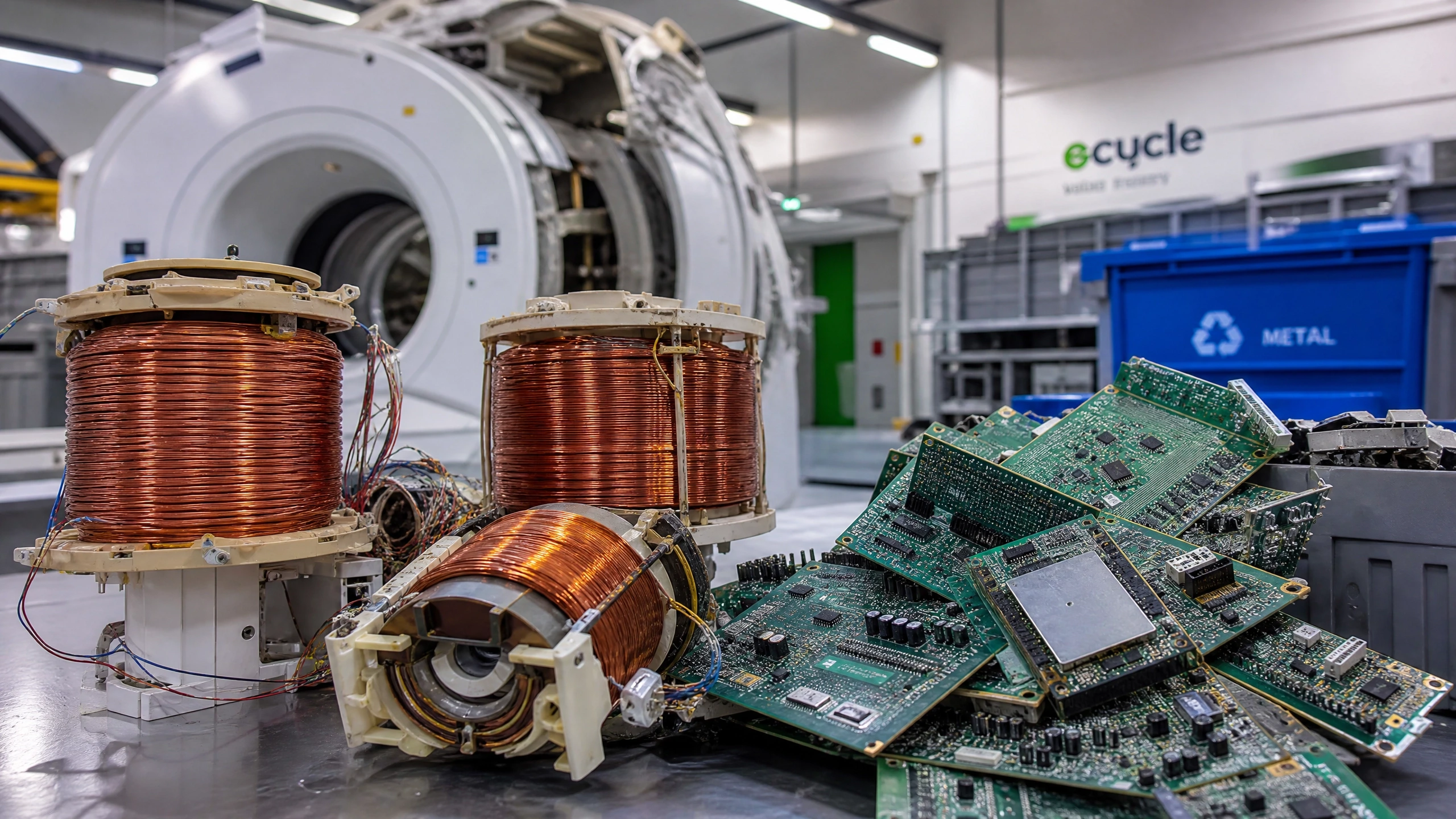
The magnet assembly is the core of the MRI system and by far its largest and heaviest component, typically weighing between 4,000 and 15,000 kilograms depending on field strength and configuration. After the magnetic field has been ramped down and the cryogenic system safely quenched, the magnet assembly contains superconducting coil windings, stainless steel and aluminium structural components, helium vessel assemblies, and extensive cabling. The physical magnet bore, gradient coil assembly, and magnet housing are all included in EwasteCollect’s MRI machine disposal Australia scope.
Gradient Coil System
The gradient coil system sits inside the main magnet bore and generates the rapidly switching magnetic field gradients used to spatially encode MRI signals. Gradient coils contain precision copper windings, fibre reinforced polymer formers, and high-current cabling and connectors. Once the main field has been ramped down, gradient coil systems are collected as part of the main magnet assembly or separately depending on the decommissioning approach used.
Radiofrequency Coils
MRI radiofrequency coils — including body coils, head coils, spine coils, extremity coils, and specialty coils — are electronic devices containing precision electronic components, connectors, and composite materials. End-of-life RF coils accumulate in imaging departments as systems are upgraded or coil technology changes. EwasteCollect accepts all RF coil types for MRI machine disposal Australia, including coils that are no longer compatible with the facility’s current system.
MRI Console and Computer Systems
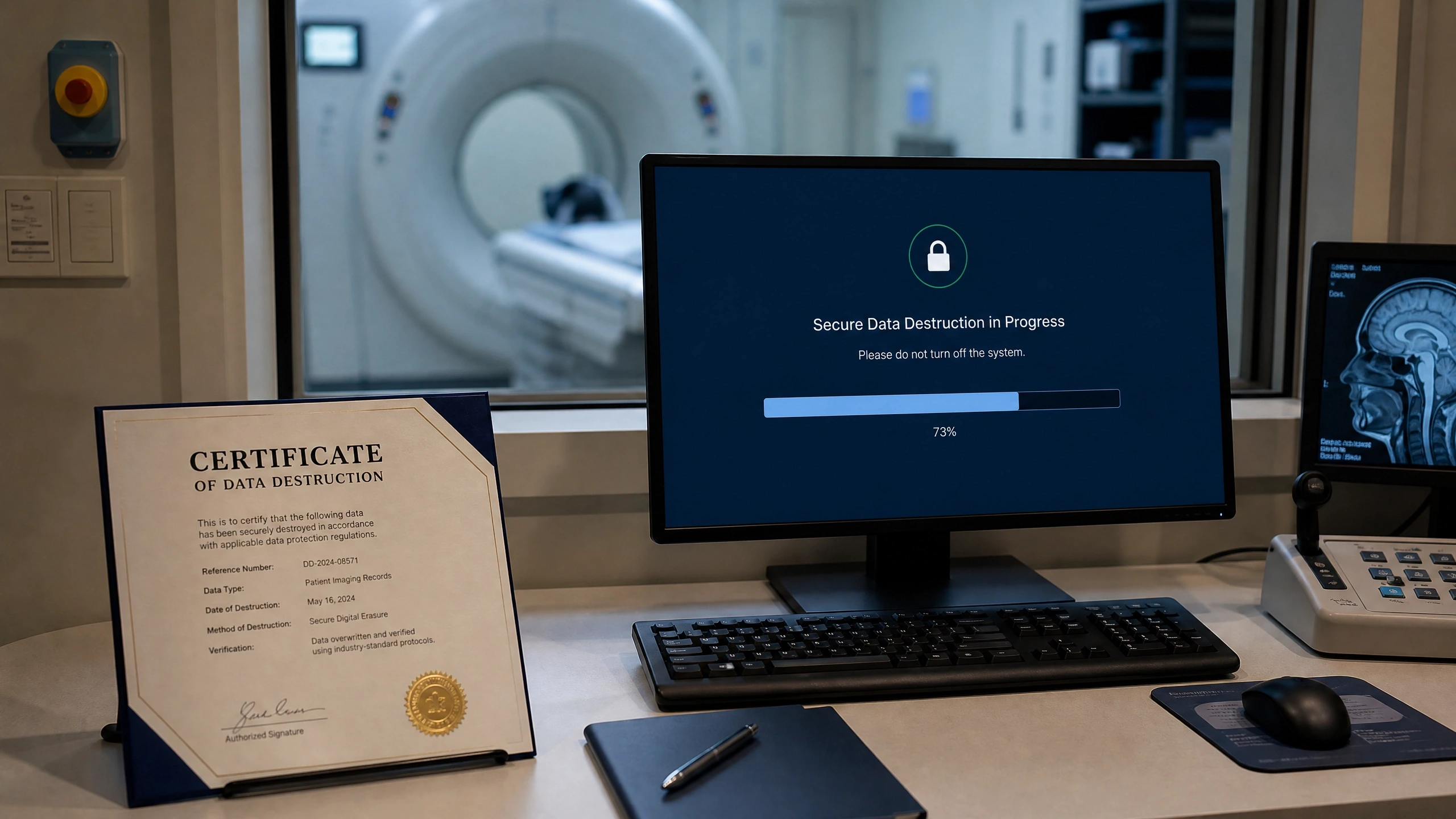
The MRI operator console, image reconstruction computers, and associated processing hardware contain electronic components, storage media holding patient scan data, printed circuit boards with recoverable precious metals, and display systems. Patient data stored on MRI console systems must be securely destroyed in accordance with the Privacy Act 1988 (Cth) before equipment leaves the facility. EwasteCollect provides certified data destruction for all MRI console and computer systems as part of every MRI machine disposal Australia project.
Radiofrequency Shielding and Faraday Cage Infrastructure
MRI suites require radiofrequency shielding — a Faraday cage — to prevent external RF interference from degrading image quality. When an MRI scanner is decommissioned, the RF shielding panels, waveguide filters, shielded doors, and associated infrastructure in the MRI room may also need to be removed, particularly in facility closures, room repurposing, or when a new MRI is being installed in a different location. EwasteCollect can include RF shielding infrastructure in the MRI machine disposal Australia collection scope.
Cryogenic Infrastructure
Superconducting MRI magnets are cooled by liquid helium and, in some configurations, liquid nitrogen systems. After a controlled quench, the cryogenic infrastructure including helium vessel components, quench pipe assemblies, and coolant system hardware requires specialist handling. EwasteCollect coordinates with qualified cryogenic handling specialists for the safe management of cryogenic system components as part of MRI machine disposal Australia projects.
MRI-Compatible Patient Monitoring and Ancillary Equipment
MRI suites typically include MRI-compatible patient monitoring equipment, anaesthesia delivery systems for sedation cases, patient positioning devices, contrast injection systems, and communication equipment. End-of-life MRI-compatible equipment accumulates in imaging departments as systems are upgraded. EwasteCollect accepts all MRI suite ancillary equipment for certified disposal as part of MRI machine disposal Australia collections.
Planning an MRI Decommission?
EwasteCollect coordinates the certified recycling and collection phase of MRI machine disposal Australia projects. Contact our team early in your planning process to ensure the downstream recycling phase is coordinated with your engineering and project timeline.
Start Your MRI Disposal EnquiryWhy MRI Machine Disposal Australia Requires Specialist Coordination
MRI machine disposal Australia is categorically different from general medical equipment disposal. Several factors make specialist coordination essential for safe, compliant, and efficient decommissioning.
Magnetic Field Safety
Even powered-down MRI magnets with superconducting coils retain a residual magnetic field unless the coil has been deliberately warmed above its superconducting transition temperature. A powerful residual field presents serious projectile risks — ferromagnetic objects brought near the magnet can be violently attracted and become dangerous projectiles. This is why all magnetic field work must be performed by specialist MRI engineers with appropriate training and safety protocols, well before any removal or recycling activity begins.
Cryogen Safety
Liquid helium at minus 269 degrees Celsius and liquid nitrogen at minus 196 degrees Celsius present serious cryogenic burn, asphyxiation, and pressure risks if mishandled during a quench procedure. The controlled quench of an MRI magnet results in rapid vaporisation of the cryogen and release through the quench pipe. This process must be performed only by qualified personnel with appropriate safety equipment and site preparation.
Patient Data Security
MRI console systems and image archive hardware store extensive patient imaging data accumulated over the operational life of the system. Facilities must ensure all patient data is securely destroyed before console or archive hardware leaves their control. EwasteCollect provides certified data destruction with written certification, issued within three business days of collection, confirming all patient data has been irreversibly removed.
Weight and Access Logistics
MRI magnets weigh between 4,000 and 15,000 kilograms and are typically located in purpose-built shielded rooms that may not have direct access for standard removal equipment. Removal requires structural engineer assessment, specialist lifting equipment, possible removal of walls or doorways, and careful floor loading calculations. EwasteCollect coordinates with specialist MRI removal contractors for the physical extraction phase of MRI machine disposal Australia projects.
Hazardous Materials in Older Systems
MRI systems manufactured before widespread adoption of RoHS-equivalent design standards may contain lead solder in electronic assemblies, cadmium in batteries, and other hazardous materials subject to specific handling requirements under Australian environmental legislation. EwasteCollect’s recycling processes are designed to identify and appropriately manage hazardous components across all MRI equipment types.
The EwasteCollect MRI Machine Disposal Australia Process
EwasteCollect’s MRI machine disposal Australia process is structured to integrate with the specialist engineering phases of MRI decommissioning. We recommend engaging our team at the earliest stage of your decommissioning planning to ensure the recycling phase is coordinated with your engineering and project timeline.
- Early Engagement and Scope Review — Contact EwasteCollect as early as possible in your MRI decommissioning planning process. Our team will review the MRI system type, field strength, configuration, site access, and all associated equipment to be collected, and provide a scope and proposal for the recycling and collection phase.
- Engineering Coordination — EwasteCollect coordinates with your existing MRI service provider or specialist MRI decommissioning engineers for the magnet ramp-down and quench phase. If you do not have an existing engineering relationship, we can refer you to qualified MRI decommissioning specialists.
- Data Destruction Planning — For MRI console systems and image archive hardware, we confirm the data destruction method to be applied — either on-site prior to collection or at our processing facility — and arrange the relevant documentation and certification.
- Removal Logistics Planning — EwasteCollect assesses the physical removal requirements for your MRI system, including access constraints, floor loading, specialist lifting equipment, and any structural modifications required for extraction. We coordinate with specialist MRI removal contractors as required.
- Collection and Chain of Custody — Following successful magnet decommissioning and site preparation by engineering teams, EwasteCollect attends to collect and transport all MRI components under documented chain of custody. A manifest is issued at collection confirming every item removed.
- Certified Recycling and Documentation — MRI components are processed at compliant recycling facilities, with a certificate of recycling and data destruction certificate issued within three business days of collection.
Early engagement is the most important factor in a smooth MRI machine disposal Australia project. MRI decommissioning typically requires four to twelve weeks of planning across engineering, logistics, and facility management teams. Contacting EwasteCollect at the start of this process ensures the recycling phase is integrated into your project plan from day one.
Documentation Issued for MRI Machine Disposal
Documentation for MRI machine disposal Australia projects is comprehensive, reflecting the complexity of the equipment and the regulatory obligations involved.
Collection Manifest
Itemised list of every component collected from your facility, including magnet assembly, console systems, RF coils, and all ancillary equipment, with serial numbers where available. Issued at collection and signed by both parties.
Certificate of Recycling
Confirms all collected MRI components have been processed through compliant Australian recycling streams. Suitable for asset register updates, environmental reporting, and accreditation evidence.
Data Destruction Certificate
Issued for MRI console systems and all equipment with internal data storage. Confirms patient imaging data and device records have been irreversibly destroyed in accordance with applicable privacy obligations.
Chain of Custody Record
Documents the movement of all MRI components from your facility to our recycling site. Provides a traceable record for internal compliance reporting, health network governance, and accreditation purposes.
MRI Machine Disposal Australia Coverage
EwasteCollect provides MRI machine disposal Australia services to facilities in every state and territory. Our national reach means you can arrange consistent, compliant disposal regardless of where your facility is located.
We coordinate MRI machine disposal Australia projects across metropolitan and regional locations, including major public hospital networks, private radiology practices, imaging centres, and research institutions. For facilities in regional locations, we coordinate with local logistics and engineering partners to manage the physical extraction and transport phase efficiently.
MRI Field Strengths and System Types Covered
EwasteCollect’s MRI machine disposal Australia service covers all clinical MRI system types regardless of field strength, magnet type, or manufacturer.
| System Type | Common Field Strengths | Typical Weight Range |
|---|---|---|
| Superconducting (closed bore) | 1.5T, 3T | 4,000 — 15,000 kg |
| Open MRJ (permanent magnet) | 0.2T — 1.0T | 8,000 — 30,000 kg |
| Wide bore superconducting | 1.5T, 3T | 5,000 — 16,000 kg |
| Extremity MRI | 0.2T — 1.0T | 400 — 2,000 kg |
| Research MRI (7T and above) | 7T, 9.4T and above | Varies significantly |
All major MRI manufacturers are covered including Siemens Healthineers, GE Healthcare, Philips Healthcare, Hitachi, Canon Medical, and all other manufacturers. EwasteCollect does not manufacture MRI systems and is not affiliated with any MRI vendor — we are an independent recycling and collection service.
When to Plan MRI Machine Disposal Australia
MRI machine disposal Australia planning should begin at least three to six months before the intended decommissioning date in most cases, and longer for complex installations. The following situations commonly trigger MRI disposal projects.
Technology upgrades are the most frequent driver, as Australian radiology facilities transition from 1.5T to 3T systems or adopt newer platform generations. Retiring an established MRI fleet generates significant logistical and compliance work and should be planned well in advance to allow coordinated scheduling of engineering, logistics, and recycling phases.
Facility closures or relocations require complete MRI machine disposal Australia for all systems not being transferred to a receiving site. The timeline for facility closure is typically fixed, making early engagement with recycling and decommissioning partners critical to meeting the closure deadline.
Infrastructure failures in older MRI systems — particularly helium fill failures, gradient amplifier failures, or magnet quench events — can result in unplanned decommissioning. EwasteCollect can respond to unplanned MRI disposal requirements and coordinate expedited collection where possible.
Frequently Asked Questions About MRI Machine Disposal Australia
Does EwasteCollect perform MRI magnet ramp-downs and quench procedures?
No. Magnet ramp-down and quench procedures must be performed by qualified MRI engineers with specific training in cryogenic and magnetic field safety. EwasteCollect coordinates the certified recycling and collection of MRI components after the magnet has been safely decommissioned by qualified specialists. We can refer you to specialist MRI decommissioning engineers if you do not have an existing relationship with one.
How early should we contact EwasteCollect for an MRI disposal project?
We recommend contacting EwasteCollect as early as possible — ideally three to six months before the intended decommissioning date for standard installations, and longer for complex systems or regional sites. Early engagement allows us to integrate the recycling phase into your project timeline and coordinate with your engineering and facilities teams from the outset.
What happens to patient imaging data stored on the MRI console?
Patient imaging data stored on MRI console systems, image archive hardware, and associated storage must be securely destroyed before any equipment leaves your facility. EwasteCollect provides certified data destruction for all MRI console and archive systems as part of every MRI machine disposal Australia project. A written data destruction certificate is issued confirming all patient data has been irreversibly removed.
Does EwasteCollect buy MRI machines?
No. EwasteCollect is a recycling and collection service, not a buyer or reseller of used medical imaging equipment. We collect end-of-life MRI machines for responsible recycling and do not participate in the secondary market for used MRI systems. If you are looking to sell a functional MRI system, that is a separate process from MRI machine disposal Australia.
Can EwasteCollect handle MRI disposal for regional and rural facilities?
Yes. EwasteCollect provides MRI machine disposal Australia services for facilities across metropolitan, regional, and rural locations in every state and territory. For regional facilities, we coordinate with local logistics and engineering partners to manage the physical extraction and transport phase. Contact our team to discuss the options for your facility’s location.
What happens to the MRI Faraday cage shielding when the scanner is removed?
RF shielding infrastructure can be included in the MRI machine disposal Australia collection scope if required. Whether the shielding is removed typically depends on whether the room will be repurposed, whether a new MRI is being installed in the same location, or whether the facility is being closed. EwasteCollect can assess the RF shielding as part of the overall collection scope and advise on the most appropriate approach for your situation.
Is MRI equipment covered by Australian e-waste regulations?
Yes. MRI console systems, computer hardware, monitors, RF coils, patient monitoring equipment, and associated electronic components fall under the Product Stewardship Act 2011 and associated co-regulatory arrangements that restrict these items from entering general landfill waste streams. The magnet assembly itself is not classified as e-waste but requires specialist handling and recycling as a large industrial item. EwasteCollect’s MRI machine disposal Australia service ensures full compliance with applicable regulations across all components.
Ready to Arrange MRI Machine Disposal?
EwasteCollect provides certified MRI machine disposal Australia for hospitals, radiology practices, imaging centres, and research institutions. Contact our team early in your decommissioning planning to ensure a smooth, compliant project.
Start Your MRI Disposal Enquiry