Medical Equipment Disposal Compliance: What Clinics and Hospitals Must Do
Medical equipment disposal compliance starts before old equipment leaves a clinic, hospital, laboratory or imaging centre. Australian healthcare facilities need a clear process for classifying equipment, separating clinical waste, checking data-bearing devices, preparing assets for pickup, documenting decisions and using appropriate recycling or disposal pathways.
Medical equipment disposal compliance is not just about removing unwanted devices from a storage room. For clinics, hospitals, pathology laboratories, imaging centres, dental practices and aged care providers, compliance means making sure retired medical and laboratory equipment is identified, cleaned where required, separated from clinical or hazardous waste, assessed for data security, documented for internal records and sent through a responsible recycling or disposal pathway.
This is especially important because healthcare equipment is different from ordinary office electronics. A retired ultrasound system may contain patient images. A laboratory analyser may have sample pathways or reagent residues. A patient monitor may contain batteries and device logs. A freezer may contain refrigeration components. A computer from a clinic may hold sensitive patient or business data. Because of these risks, medical equipment disposal should be planned rather than treated as a simple rubbish removal job.
This cluster post supports the main pillar page for medical equipment disposal regulations in Australia. The goal is to give healthcare teams a practical overview of what must be checked before equipment is recycled, collected, removed or disposed of.

What Does Medical Equipment Disposal Compliance Mean?
Medical equipment disposal compliance means following a structured process so that retired healthcare equipment is handled safely, legally, securely and responsibly. It is not one single rule. It is a combination of waste classification, infection-control preparation, data security, hazardous materials awareness, workplace safety, transport planning, recycling documentation and internal governance.
For a small clinic, compliance may mean keeping a list of retired equipment, removing consumables, confirming that devices are cleaned, checking whether computers or diagnostic devices contain data, and booking a responsible pickup. For a hospital, compliance may involve biomedical engineering, infection control, IT security, facilities, sustainability teams, procurement, asset management and approved contractors.
Compliance Is a Process, Not Just a Certificate
Some facilities think compliance only means receiving a certificate after disposal. Documentation is important, but it is only one part of the process. The compliance journey begins when equipment is identified as surplus, faulty, obsolete, replaced or end-of-life. From that point, the organisation should decide how it will classify, prepare, track and remove the equipment.
Core Compliance Question
The key question is: can this item safely enter a medical equipment recycling or disposal pathway, or does it need a separate clinical, hazardous, pharmaceutical, chemical, radiation or data security process first?
Practical Compliance Goal
The practical goal is to avoid mixing the wrong waste streams, protect patient data, reduce risk to staff, prevent unsafe handling and maintain a record of what happened to retired assets.
Important Note
This guide is general information for Australian healthcare organisations. It should not replace legal advice, regulator guidance or your internal infection-control, privacy, WHS, clinical governance or procurement procedures.
Step 1: Identify and Classify the Equipment
The first step in medical equipment disposal compliance is knowing exactly what you are dealing with. A facility should not book a pickup until it understands the equipment type, condition, location, size, data risk and possible contamination status.
Classification helps separate recyclable medical electronics from clinical waste, general rubbish, hazardous chemicals, pharmaceutical waste, sharps, radioactive materials and non-electronic scrap. Without classification, equipment can be sent to the wrong pathway, creating safety and compliance problems.
Basic Equipment Classification Checklist
- Device name and category: patient monitor, centrifuge, analyser, autoclave, ultrasound, computer, freezer or other item.
- Brand, model and serial number where available.
- Condition: working, faulty, damaged, obsolete, incomplete or unknown.
- Location: clinic room, lab, storage area, imaging suite, basement, upstairs or loading bay.
- Data risk: does it contain storage media, patient records, images, logs or network settings?
- Contamination risk: has it contacted patients, samples, reagents, fluids or biological material?
- Hazard risk: batteries, refrigerants, chemicals, radiation sources, fluids or heavy components.
- Removal needs: manual handling, palletising, crating, deinstallation or specialist access.
Step 2: Separate Medical Equipment from Clinical Waste
A major part of healthcare waste compliance is keeping electronic equipment separate from clinical waste. Medical devices and laboratory equipment may be recyclable, but sharps, infectious materials, contaminated consumables, pharmaceutical waste and chemical residues are not part of a standard equipment recycling stream.
NSW Health describes clinical waste as waste from medical, nursing, dental, pharmaceutical, skin penetration or related clinical activity that has the potential to cause injury, infection or offence. This is a useful practical distinction for facilities: the device itself may be equipment waste, while contaminated materials attached to it or left inside it may belong to a different stream.
| Item Type | Examples | Compliance Risk | Practical Action |
|---|---|---|---|
| Medical equipment | Monitors, pumps, ECG machines, ultrasound systems, analysers | Data, batteries, handling, contamination status | Assess, clean, document and recycle where suitable |
| Clinical waste | Blood-contaminated items, dressings, swabs, contaminated disposables | Infection, injury or offence risk | Use approved clinical waste pathway |
| Sharps | Needles, scalpels, lancets, blades | Puncture and infection risk | Use approved sharps containers |
| Chemical or pharmaceutical waste | Reagents, solvents, expired medicines, medicine residue | Hazardous substance or medicine risk | Use chemical or pharmaceutical waste pathway |
Step 3: Remove Consumables, Samples and Loose Waste
Before medical or laboratory equipment is collected, staff should remove loose consumables and unrelated waste. This is a basic but often overlooked part of medical equipment disposal compliance. Items such as sample tubes, pipette tips, reagent packs, tubing, sharps, swabs, disposable sensors and biological materials should not be left inside equipment unless a specific handling arrangement has been made.
For laboratories, this step is critical. Analysers, centrifuges, sample processors and PCR systems may have accessories, trays, sample holders or internal areas that need review. Removing consumables reduces risk to the collection team and helps the recycler assess the equipment as an asset rather than a mixed waste item.
Examples of Items to Remove Before Pickup
- Used sample tubes, swabs, pipette tips and plates.
- Reagent packs, chemical containers or liquid residues.
- Needles, blades, scalpels, lancets or other sharps.
- Disposable sensors, tubing, masks, gloves and gowns.
- Patient-contact consumables and single-use accessories.
- Loose rubbish, packaging waste or unrelated storage items.

Step 4: Clean and Decontaminate Where Required
Healthcare facilities should follow their internal infection-control and cleaning procedures before releasing equipment for collection. The recycling provider should not be expected to guess whether equipment is clean, contaminated or safe to handle. Good preparation makes the process safer and more professional.
Not every item needs the same level of preparation. A clinic printer may need data review but not clinical decontamination. A centrifuge used in a pathology laboratory may need cleaning and confirmation that samples have been removed. An autoclave should be empty, cooled, cleaned and disconnected if required. A patient monitor may need surface cleaning and accessory removal.
Decontamination Preparation Checklist
- Confirm whether the equipment was used near patients, samples, fluids, reagents or biological materials.
- Remove loose clinical waste, consumables, disposable accessories and sample materials.
- Clean accessible surfaces according to internal procedures and manufacturer guidance where relevant.
- Drain fluids or remove reagents where safe and appropriate.
- Flag equipment that cannot be safely cleaned or has unknown contamination history.
- Label or document preparation status for collection staff.
- Keep a contact person available to answer pickup questions on the day.
Step 5: Check Data-Bearing Devices
Data is one of the biggest hidden risks in healthcare equipment disposal. Many devices can store more information than staff expect. Imaging systems may store patient images. ECG machines may store reports. Laboratory analysers may store test logs. Computers and servers may contain patient records. Printers and scanners may hold cached documents or network settings.
For strong medical equipment disposal compliance, data-bearing devices should be identified before collection. The facility should decide whether data will be backed up, wiped, removed, destroyed or documented. The ACSC provides guidance on media sanitisation processes designed to reduce the risk of recoverable data remaining after sanitisation.
Equipment That May Contain Data
- Ultrasound systems and imaging workstations.
- ECG machines and diagnostic workstations.
- Patient monitors and central monitoring systems.
- Laboratory analysers and pathology computers.
- Medical tablets, laptops, servers and desktop computers.
- Printers, scanners and multifunction devices.
- Hard drives, SSDs, USB media and memory cards.
- Network devices, backup units and connected medical systems.
Data Compliance Actions
- Identify which devices may contain storage media.
- Confirm whether patient, research, business or network data is present.
- Follow internal privacy and cybersecurity procedures.
- Use secure wiping, storage media removal or physical destruction where required.
- Request documentation if the facility needs proof of data destruction.
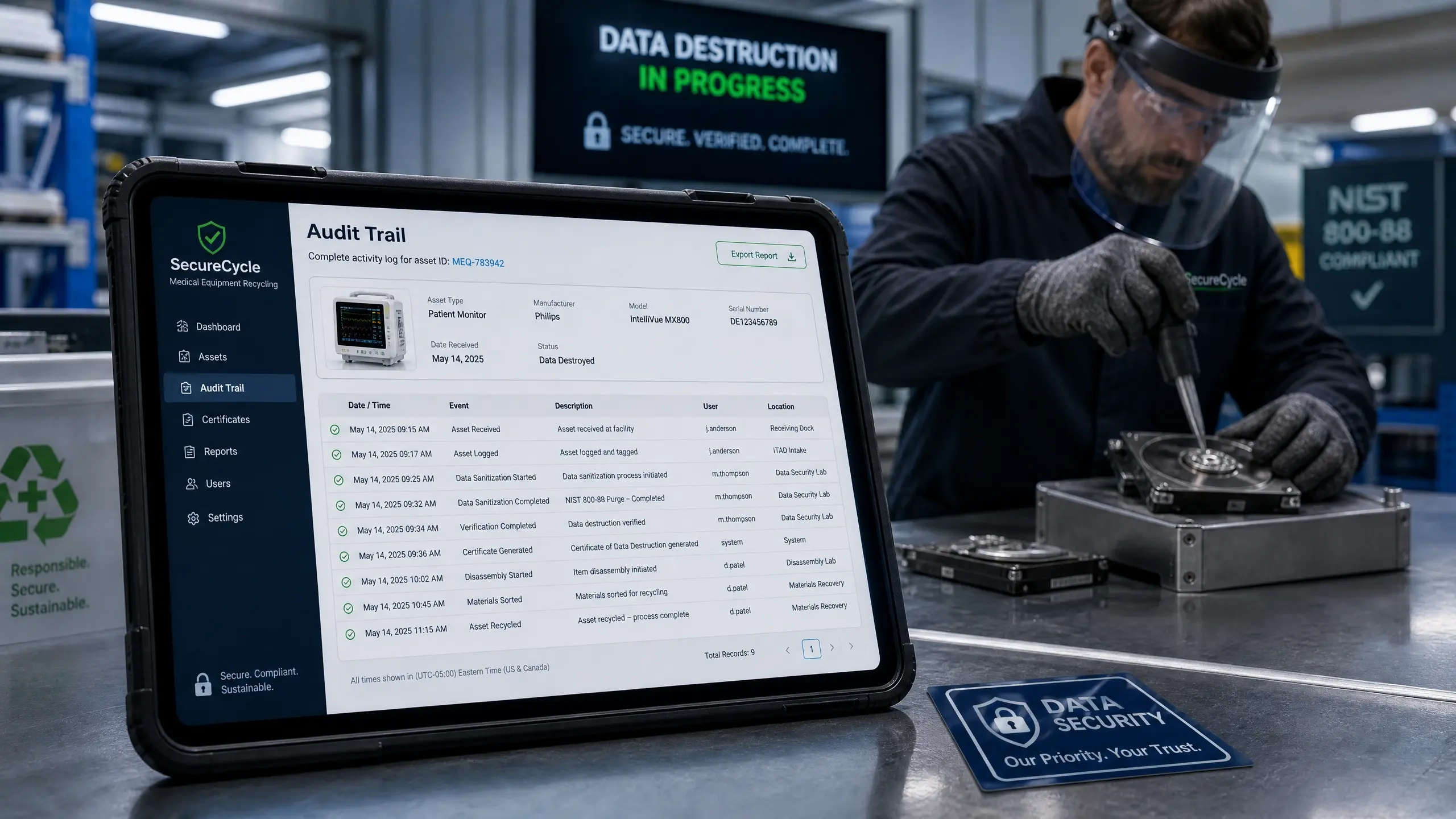
- Maintain a chain-of-custody record for sensitive assets.
Step 6: Identify Batteries, Refrigerants, Chemicals and Hazardous Components
Some equipment contains components that need special attention before recycling. Portable medical devices may contain lithium batteries. Laboratory freezers and refrigerators may contain refrigerants. Older imaging or display equipment may contain heavy metals. Laboratory analysers may include fluid lines or chemical residues. These details matter because they can affect pickup, transport, dismantling and downstream processing.
A compliance-focused pickup request should flag these issues early. This does not automatically mean the equipment cannot be recycled. It means the recycler or removal team needs to plan properly.
| Risk Area | Common Equipment | What Clinics/Hospitals Should Do |
|---|---|---|
| Batteries | Pumps, monitors, portable diagnostic devices, UPS units | Identify damaged, swollen, leaking or removable batteries before pickup |
| Refrigerants | Lab fridges, ULT freezers, vaccine fridges | Flag refrigeration equipment and confirm access requirements |
| Chemical residues | Analysers, sample processors, lab systems | Remove reagents and follow hazardous waste procedures where needed |
| Radiation concerns | Selected imaging, oncology or specialist devices | Confirm whether licensed radiation assessment or decommissioning is required |
| Heavy equipment | Imaging systems, beds, tables, cabinets, large analysers | Plan manual handling, lifting, palletising, crating or deinstallation |
Step 7: Keep Documentation and Internal Records
Documentation is a major part of medical equipment disposal compliance. Even when a facility is not required to produce a formal regulatory report for every retired device, internal records help show that equipment was managed responsibly.
Documentation also protects the organisation. If a question comes up later about data, asset removal, recycling, contamination or environmental reporting, a simple record can help show what was removed, when it was collected, who handled it and what pathway was selected.
Useful Records to Keep
- Asset list with equipment type, brand, model, serial number and quantity.
- Photos of devices before collection.
- Pickup booking confirmation and service provider details.
- Internal cleaning or decontamination confirmation where applicable.
- Data wiping, media destruction or chain-of-custody records where applicable.
- Certificate of recycling, disposal confirmation or processing summary where provided.
- Hazard notes for batteries, refrigerants, chemicals or radiation concerns.
- Access and logistics notes for large removals or deinstallation work.

Step 8: Choose the Right Recycler or Removal Partner
Choosing the right recycling or removal partner is part of the compliance process. A general rubbish removal provider may not understand medical equipment, data-bearing devices, laboratory assets, infection-control preparation or documentation expectations. Clinics and hospitals should look for a provider that asks the right questions before collection.
A responsible provider should want to know what equipment you have, whether it contains data, whether it has been cleaned, whether there are batteries or fluids, whether it needs deinstallation, and whether you need reporting. If a provider does not ask about these issues, the facility should be cautious.
Questions to Ask Before Booking
- Do you collect medical, laboratory, pathology and healthcare electronic equipment?
- Can you handle metro and regional pickup planning?
- Do you assess data-bearing devices before recycling?
- Can you provide recycling or disposal documentation if required?
- Can you support packing, palletising, crating or deinstallation?
- How should we prepare equipment before pickup?
- What items are excluded from your e-waste collection stream?
- How do you handle batteries, heavy equipment or unusual devices?
Compliance Responsibilities for Clinics
Small clinics may not have a large facilities department, but they still need a sensible process. For a clinic, medical equipment disposal compliance usually means creating a basic equipment list, separating clinical waste, protecting patient data and making sure old devices are collected by an appropriate provider.
Clinic Compliance Checklist
- Identify retired or unwanted medical devices.
- Remove patient-contact consumables and loose clinical waste.
- Check computers, printers and diagnostic devices for data.
- Clean equipment according to internal procedures.
- Take photos and note brand/model details.
- Confirm access, parking and pickup contact.
- Request documentation if needed for internal records.
Compliance Responsibilities for Hospitals
Hospitals usually need a more formal process because of the volume, complexity and risk profile of equipment. Departments may include biomedical engineering, infection control, IT, facilities, procurement, sustainability and clinical teams. A hospital equipment disposal project should be planned and documented.
Hospital Compliance Checklist
- Assign a project owner or department contact.
- Create a multi-department asset list.
- Identify installed, heavy or connected equipment requiring deinstallation.
- Confirm infection-control preparation requirements.
- Review IT and data-bearing equipment with the cybersecurity or IT team.
- Separate clinical waste, chemicals, batteries and excluded materials.
- Plan access, loading docks, security sign-in, lift use and removal windows.
- Request certificates, reports or chain-of-custody records where required.
Compliance Responsibilities for Laboratories and Pathology Providers
Laboratories need special care because equipment may have handled samples, reagents, fluids, chemicals or biological materials. Compliance requires clear separation between recyclable equipment and laboratory waste streams.
Laboratory teams should remove consumables, empty chambers, drain safe fluids where appropriate, follow chemical waste procedures and clearly identify any equipment with unknown or high-risk contamination history.
Laboratory Compliance Checklist
- Remove samples, tubes, plates, pipette tips and biological consumables.
- Remove reagent packs and chemical containers.
- Clean accessible areas according to internal laboratory procedures.
- Identify fluids, refrigeration, batteries or unusual hazards.
- Check analysers and workstations for data or software records.
- Take photos of model plates, connections and accessories.
- Confirm whether equipment is bench-mounted, plumbed or connected.
Practical Compliance Workflow
A simple workflow can help healthcare organisations manage equipment disposal consistently. The same process can be used for one clinic, a hospital department or a multi-site healthcare group.
- Identify retired equipment and create an asset list.
- Classify each item as medical equipment, laboratory equipment, healthcare IT, clinical waste, chemical waste or other category.
- Remove consumables, samples, sharps and unrelated waste.
- Clean and decontaminate equipment according to site procedures.
- Check data-bearing devices and plan sanitisation or destruction.
- Identify batteries, refrigerants, fluids, chemicals or radiation concerns.
- Take photos and document model/serial details.
- Confirm access, lifting, packing, palletising or deinstallation needs.
- Book collection with an appropriate provider.
- Keep pickup records, recycling documentation and data destruction records where applicable.
External Compliance References
For national context on electronic and electrical product stewardship, see Australian Government e-stewardship information and DCCEEW product stewardship information.
For clinical waste separation and handling context, see NSW Health clinical waste management and NSW EPA clinical and related waste. For data-bearing devices, see the Australian Cyber Security Centre media sanitisation guidance.
Common Compliance Mistakes to Avoid
1. Treating Medical Equipment as General Rubbish
Old medical equipment can contain recoverable materials, batteries, circuit boards and sensitive data. Sending it to general rubbish without assessment can create environmental, security and governance risks.
2. Mixing Clinical Waste with Recyclable Equipment
Clinical waste, sharps, contaminated consumables and biological materials should not be mixed with medical equipment recycling collections. This is one of the most important separation steps.
3. Forgetting Data Security
A device that looks like ordinary equipment may contain patient data or internal storage. Medical equipment disposal compliance should always include a data check.
4. Booking Collection Without Photos or Device Details
Photos, model numbers and access details help the pickup team plan transport, lifting, palletising or deinstallation. Missing details can delay collection.
5. Assuming Every Recycler Handles Healthcare Equipment
Healthcare equipment has unique risks. Facilities should choose a provider familiar with medical, laboratory and data-bearing devices.
Final Compliance Checklist for Clinics and Hospitals
Use this final checklist before arranging medical equipment removal or recycling:
- Has each item been identified and listed?
- Have photos been taken?
- Has clinical waste been removed?
- Have sharps, samples, consumables and reagents been separated?
- Has equipment been cleaned or decontaminated where required?
- Have data-bearing devices been checked?
- Have batteries, fluids, refrigerants or hazardous parts been flagged?
- Has access been confirmed?
- Is deinstallation, palletising or crating required?
- Do you need certificates, reports or chain-of-custody records?
What Cannot Go Through Standard Equipment Recycling
Equipment recycling is for devices and hardware. Some items must be removed first and handled through the right waste stream:
- Sharps and clinical waste – needles, blades, blood-contaminated items and biohazard bags.
- Pharmaceuticals and chemicals – medicines, reagents, cleaning agents and fixer or developer solutions.
- Radioactive sources – handled under state radiation-safety rules, never with general equipment.
- Pressurised gas cylinders – usually returned to the supplier.
- Refrigerants – recovered from fridges and freezers by a licensed refrigerant technician.
Classification and licensing requirements differ between states and territories, so check with your state environment protection or health authority when you are unsure.
Home Users: Disposing of Small Medical Devices
Households often have CPAP machines, nebulisers, blood pressure monitors, glucose meters or mobility aids. For small quantities:
- Remove batteries and recycle them separately at a battery drop-off point.
- Delete personal data or remove memory cards from devices that record therapy or readings.
- Take small electronic devices to an e-waste drop-off; your local council can tell you where.
- Dispose of sharps through your council or pharmacy sharps program, not with e-waste.
- Ask the supplier or manufacturer whether they run a take-back program.
Clinics, hospitals, laboratories and larger quantities can request a pickup quote.
Conclusion: Compliance Starts Before Pickup
Medical equipment disposal compliance starts long before a device is collected. It begins with classification, continues through cleaning, data review, waste separation, hazard identification, documentation and provider selection, and ends with recycling, disposal reporting or data destruction records where required.
Clinics, hospitals and laboratories do not need to make the process complicated. They need a repeatable workflow. Identify the equipment, remove excluded waste, check data, prepare the device, document the process and choose a suitable recycling or removal partner. This approach reduces risk, supports internal governance and helps keep valuable medical and laboratory equipment materials out of landfill.
For a deeper overview of the wider regulatory topic, visit our pillar guide to medical equipment disposal regulations in Australia.
Need Help With Medical Equipment Disposal Compliance?
E-Waste Collect helps clinics, hospitals, laboratories and healthcare facilities prepare retired equipment for responsible pickup, recycling, deinstallation and documentation.
Book a Free PickupFrequently Asked Questions About Medical Equipment Disposal Compliance
1) What is medical equipment disposal compliance?
Medical equipment disposal compliance means following a structured process for classifying, preparing, documenting and responsibly recycling or disposing of retired healthcare and laboratory equipment. It includes clinical waste separation, data security, safe handling and record keeping.
2) What must clinics do before disposing of old medical equipment?
Clinics should identify the equipment, remove clinical waste and consumables, clean devices according to internal procedures, check for patient data, take photos, confirm access details and keep pickup or recycling records.
3) What must hospitals do before equipment recycling?
Hospitals should coordinate between biomedical engineering, infection control, IT, facilities and asset management teams. They should create an asset list, identify data-bearing devices, separate excluded waste streams and plan logistics for large or installed equipment.
4) Is clinical waste the same as medical equipment waste?
No. Clinical waste usually includes infectious, sharps, biological, pharmaceutical or contaminated materials. Medical equipment waste refers to durable devices or assets such as monitors, pumps, analysers, autoclaves and computers.
5) Do medical devices need data wiping before disposal?
Some do. Imaging systems, diagnostic workstations, patient monitors, laboratory analysers, computers, servers, printers and tablets may contain data. These should be reviewed before recycling or disposal.
6) What documents should be kept?
Useful records include asset lists, photos, pickup confirmations, cleaning or decontamination notes, recycling certificates, disposal confirmations, data destruction records and chain-of-custody documents where applicable.
7) Can contaminated equipment be recycled?
Potentially contaminated equipment should be assessed and prepared first. Facilities should follow internal infection-control and decontamination procedures before recycling is considered.
8) What should laboratories check before disposal?
Laboratories should remove samples, tubes, plates, reagents, fluids and consumables. They should also identify chemical residues, batteries, refrigeration components, sample pathways and any data-bearing devices.
9) Do clinics need certificates for every item?
Not every item will require the same documentation, but clinics should keep enough records to show what was removed, when it was collected and what pathway was used. Data-bearing devices may require stronger documentation.
10) How do we start a compliant pickup request?
Start with an equipment list, clear photos, location details, condition notes, data concerns, contamination status and access information. This allows the pickup and recycling process to be planned properly.
Tip: For multi-site healthcare groups, use one spreadsheet with site name, suburb, contact person, device list, photos and access notes.