Lab & Hospital Equipment Recycling Australia
Lab equipment recycling Australia is no longer a side issue for facilities teams or procurement departments. For pathology labs, research centers, private clinics, hospitals, universities, diagnostic sites, and healthcare networks that frequently replace outdated equipment, grow departments, close wards, modernize assets, or oversee end-of-life systems, it has become a major operational issue. As equipment ages, breaks down, becomes uneconomical to repair or falls behind newer standards, organisations face the same question: how do you remove it responsibly, safely and efficiently without turning the process into an expensive headache?
The answer is not just to throw everything on a truck and hope for the best.Identification, collection planning, deinstallation when necessary, part segregation, environmental treatment, logistics, documentation, and site safety are all included in the structured service of proper lab and hospital equipment recycling. Some items may have reuse value. Some must be dismantled carefully. Some contain regulated or hazardous components. Some are easy to collect but difficult to process properly. And some look harmless until you realise they are still tied into active clinical or laboratory workflows.
That is why a specialist recycling and disposal strategy matters so much. A good process protects the site, reduces avoidable landfill, supports sustainability goals, makes replacements easier and helps organisations stay in control during equipment transitions. A poor process creates clutter, confusion, damage, delays and that familiar institutional mystery where nobody can explain who removed what, where it went or why there are still six abandoned accessories sitting in a hallway cupboard.
Why this pillar page matters
This pillar page is designed to help hospitals, pathology labs, universities, clinics, surgery centres, facility managers, biomedical teams, practice owners and sustainability leads understand how end of life laboratory and hospital assets should actually be handled. This website presents recycling and equipment retirement as a component of a broader transition strategy rather than treating disposal as an afterthought. That process includes planning, compliance awareness, logistics, environmental outcomes and site readiness for whatever comes next.
For EwasteCollect, this topic is also highly strategic. People searching terms related to lab equipment recycling Australia or hospital equipment recycling usually have a real need, a real site and real equipment that must move. That makes this topic ideal for a strong authority page that can support service enquiries, internal linking, local SEO pages and cluster content for specific device categories.
In the sections below, we cover major categories that matter in real world projects: laboratory equipment such as centrifuges, PCR systems and analyzers; hospital assets such as beds, monitors, pumps and operating room equipment; sterilizers and autoclaves; refrigeration and freezer systems; large hospital clear outs; and the important distinction between ordinary consumables and parts that need special handling. Together, these topics form the foundation of a proper equipment recycling framework for the healthcare and scientific sectors.
Lab equipment recycling Australia
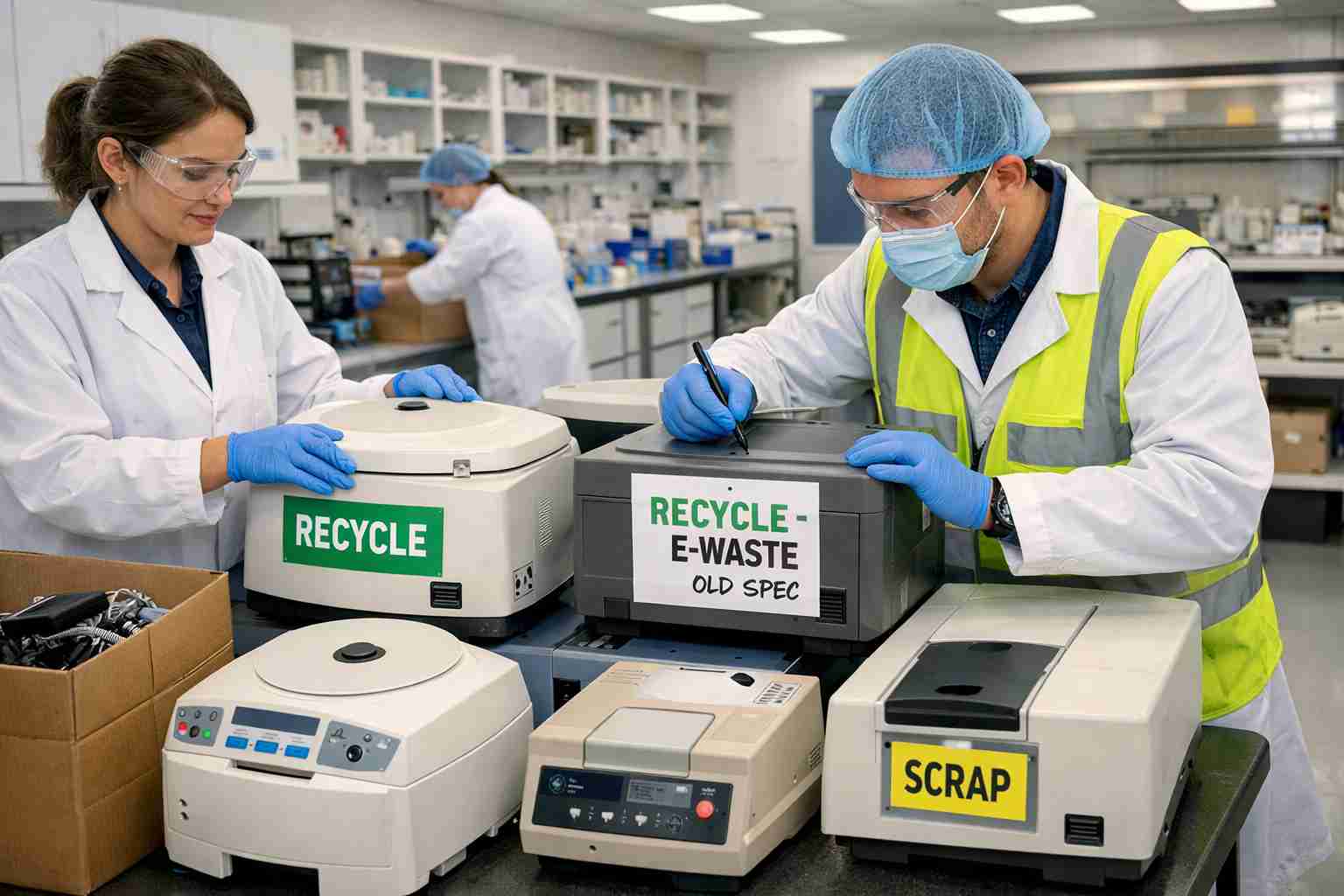
Lab equipment recycling Australia has become increasingly important as laboratories modernise instrumentation, expand testing capabilities, retire outdated equipment and respond to changing operational requirements. Research laboratories, pathology labs, university science departments, biotech facilities, pharmaceutical sites and industrial testing labs all generate a wide range of old or surplus equipment that cannot be handled like ordinary office waste. These assets are technical, valuable, sometimes delicate, and often mixed with electronics, metals, plastics and specialised components that require structured removal and recycling pathways.
The phrase lab equipment recycling Australia covers much more than one category of machine. It can include benchtop instruments, centrifuges, analyzers, PCR systems, incubators, water baths, balances, microscopes, biosafety related equipment, cold storage units, shakers, mixers, spectrophotometers and various support devices that accumulate over years of laboratory operation. Some items are small enough to move easily. Others are heavy, awkward or integrated into benches and service lines. That diversity is exactly why laboratory disposal should not be treated as a one size fits all collection task.
A strong recycling process starts with classification. Is the equipment obsolete, broken, surplus, partially functional or still suitable for evaluation and potential reuse? Some instruments retain component value even when they are no longer viable as full working units. Others have no practical reuse pathway but still contain recoverable materials. The organisation needs a provider who can separate these categories intelligently rather than treating all lab assets as the same heap of metal and plastic.
Centrifuge disposal is a great example. A centrifuge may appear straightforward to remove, but depending on the model it may be extremely heavy, unbalanced when empty, or tied to specialised rotor systems and accessories. Proper handling involves safe lifting, inventory of rotors and lids, and a review of whether any attached or associated parts are being retained on site. If a lab is clearing several rooms at once, centrifuges can also become a classic trip point for poor planning because they are dense, awkward and easy to underestimate until someone attempts to wrestle one through a narrow doorway with misplaced confidence.
PCR machine recycling has its own logic. PCR systems may be compact compared with major analyzers, but they are high value electronics containing control interfaces, thermal components and often integrated digital features. Labs replacing molecular systems should ensure the old units are collected with accessories, power supplies and related devices where relevant. A structured lab equipment recycling Australia workflow helps teams keep that equipment group together so nothing important is left scattered across benches, shelves or forgotten storage rooms.
Lab analyzers recycling is another critical segment. Clinical analyzers and specialised lab systems can be physically large, technically complex and expensive to remove incorrectly. They may have associated consumable bays, peripheral modules, displays, power connections and support carts. Some need partial dismantling before removal. Some may also require internal review by site staff before handover to ensure there are no retained materials, no loose test items and no components still earmarked for internal reuse.
A key reason lab equipment recycling Australia deserves specialist attention is the variety of laboratory environments. A research lab at a university is not the same as a pathology facility. A biotech site is not the same as a food testing lab. Access routes, contamination risks, documentation needs and site rules can differ significantly. A professional recycling provider adapts to those conditions rather than applying the exact same removal logic to every site.
Timing also matters. Labs often operate on strict schedules, active experiments, temperature controlled storage routines and equipment interdependencies. Removing one unit may affect bench space, cable routing or workflow in ways non laboratory contractors do not anticipate. A smart lab equipment recycling Australia service works around operational realities instead of barging into a technical environment with the emotional energy of a furniture move.
Environmental benefit is another reason organisations take this seriously. Laboratories generate a steady stream of old equipment, and without a proper recycling pathway, too much of it ends up stored indefinitely or disposed through poor quality channels. Specialist recovery improves outcomes by separating metals, electronics and reusable components wherever possible. It also helps institutions align with sustainability commitments in a practical, measurable way.
For facilities managers and lab directors, there is also a space management gain. Old devices consume valuable room even when nobody uses them. They sit on benches, block corridors, fill storage rooms and quietly become background clutter. A proper lab equipment recycling Australia process clears that dead space and turns it back into useful operational capacity.
Common laboratory items included in recycling projects
- Centrifuges and rotor accessories
- PCR machines and molecular testing systems
- Clinical analyzers and benchtop instruments
- Balances, mixers, shakers and incubators
- Microscopes, printers and control modules
- Research lab electronics and support devices
- Peripheral accessories and surplus laboratory carts
When done properly, lab equipment recycling Australia becomes more than disposal. It becomes a practical asset transition system that helps institutions remove clutter, recover recyclable materials, improve room functionality and maintain professional control over equipment retirement. That is exactly the kind of service a specialist medical and laboratory recycler should deliver.

Hospital equipment recycling
Because hospitals have a vast array of assets dispersed throughout wards, treatment areas, operating rooms, procedure spaces, recovery rooms, storage zones, clinics, and support departments, hospital equipment recycling is more extensive, heavier, and frequently more logistically demanding than most laboratory recycling work. Beds, monitors, infusion pumps, mobile workstations, operating room tables, carts, trolleys and assorted care equipment all move through replacement cycles over time. Some are retired due to age, some due to standardisation, some due to damage, and some because an entire ward or site is being upgraded.
The scale of hospital equipment recycling means planning is everything. A single clinic may need pickup of ten items. A hospital may need removal of hundreds spread over multiple floors, departments and timelines. If the equipment is still in active service areas, the project must work around patient care, staff movement, cleaning routines, emergency access and infection control expectations. This is why hospital asset removal cannot be run like a casual warehouse clean out.
Hospital beds are a common category in these projects. They are bulky, heavy and often awkward to store once decommissioned. Old beds may include electric controls, motors, rails and associated accessories that require separation and recycling consideration. The same is true for patient monitors. A monitor might look like a simple device, but across a hospital network there may be dozens or hundreds of monitors tied into rolling stands, mounting arms, cables and accessories. Without structure, those projects quickly descend into inventory chaos.
Infusion pumps are another major asset group. Hospitals regularly rotate, replace and standardise these devices, and when large numbers leave service, they need organised collection, sorting and downstream handling. A professional hospital equipment recycling workflow keeps pump groups together, reduces internal clutter and supports controlled handover from biomedical or ward teams to the recycler or removal provider.
Operating room and procedure room equipment raises the complexity even further. Items may include surgical lights, tables, support carts, monitors, mobile imaging accessories, anesthesia related furniture, mounted equipment and specialised trolleys. Some are easy to roll out. Some require deinstallation. Some can only be removed in narrow time windows. The provider needs to understand that hospital equipment recycling is often a site coordination project as much as a collection task.
There is also the human factor. Hospitals are not static workplaces. Staff are busy, departments are under pressure and nobody enjoys having old equipment stacking up in hallways while they wait for someone to figure out pickup. A specialist recycling service solves that problem by giving hospitals a clear offload pathway. The result is cleaner departments, better storage control and fewer passive aggressive emails about abandoned equipment.
From a sustainability point of view, hospital equipment recycling has huge potential. These sites hold a significant volume of metals, electronics, plastics and reusable structures that should not automatically end up in landfill. A specialist provider can separate general recyclable materials from items needing more controlled treatment, and in some cases assess whether certain assets are appropriate for refurbishment or component recovery.
Documentation matters too. Larger healthcare organisations increasingly want clear records of what left site, what category it belonged to and how it was handled. Good documentation supports procurement, sustainability teams, facilities management and internal governance. In other words, hospital equipment recycling is not only about getting rid of stuff. It is about doing so with traceability, clarity and professionalism.
| Hospital asset category | Typical recycling or removal challenge |
|---|---|
| Beds and ward furniture | Bulky movement, storage congestion and mixed material separation |
| Monitors and stands | Electronics handling, accessory tracking and serialised asset grouping |
| Infusion pumps | High volume collection and controlled batch removal |
| Operating room equipment | Access restrictions, timing coordination and deinstallation needs |
| Mobile carts and support devices | Mixed reuse potential and scattered equipment across departments |
The best hospital equipment recycling programs create order from complexity. They help healthcare providers clear space, retire outdated assets, prepare for new equipment and recover more material responsibly. They reduce on site clutter and support a cleaner operational environment. Most importantly, they turn end of life equipment management into a repeatable system rather than a recurring institutional drama.
Sterilizers/autoclaves disposal
Sterilizers disposal and autoclaves disposal require special attention because these machines are not simple plug and play devices. They are often large, heavy, connected to building services and located in sensitive environments such as sterilisation departments, laboratories, dental facilities, surgical support areas and clinical processing zones. Their removal must consider validation history, utility disconnection, safe decommissioning and site protection.
Autoclaves in particular can be physically imposing and mechanically complex. They may be floor standing, bench mounted or integrated into dedicated reprocessing areas. Depending on their configuration, removal may involve water, steam, drainage, power connections and fixed installation points. That means a serious autoclaves disposal project usually begins with scope review and service isolation planning, not just manual lifting and transport.
Validation and internal governance can also matter in sterilizers disposal. In healthcare and laboratory settings, sterilization equipment is often tied to quality systems, maintenance records and procedural control. Before removal, the site may want to confirm the unit is formally decommissioned, released from service and cleared for pickup. This protects documentation integrity and avoids confusion about whether a machine is retired, in storage, under assessment or still technically active.
Safety is a major issue here. Sterilizers and autoclaves can contain heavy chamber structures, insulated panels, metal frames, mechanical components and service connections that need careful handling during dismantling. If the equipment is built into a room or positioned in a constrained processing area, access may be difficult. A provider experienced in sterilizers disposal will inspect these conditions before arrival rather than turning up on the day and improvising while everyone nearby loses confidence.
Stainless steel recovery is one of the environmental positives in this category. Many sterilizers and autoclaves contain substantial metal value, and with proper dismantling and separation, that material can move into recycling streams. Electronic controls, cabling and peripheral components may also be sorted appropriately. The key is to treat the machine as a structured asset, not as anonymous industrial scrap.
Another issue in sterilizers disposal is infection control and room condition. Even after a unit is no longer operational, the surrounding area may still be governed by strict site rules. Work may need to be staged, timed or separated from active workflows. Protective coverings, access management and debris control become important, especially when equipment must be dismantled inside the room before removal.
Good autoclaves disposal also considers what happens after the machine is gone. Is the site expecting a replacement? Does the room need to be cleared for builders or service contractors? Are there brackets, penetrations or utility remnants that must be addressed? A professional provider clarifies these expectations early. Otherwise, the site thinks it bought full removal while the contractor thinks they only promised to take the shiny part and leave the rest like a mechanical fossil embedded in the wall.
In short, sterilizers disposal and autoclaves disposal should be managed as controlled decommissioning projects. When done correctly, they reduce risk, protect the building, recover valuable materials and prepare the area for its next use without unnecessary disruption.

Refrigeration/freezers disposal
Refrigeration disposal and freezers disposal are among the most compliance sensitive parts of lab and hospital equipment recycling because these systems can involve refrigerants, compressors, insulation materials, electronics and in some cases highly specialised temperature control applications. In healthcare and laboratory settings, this category includes vaccine fridges, pathology refrigerators, laboratory cold storage, pharmacy fridges, blood bank units and ultra low temperature freezers.
The reason this category matters so much is simple: cold storage equipment is not just bulky metal. It may contain regulated gases, sealed systems and technical components that require proper downstream processing. A normal waste pathway is not suitable, and careless handling can create environmental and compliance problems. That is why refrigeration disposal should always be handled by providers who understand medical and laboratory equipment streams.
Freezers disposal becomes even more important when dealing with larger or specialist units. Ultra low temperature freezers, for example, are common in research, pathology and life science settings. These are valuable, heavy and often difficult to move because of their size, internal shelving, insulation design and location within tight laboratory rooms. A proper removal plan considers the route, the weight, the condition of the unit and the downstream treatment requirements.
Another factor is contents clearance. Before any refrigeration disposal or freezers disposal project begins, the site needs to confirm that all biological materials, samples, medicines, consumables or internal contents have been removed and managed according to site protocol. The recycler or equipment removal provider is not there to guess what is still inside a freezer that has been humming in the corner since the last decade. Clear handover matters.
Once the unit is ready for collection, the main priorities are safe movement, site protection and compliant downstream handling. Large freezers and refrigerators can be awkward through doorways, vulnerable to tipping risk and heavy enough to damage floors or thresholds if moved carelessly. The best providers assess these issues early and use the right handling equipment rather than relying on optimism and several people saying “lift a bit more.”
Environmental compliance is central here because refrigerants require proper management. This is one reason refrigeration disposal is different from many other hospital asset categories. The equipment cannot simply be broken apart without regard for its cooling system. Controlled processing, responsible gas handling and appropriate recycling pathways are essential to reducing environmental harm and ensuring the project aligns with good practice.
There is also a practical sustainability message for healthcare facilities. Medical and laboratory refrigeration is replaced regularly, particularly when organisations upgrade to more energy efficient systems or reconfigure sites. A structured freezers disposal program helps facilities remove old units cleanly, avoid clutter and improve reporting around responsible equipment retirement.
If the site is planning a full room refresh or laboratory upgrade, refrigeration disposal may form part of a broader project that includes benches, analyzers, cabinets and general equipment. In these cases, sequencing matters. Cold storage units should be coordinated with the overall clear out plan so that access routes, loading schedules and disposal records all align properly.
When managed professionally, refrigeration disposal and freezers disposal support environmental responsibility, protect the site, prevent avoidable risk and make space for new equipment without chaos. For labs, clinics and hospitals, that is exactly the kind of dependable transition support that turns an equipment problem into a clean operational outcome.
Bulk hospital clear outs
Bulk hospital clear outs are where equipment recycling stops being a simple collection request and becomes a full project workflow. These jobs may happen during ward closures, major refurbishments, hospital relocations, site consolidations, tenancy exits, emergency upgrades or large scale replacement programs. Instead of removing a few isolated assets, the provider may be dealing with dozens or hundreds of items across multiple departments, floors or buildings.
In that setting, project management matters just as much as physical collection. The first stage of bulk hospital clear outs is scoping. What is being removed? From where? On what dates? Which areas remain active? What must stay? What needs deinstallation? Which assets are general recyclable medical equipment, which require special handling and which are potentially reusable? A clear scope prevents the most common clear out disaster of all: everyone assuming someone else made the list.
Asset tagging is often useful in these projects. Even a basic identification system can help separate categories such as remove, retain, transfer, review or recycle. Without this, teams can waste hours debating whether a trolley, monitor, pump or bed frame is meant to go, stay or be hidden temporarily in a nearby room where it will later reappear like a cursed prop. Structured tagging reduces confusion and speeds up pickup.
Access planning is another cornerstone. Large hospital clear outs depend on route control, loading dock coordination, lift bookings, floor protection and timing that fits around site operations. Hospitals remain busy even during renovations. Patients move, staff move, contractors move, and occasionally absolutely everybody seems to need the same corridor at once. A professional project plan anticipates these realities and builds the collection schedule around them.
Bulk hospital clear outs also need staging logic. Everything does not have to move at once. In many cases, the best outcome comes from staged collection by zone, equipment type or project phase. This minimises disruption, reduces internal congestion and gives facilities teams more control. It also improves recycling quality because assets can be sorted more cleanly rather than shoveled into a generic mixed load during a frenzy.
Another critical factor is communication. Hospital clear out projects can involve facilities teams, clinical departments, biomedical engineering, contractors, builders, leasing managers, sustainability leads and procurement staff. If communication breaks down, even a good removal team can end up stuck outside a locked wing with a truck booking expiring and a very philosophical view of institutional dysfunction. Clear contacts, escalation paths and sign off procedures make a huge difference.
From a recycling perspective, bulk hospital clear outs create strong opportunities to divert more material from landfill. Because there is scale, providers can sort better, consolidate collection more efficiently and identify recoverable categories that might be missed in small ad hoc jobs. This makes bulk projects ideal for organisations that want both operational efficiency and environmental credibility.
Documentation is especially valuable at this stage. Large projects generate a lot of internal questions after the fact. What was removed from ward A? Was operating room furniture included? Were old pumps picked up in stage one or stage two? Which items were sent for recycling? The more clearly the provider records the workflow, the easier it is for the organisation to close the project with confidence.
Bulk hospital clear out workflow
- Site scope review and equipment mapping
- Asset tagging or category identification
- Access route planning and protection
- Staged collection by area or equipment type
- Deinstallation of fixed or room integrated items where required
- Segregation for recycling, reuse review or controlled disposal
- Loading coordination and removal from site
- Completion records and close out reporting
The real value of bulk hospital clear outs is not speed alone. It is controlled progress. A specialist provider gives the site a method, not just manpower. That method protects the building, reduces disruption, supports recycling outcomes and helps large healthcare organisations transition equipment with less friction. When done well, the project looks organised from day one to day done.

Consumables vs regulated parts
One of the most misunderstood areas in healthcare and laboratory recycling is the difference between ordinary consumables and regulated parts. This matters because not everything removed from a site belongs in the same waste or recycling stream. Some items are straightforward. Others require more careful assessment due to contamination risk, embedded electronics, batteries, regulated materials or site specific rules. A provider who cannot distinguish between these categories will eventually create compliance trouble, environmental waste or both.
Consumables generally refer to items used up during routine operations or replaced frequently as part of normal workflow. Depending on the item and site condition, these may have relatively standard disposal pathways. But even then, context matters. Packaging, plastics and general non contaminated materials are not the same as items that have been used in sensitive clinical or laboratory processes. Once contamination or regulated content enters the picture, ordinary handling assumptions break down quickly.
Regulated parts are different because they may include batteries, electronic modules, pumps, controlled components, sealed systems, cooling elements or parts associated with clinical or technical risk. Even when attached to a larger device, these components may need separate treatment. This is why equipment recycling projects often require careful sorting rather than broad category labels like “junk” or “old medical stuff,” both of which are technically useless and spiritually exhausting.
In laboratory environments, the distinction can show up around accessories, internal modules, cold storage components, powered devices or surplus instrument parts. In hospitals, it may involve monitors, pumps, powered beds, procedure equipment, battery backed devices or specialised control units. The lesson is simple: appearance is not a reliable guide. Something small and boring may still need special handling. Something large and dramatic may actually be easier to recycle once properly stripped and sorted.
Another issue is internal confusion about what qualifies as equipment, what qualifies as consumable and what qualifies as regulated. Departments often accumulate mixed storage areas over time. You get packaging, accessories, retired devices, unknown cables, spare pumps, empty crates, used parts and a mysterious shelf of things nobody wants to claim. A good recycling program brings order to that mess by identifying categories clearly and assigning the right handling path to each one.
This is also where staff education helps. When teams know what can go through standard collection and what needs a specialist stream, equipment retirement becomes smoother. Facilities are less likely to over store items “just in case” and less likely to mix important parts into the wrong load. That improves both safety and efficiency.
For EwasteCollect, this section is strategically important because it demonstrates expertise beyond simple pickup. It shows that your service understands the real distinction between general recyclable medical equipment and components that need a more considered approach. That is exactly the kind of authority signal that builds trust with serious healthcare buyers.
| Category | Typical handling approach |
|---|---|
| General non regulated equipment materials | Sorted for recycling, reuse review or standard equipment collection |
| Electronics and powered modules | Separated for specialist electronics handling and recycling |
| Batteries and backed up devices | Directed into appropriate battery related streams |
| Cooling related components | Managed under refrigeration disposal requirements |
| Potentially sensitive or regulated parts | Assessed individually for correct controlled handling |
Put simply, the line between consumables and regulated parts is one of the most important judgment calls in a professional recycling workflow. Get it right and the project is safer, cleaner and more compliant. Get it wrong and you invite exactly the kind of risk that healthcare organisations work so hard to avoid.
Why specialist recycling matters for medical and laboratory equipment
Specialist recycling matters because healthcare and laboratory equipment are unlike ordinary commercial assets. The environments are more sensitive. The devices are more technical. The materials are more mixed. The documentation needs are greater. And the consequences of poor removal are more serious. A generic waste service might be able to collect volume, but that is not the same as understanding what the equipment is, how it should move through a live site and how different parts should be handled downstream.
This becomes especially important when sites are under pressure. During refurbishments, relocations, procurement upgrades or emergency replacements, decision makers want a provider who can see the whole picture. They need someone who can remove a freezer without damaging a lab, collect pumps without losing inventory control, clear old beds without blocking a corridor and separate recyclable equipment from components that need special handling. In other words, they need competence with a clipboard, not chaos with a truck.
Specialist providers also help organisations think more strategically. Instead of asking only “how fast can this leave site,” the conversation expands to include “what can be recycled,” “what needs deinstallation,” “what can be grouped into one project,” and “how do we document the outcome.” That shift is where real value appears.
It is also where brand trust is built. If your site content shows a deep understanding of lab equipment recycling Australia and hospital equipment recycling, buyers are far more likely to see EwasteCollect as a serious partner rather than another generic collection listing. Authority pages like this do not just rank. They reassure.
Best practice tips before booking a pickup
Before booking a pickup, sites can make the process faster and safer by preparing basic information. Start with a rough equipment list. Include the type of item, quantity, location and whether it is loose, fixed, heavy or connected to utilities. Identify anything that may require deinstallation, refrigeration handling or special access arrangements. If possible, take site photos. This makes scoping more accurate and reduces day of collection surprises.
It also helps to decide what is definitely leaving versus what is still under review. Mixed instructions create delays. So does the classic message that says “take everything except the things with the red sticker, unless biomed wants those, and maybe the old analyzers in room two if the manager calls before lunch.” Clear categories make for clean pickups and calmer people.
Finally, confirm that all items are cleared from service and ready for removal. For cold storage, contents must be emptied. For laboratory devices, associated materials should be removed. For sterilizers or fixed equipment, service isolation and room release should be arranged where needed. These small steps dramatically improve project quality.
Official external resources
For broader guidance around healthcare waste, environmental management and workplace safety, you can also review these official resources:
Frequently asked questions
What types of equipment are included in lab equipment recycling Australia?
Lab equipment recycling Australia can include centrifuges, PCR systems, analyzers, microscopes, balances, incubators, laboratory electronics, support devices and related accessories. The exact scope depends on site needs, equipment condition and whether the project involves single items or a larger clear out.
Can old hospital equipment be recycled instead of dumped?
Yes. Many categories of hospital equipment contain recoverable metals, electronics, plastics and components that can enter proper recycling pathways. A specialist provider helps separate those materials and determine whether any items should be assessed for reuse or controlled disposal.
Do sterilizers and autoclaves need special handling?
Usually yes. Sterilizers disposal and autoclaves disposal often involve heavy equipment, service connections, decommissioning requirements and safe dismantling. They should be planned more carefully than a simple loose item pickup.
Why are refrigeration disposal and freezers disposal different from other equipment removals?
Because refrigeration systems may involve regulated cooling components and require compliant downstream treatment. They also tend to be bulky, heavy and operationally sensitive in laboratories, pharmacies and hospital departments.
What are bulk hospital clear outs?
Bulk hospital clear outs are large scale equipment removal projects that may involve wards, departments, renovations, relocations or site closures. They usually require project planning, staged collection, route management and detailed coordination rather than a simple pickup request.
Why is it important to separate consumables from regulated parts?
Because not all materials can be handled the same way. Some items are suitable for standard collection or recycling, while others contain electronics, batteries, cooling systems or components that need specialist handling. Correct separation improves safety, compliance and recycling outcomes.
Final word on Lab & Hospital Equipment Recycling
Lab equipment recycling Australia is one of the strongest authority topics a specialist medical recycling brand can target because it speaks directly to real operational needs across laboratories, clinics and hospitals. This is not curiosity traffic. It is decision traffic. The people landing on this page are often managing surplus assets, site upgrades, old analyzers, retiring beds, outdated pumps, refrigeration replacements or full department clear outs.
That is why this pillar page matters so much for EwasteCollect. It positions your brand as a serious operator in the medical, laboratory and hospital equipment recycling space. It shows that you understand not only collection, but also deinstallation, logistics, sustainability, site safety and downstream handling. That combination is what makes a recycling brand credible in healthcare.
A strong service page does more than describe what you collect. It shows buyers that you understand their environment, their pain points and the practical realities of equipment retirement. When your content does that consistently, your site starts to become exactly what you want it to be: a trusted authority for recycling medical, laboratory and hospital equipment in Australia.